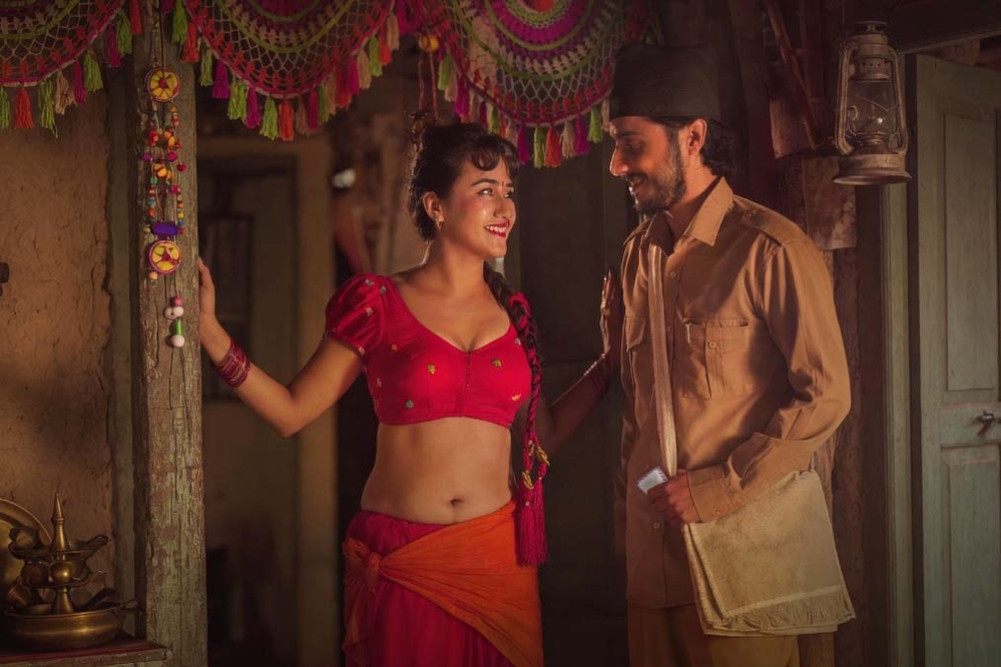
The film also has some weaknesses. The story feels like it's being torn in two directions. On one hand, the issue of the Badi community, on the other, widespread social injustice.
We use Google Cloud Translation Services. Google requires we provide the following disclaimer relating to use of this service:
This service may contain translations powered by Google. Google disclaims all warranties related to the translations, expressed or implied, including any warranties of accuracy, reliability, and any implied warranties of merchantability, fitness for a particular purpose, and noninfringement.
I don't go to the cinema hall much . I don't have the habit of watching films regularly even on television . Perhaps it is because I was born and raised in a village without electricity, I never had a special attraction to films . It was only after I came to Surkhet that I started getting closer to the culture called 'hall' . When I saw the Laxmi Cinema Hall near Bulbule FM where I work, I first realized that 'a film would be suitable here' . However, I didn't get the chance to go to the cinema hall for years . In the last three years alone, I have watched three films in Surkhet, and the other two films in Hetauda .
A few days ago, while going to the market, I came across the Laxmi Hall again . Suddenly, I wanted to watch a film . I had no plan on which film to watch . I entered the cinema hall with my friends in a huff. I had a ticket for 'Lalibazar' in my hand .
After sitting in the hall, my attention was more focused on the debate that arose around the film than on the story. There was information that some people from the Badi community had protested that the film misrepresented their community and that the matter had reached the court, and that the film was released after a court order. That is why I was curious about what was actually in the film.
While watching the film, I felt that the story was drawn out at times. It also felt like some scenes were unnecessarily spread out. However, the emotional scenes that came in between kept me tied up, as if tied by a rope of love. Tears flowed many times. I even screamed with joy several times. By the time I left the hall, I had already started thinking – this is not just a review of the film, but the real stories of the society it reminded me of.
While watching ‘Laali Bazaar’, I did not feel that it was just a story about the Badi community. It seemed like a representative story of the pain, humiliation and struggles experienced by many women in our society. There is definitely exaggeration in some scenes of the film. Especially that of actor Rabindra Singh Baniya, who plays the role of Raja Saheb. However, the pain, struggle and dedication of a mother towards her daughter shown by the main character Madhubala, i.e. Swastima Khadka, was very impressive and vivid. The mother's struggle to get her daughter out of her swamp even in difficult circumstances touched my heart. Vishal Devkota's performance as a father for her daughter and fighting society was also powerful. Towards the end, the daughter was struggling to fulfill her mother's dream - may every daughter become capable and successful like this.
However, while watching the film, I had repeatedly visited my own village. Growing up as a daughter of the Thakuri community in a remote village in Achham, I have witnessed many such incidents up close. I have felt since childhood how deeply rooted the idea of considering women as objects of use is in society. That is why many of the scenes shown in the film did not seem fictional to me.
In my village, the people of the Dalit community used to call the Thakuris ‘Darshan Hazur’. We Thakuri girls were not allowed to talk to men from other communities, but Thakuri men could do whatever they wanted to women from other communities. The rules of society applied only to women.
Not only that, even if a woman’s name was linked to a man, her character was questioned. The man would easily escape, the woman’s life would be ruined. While watching ‘Lali Bazaar’, two incidents from my village kept coming to mind.
I did not feel the need to oppose 'Lali Bazaar'. Instead, I felt the need to raise the question of why such a society has been created. The first incident, a man from the Thakuri community had a relationship with a woman from the Dalit community. The woman became pregnant. Rumors spread like wildfire throughout the village. Then the man fled to India. The woman's family said she was 'carrying someone else's child' and did not let her stay at home. The man did not take responsibility, because he was from the so-called 'high caste'. I do not know what the woman's condition is now. However, when the scene in the film where the father's name is searched for the daughter's birth certificate and school admission came, I repeatedly thought of that child. I do not know whether she got citizenship or not. Did she get to go to school? Where did she have the opportunity to become successful through rebellion and struggle like in the film?
Another incident was equally painful. A woman was left by her husband on the charge of having an affair with another man. I had met the woman there a few years ago when I went to the Manav Sewa Ashram in Surkhet while reporting. She was kept in an ashram after her mental condition deteriorated. Society held her guilty, but no one wanted to understand the reality of the situation.
That is why I did not feel the need to oppose the 'Lali Bazaar'. Instead, I felt the need to raise the question of why such a society has been formed. It was necessary to debate how we can keep our daughters safe and how to give them a respectable life.
When I was young, women and children from the Badi community used to roam around the villages. Men sang songs, women danced. Society's view of them was very bad. There was a deep-rooted mentality that women from the Badi community were tools that could be used by anyone. Even after coming to Surkhet, I read a lot of news about this community. Their condition is still pitiful. Landlessness, poverty and social discrimination are still the same. The younger generation is just starting to get the opportunity to study. Activist Hikmat Badi is running a hostel and educating children from the Badi community. Sita Badi has recently become a minister. Such efforts give hope, but it is frustrating to see that the social perspective on the community has not changed.
We tend to consider this problem only for the Badi community. Although it is in different forms, the exploitation faced by women is present in many communities. While living in Baitadi in the course of journalism, I had the opportunity to understand the Deuki custom. I understood at that time how Deuki women, who were offered in temples at a young age, were used as a means of sexual intercourse by influential men in the society. The children born to them had to struggle to obtain citizenship. There is no accounting for the rejection of the society as a 'child of Deuki'. Citizenship could only be obtained after verification by the local level. It was heartbreaking to hear the pain of women who were forced to live alone in old age despite being under the gaze of men throughout their youth.
That is why I did not feel that the issue raised by ‘Laali Bazaar’ was just a story of a community. It also seemed to me that it was a story of how this society views women, how they use them and ultimately how they leave them alone.
The scene where the main character of the film, Madhubala, searches for her daughter’s father for her birth certificate is very poignant. After the death of her real husband, she urges the men who use her to ‘become fathers’. But, why would anyone be ready? The true character of society is revealed there – a society that is ready to use its body is not ready to take responsibility. Finally, the scene where her own brother says ‘I will become a father’ not only makes the audience emotional, but also makes them think.
After watching 'Lali Bazaar', I felt that we are still not able to accept women as independent individuals. Another powerful aspect of the film is Madhubala’s struggle to prevent her daughter from living the same life as her. Her struggle to save her daughter from the quagmire of the sex trade shows the depth of a mother's love. The film ultimately self-criticizes the 'mother who sells her daughter' comment shown in the trailer. In fact, Madhubala is not a rebellious woman fighting to save her daughter, but to sell it.
However, there are some weaknesses in the film. The story feels scattered in two directions. On one hand, the issue of the Badi community, on the other, widespread social injustice. If the story had been focused on a single topic, it could have been more solid. The posters and promotional materials also seem to have caused unnecessary controversy. The poster of the pregnant woman at the door seemed to try to send a message that a customer was waiting. Perhaps the objection of the Badi community was also there. While the real story of the film was not like that. Rather, it is the story of a mother's struggle to get her daughter out of the swamp. If the promotional materials had also prioritized this message, perhaps the film could have become a topic of conversation rather than controversy.
After watching 'Lali Bazaar', I felt that we are still not able to accept women as independent individuals. Society forgets the mistakes of men, keeps a record of women throughout their lives. In a society where a child cannot find identity without the name of the father, the mother's struggle is not over yet. Therefore, 'Lali Bazaar' is not just a film, it is a mirror of our society. In that mirror, not only the Badi community, but all of our faces are reflected.