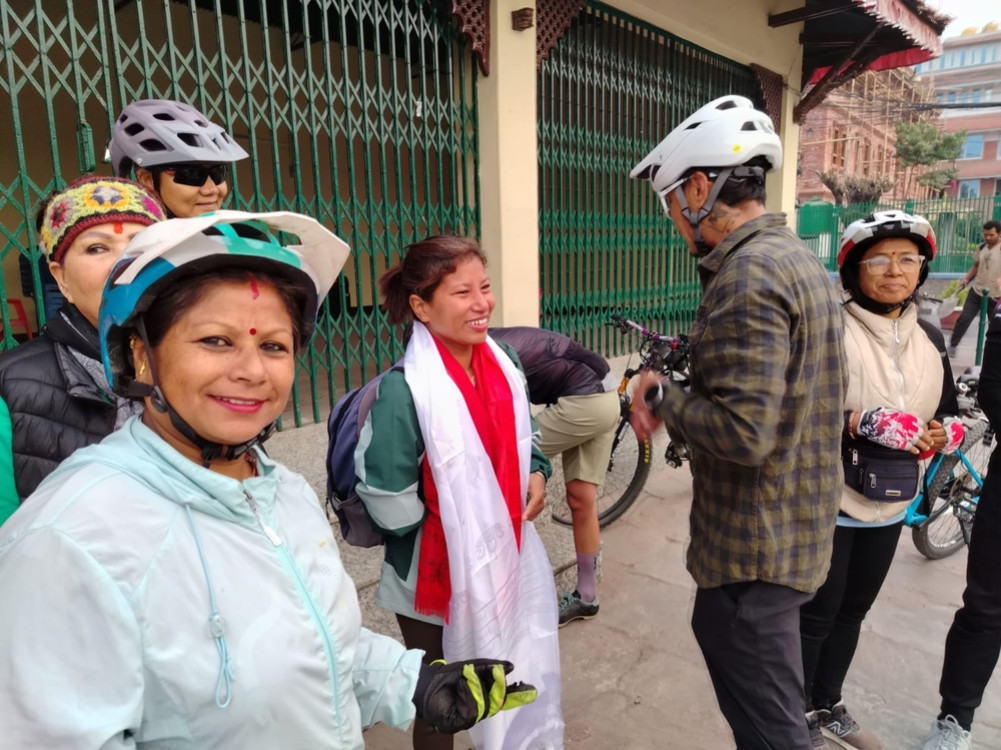
Ranjana's participation in the UCI Paracycling World Cup is a special topic. How much encouragement and motivation did she gain during this process? How strong did she become? How brave did she become? How proud did she feel? A flood of questions can be seen in her tears.
We use Google Cloud Translation Services. Google requires we provide the following disclaimer relating to use of this service:
This service may contain translations powered by Google. Google disclaims all warranties related to the translations, expressed or implied, including any warranties of accuracy, reliability, and any implied warranties of merchantability, fitness for a particular purpose, and noninfringement.
Women's cycling leader Asmita Rajbanshi had informed me about Ranjana's World Cup journey the day before. According to Asmita, Ranjana was going to Thailand for the first time in history from Nepal to compete in the UCI Para Cycling World Cup.
It was not common news for a Nepali to be selected for the UCI Para Cycling World Cup. As soon as I got to know about this, I got to know Ranjita better. I got her involved with the cycling culture community. I felt like a cycling friend, as if I had known her for a long time. On the way to the airport, we stopped at the open area of Jawalakhel Chowk and gave Ranjana a group announcement and farewell.
When we reached Jawalakhel at 7 am, Ranjana had already arrived. She was standing with her luggage. Her cycling friends were coming. After the yoga session, we requested Ranjana to introduce herself in an informal gathering.
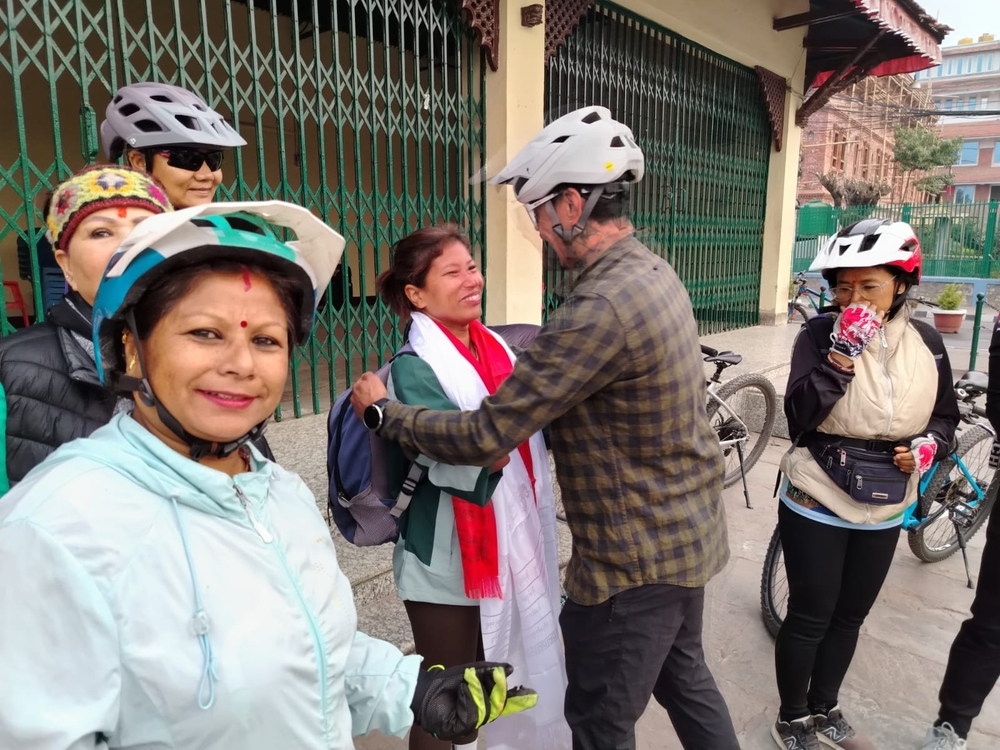
The sisters started giving money and wishing her well. Ranjana started crying. More sisters came around her. Sisters she had never seen or met before started showing her sympathy. One sister said, ‘If you win, I will organize a program with catering.’ Cyclists Usha, Hark, Ajay, Gyanendra, and women cyclists Urmila, Timila, and others started welcoming Ranjana with food, abir, garlands, bouquets, and sagun. Ranjana could not hold back tears.
It was already late for Ranjana to reach the airport. Ranjana got ready to take a taxi. I asked, ‘And you lost your relatives?’ Ranjana said tearfully, ‘You are my relatives, aren’t you?’ The participating cyclists said, ‘We are your relatives, we are with you.’
Ranjana headed towards the airport. I had to reach the university. While cycling from Jawalakhel to Tribhuvan University, a question kept spinning in my mind like a bicycle wheel: Why did Ranjana cry? What stories are there in her story? The answers could be many. When I asked her, ‘Why did Ranjana cry?’, she did not speak. Others answered: ‘Tears of joy. Where did Ranjana cry?’
I wanted to know the reason why Ranjana cried from my cycling friends. The established cycling friends in the coffee chat started saying: Who remembers cyclists in Nepal? Even cycling organizations are reluctant to respect them. Cycling groups are more entertainment-oriented. The state, cycling organizations, society, and culture rarely remember cyclists. As if invisible, they are pedaling expensive bicycles with empty pockets. Cycling is not as easy as other sports. It is not easy to participate in cycling competitions on an ordinary bicycle. Families and society ignore or ridicule those who ride expensive bicycles as if they were unemployed.
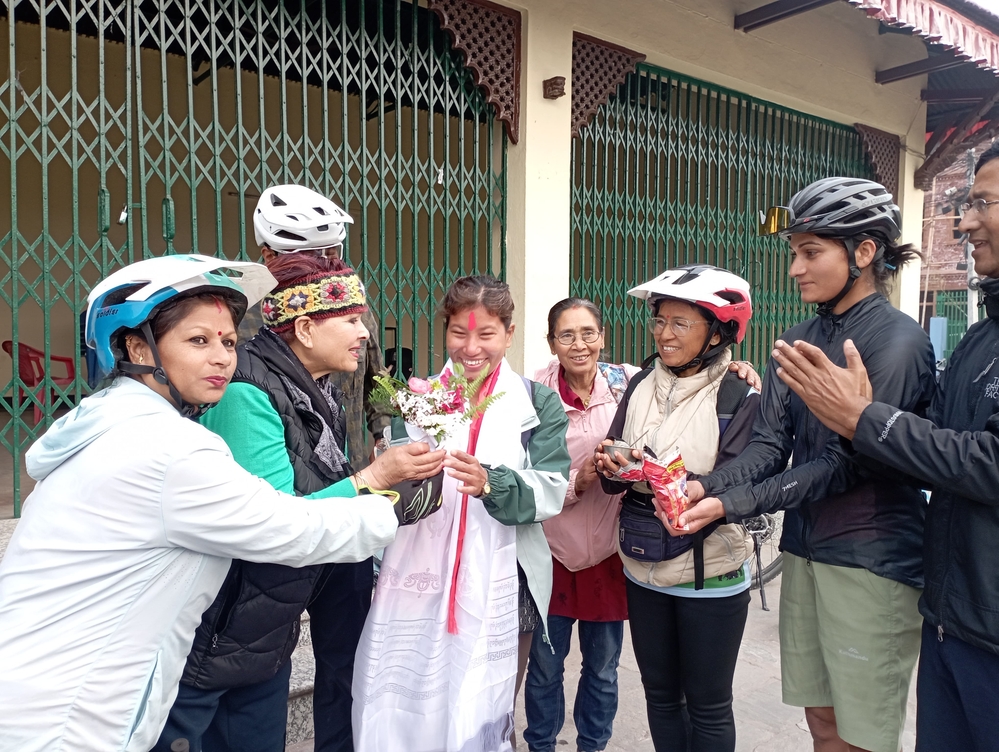
Ranjana's participation in the UCI Paracycling World Cup is a special topic. How much encouragement and motivation did she gain during this process? How strong did she become? How brave did she become? How proud would she be? A multitude of questions can be seen in her tears. It seemed that the story of Nepal's cycling sports was being woven in her tears. Such a story that is not woven in absolutes but in relativity.
Personal stories are formed according to sociality, culture, geographical location, economic and other conditions. Different stories come into existence at a certain time, connected with laughter, tears, crying, sighing, hope, aspirations. How many stories are heard and told. How many stories remain unspoken. Ranjana was creating the story of cycling culture, amidst a multitude of questions.
In what circumstances was Ranjana, who completed her master's degree in sociology, struggling in the cycling world? In what disability (un)friendly environment was she going to compete in the UCI World Cup? Are bicycles and bicycle accessories suitable for the World Cup available? What kind of struggle did she face while participating in the competition? What kind of preparation environment was created after selection?
UCI is providing five days of training, including bicycles. I was happy to hear that the organizer UCI has brought a Thailand bicycle from Switzerland for Ranjana. It seems that Nepali cyclists are being supported more by foreign countries than by the country itself. Nepal is going through political turmoil. Preparations are underway to form a powerful new government. What kind of environment will be created in the country for athletes like Ranjana after the competition? Who will create it? Many questions seemed to be flowing along with her tears.
Ranjana's feelings, experiences, and struggles were all standing as invisible stories. Yesterday's stories were different, today they were becoming different stories. Tomorrow they will become even different stories. After all, someone's experience lives in stories. Some tell their own stories. Many cannot. We can tell someone's story. We can become storytellers. Even though Ranjana does not tell us the stories within her stories, we can connect with her sorrowful feelings. Perhaps the tears that were flowing from Ranjana's eyes amidst the affection between sisters were saying: Everyone's truth is different. The situation is different. The feeling is different. Knowledge arises from different feelings. A special truth is revealed in a special feeling.
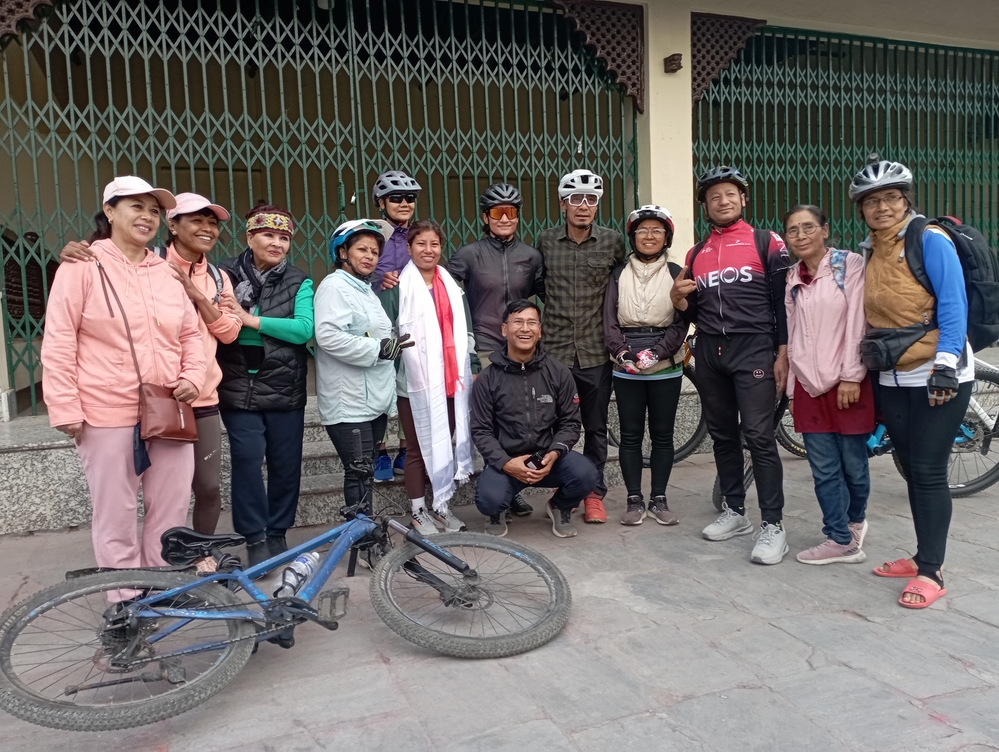
I am thinking as I watch Ranjana cry: Can the limits and strengths of Nepal's cycling sports past and present be understood from her tears? Why are many players displaced from the sports field? Most players either go abroad or leave the sports field.
Ranjana, who is also dedicated to indigenous women with disabilities, seems to have reached various countries of the world in the course of para taekwondo competitions. In a decade, she has reached China, UAE, Britain, Australia, Korea, Jordan, Philippines, Russia, Poland and won. Why did such a strong player Ranjana cry? The answer is unanswered. May Ranjana have an environment where she can enjoy and grow in cycling. May she also be connected to the intellectual world. That's all I wish for. Her tears made it seem like cyclists are seeking collective belonging in the development of cycling culture in Nepal.