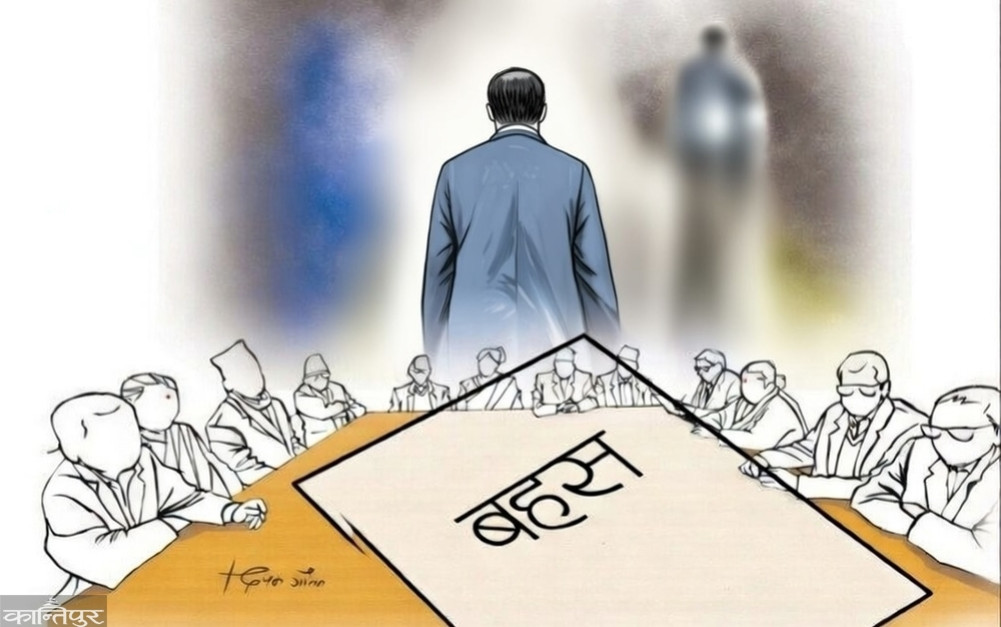
A debate based on facts and agendas, not on hype, is necessary. Voters also vote based on likes and followers on Facebook.
We use Google Cloud Translation Services. Google requires we provide the following disclaimer relating to use of this service:
This service may contain translations powered by Google. Google disclaims all warranties related to the translations, expressed or implied, including any warranties of accuracy, reliability, and any implied warranties of merchantability, fitness for a particular purpose, and noninfringement.
Whose government will it be this time? This question is being raised everywhere these days. Some parties are even campaigning saying, "This time, this is the government of so-and-so."
This tradition seen in Indian elections seems to be followed in Nepal this time too. The campaigning style is on one side. On the other hand, for the first time in the country, various parties have started their election campaigns by nominating their prime ministerial candidates. This has given voters the opportunity to choose who they want to elect as prime minister after the election. This should be considered positive.
This time, the Rashtriya Swayamsevak Sangh (RSS) has presented senior leader Balendra Shah, UML has presented Chairman KP Sharma Oli, and Nepali Congress has presented Chairman Gagan Kumar Thapa as the future prime minister. The Congress has decided on Thapa as the prime ministerial candidate in a central committee meeting on Friday. Along with this, Shram Sanskriti Party Chairman Harkaraj Rai and Nepali Communist Party Coordinator Pushpa Kamal Dahal have also presented themselves as candidates for the prime minister. However, there seems to be a debate about Shah, Oli, and Thapa in the race for the future prime minister. There is a debate that policies, programs, and plans to build the country should take priority over the popularity of the candidate. In addition, there is a demand for an open debate among the aspirants.
As I am working in the district and doing media work, I can now see and hear the general public debating on this topic when I go to various programs. Earlier, the debate that focused on the topic of ‘Who will be an MP?’ has now reached the topic of ‘Who will become the Prime Minister?’ This kind of public debate about the person who will lead the country can be considered a happy beginning in itself. Voters are interpreting the future Prime Minister in their own way with arguments and arguments rather than supporting sides. Of course, a long process has to be completed to be elected as the Prime Minister. The party had to win many seats. Then he had to become the leader of the party’s parliamentary party. He had to garner the support of at least 138 MPs. Well, such processes are being completed.
Journalist Tikaram Yatri posted a status on his Facebook wall on Friday with photos of Gagan Thapa, KP Sharma Oli and Balendra Shah. There he wrote, ‘As the Nepali Congress has formally nominated Gagan Kumar Thapa, the CPN-UML has nominated KP Oli, and the Rastriya Swatantra Party has formally nominated Balendra Shah as the future Prime Minister, we cordially invite all three of them to have a common debate with their concrete policies, plans, and programs for the development of the country. We are confident that an open and healthy debate will help the voters to choose the right person, so we will accept this request with an open heart.’
I had also reached the southern Marchwar area of Rupandehi on Friday for election reporting. During that time, I met 75-year-old Prem Harijan at Majhagaon Chowk in Kotahimai. I listened to him for about 20 minutes. After coming home and seeing the post of the traveler, I remembered what Harijan had said. Harijan has also not always understood that the same leader is the MP, the same person is the Prime Minister and the Minister. He was fed up with the fact that the leaders change but his situation does not change. He was being pinched by the fact that his children were not able to study in good schools and were deprived of health care. Even on the same road in the village, mud in the rain and dust in the winter are extremely troublesome. There is a shortage of fertilizer and irrigation during farming. Since they cannot work even as laborers here, they have sent their two sons to Saudi Arabia and Qatar.
In particular, the residents of rural areas want to be free from such suffering. They are looking for a Prime Minister who can solve this suffering. With the increasing use of communication, citizens of cities, villages, mountains and hills have become aware. They want to change both their opinions and minds. Oli has been tested. Gagan and Balendra are yet to be tested. The people have seen and experienced what Oli did or did not do during his tenure. There is interest in the candidates presented by the Rashtriya Swayamsevak Sangh (RSS) and the Congress. The entry of NCP coordinator Dahal in village debates is not heard much. The youth of rural areas are abroad. There is currently a 'debate' on social media about the Prime Ministerial candidate from home and abroad. It seems that since he is abroad, he has nominated a specific person and has expressed his support. Voters in the country are expressing their support based on merit and demerits.
A debate based on reality and agenda is necessary, not on fads. Voters do not vote based on likes and followers on Facebook. We should be able to choose a person who has the ability, policies, plans, and programs to contribute to the public sentiment and the country. The right choice we make can select a good leader. The wrong choice can make the country lose direction. Voters should be aware of this. We should ask why past commitments were not fulfilled. Therefore, to make it easier for voters to make a wise decision, I should put pressure on the future Prime Ministerial candidates on the same platform and hold a debate.
Abroad, there is a practice of going to the election by announcing the President and the Prime Minister. In India, the BJP entered the election by declaring the current Prime Minister Narendra Modi as the Prime Minister in the elections held last year. In the US, too, they enter the election by announcing the presidential candidate. It is a good thing to start good practice here too. It is the right of voters to hear and understand the plans of the proposed Prime Minister from their own mouths.
In every election in the United States from 1960 to the latest 2024, presidential candidates have been putting their agendas to the voters by holding 'live debates'. Countries like Taiwan and Kenya have also practiced this. If so, are our future prime ministerial candidates ready to sit on the same platform and have a 'live debate'? A fair debate is necessary. Would Gagan, Balendra and Oli be ready for that?
What are the future prime minister's plans for political stability and good governance, education and health, economic development and employment, infrastructure development, environment and climate change, foreign policy and international relations? Shouldn't the public know about this? It is said to be an agricultural country, but farmers are suffering due to lack of fertilizers, seeds and irrigation. It is said that prosperity comes from tourism, but there is silence in the tourism sector. Industries are producing only about 30 percent. Remittances have sustained the country. The youth have to be connected to technology. Good governance has to be maintained according to the Genji spirit. What are the future prime minister's plans at a time like this? Shouldn't they know, understand and listen to these issues? It should definitely be.
The situation we have faced today due to the selection of leaders without a plan is clear. Now, there is no exemption, because we do not have to face problems like 10 years of armed conflict, blockade, and Gen-G movement again. We have already fallen behind by decades due to conflict, earthquake, blockade, and the Corona pandemic. Now, we do not need good governance and development to forget those days. Therefore, let us get ready to debate the future Prime Minister in one place. Let us put pressure on it. Let us finally vote after listening to and reading their real plans.