We use Google Cloud Translation Services. Google requires we provide the following disclaimer relating to use of this service:
This service may contain translations powered by Google. Google disclaims all warranties related to the translations, expressed or implied, including any warranties of accuracy, reliability, and any implied warranties of merchantability, fitness for a particular purpose, and noninfringement.
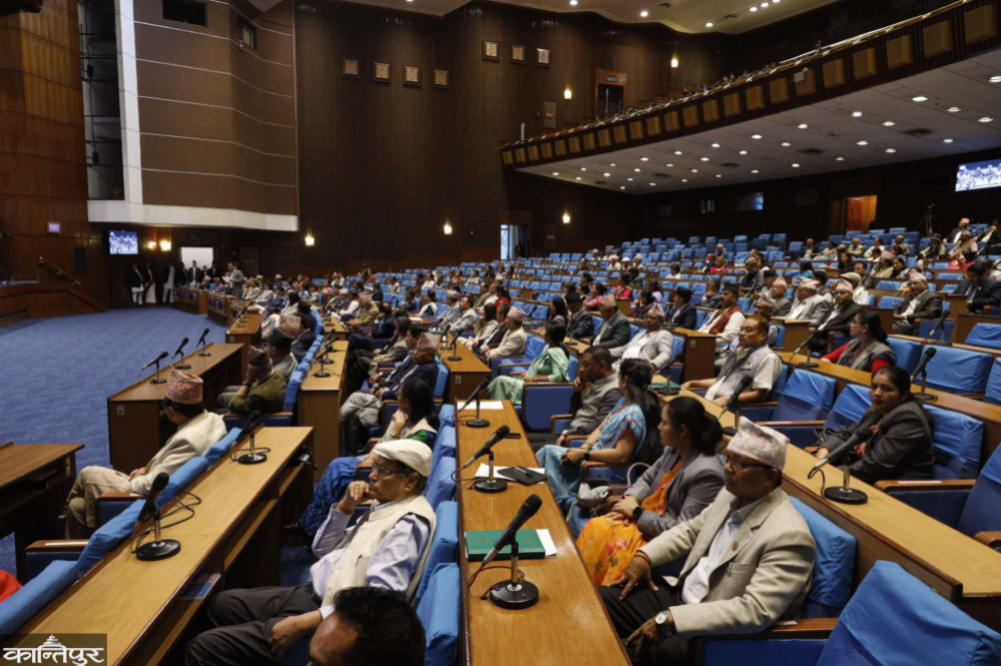
The Federal Parliament, ie the highest policy making place of the people, has recently become the center of unfounded accusations and unparliamentary expressions. What the parliamentarians said without evidence and logic has raised questions about the dignity and effectiveness of the democratic system.
Such expressions have undermined the law-making process by hurting public confidence.
The latest example – MP Sovita Gautam alleged that some members who went on a visit to Spain did not return. However, she backed down when the Prime Minister's Secretariat asked for proof. This incident shows the seriousness of the fact-free expression. In the same way, Gagan Thapa made a strong statement saying that 'there has been a situation where we are not allowed to speak against corruption'. His goal was that the Commission for Investigation of Abuse of Authority would prosecute cases by looking at individuals. But his statement was limited to criticism without revealing concrete facts or the names of the culprits. Another MP, Prem Suwal, presented the MCC as a 'military siege', but official facts disproved his claim. Such expressions create confusion among the public and have a negative impact on international relations.
Article 103(1) of the Constitution of Nepal has given MPs full freedom of speech. Along with this, its misuse is increasing. There are many instances where the Speaker has had to direct that unparliamentary words be removed from the record. The latest example is the statement of MP Amresh Kumar Singh. He said, "Give 72 districts to America, China or India". It was expunged from the record of Parliament. The ruling MPs are under pressure to remove Gautam's statement.
Such words lower the dignity of the parliament and weaken the public's trust.
The process of passing the bill has been blocked due to obstruction in the Parliament on minor issues, absence of MPs and lack of quorum. In a Parliament meeting in 2080, the meeting was adjourned due to the lack of quorum while an important budget discussion was going on. Even when the Speaker asked the MPs to attend, the quorum could not be reached for 30 minutes. Such incidents raise serious questions about the parliament's efficiency and accountability to the people.
According to Article 94 of the Constitution, the presence of at least 69 MPs is required for the meeting to run, but this process has been affected by the tendency to leave by attending. There is no focus on that, the incidence of speaking whatever comes to mind has increased. Which is not good.
Parliament's time is being wasted on unnecessary disputes. The tendency to not reach a quorum and walk out of parliament is not just a demeanor, it is a travesty of people's expectations of Parliament.
Parliament is a place to solve people's problems and formulate policies, but its purpose has not been fulfilled due to party bickering and accusations. Legislation necessary for federalism has stalled due to partisan gerrymandering. When MPs do not show seriousness in making the government accountable on contemporary issues, people's expectations are lost. Factual expressions spread misinformation, negatively affect Nepal's international image and undermine the dignity of Parliament. As an example of
fact-checking, Canadian journalist Roseanne McCallion fact-checked claims of foreign interference in the Canadian Parliament. His 2021 investigation showed that allegations of Chinese interference in the 2019 and 2021 elections lacked solid evidence. A 2020 report by the Canadian Security Intelligence Service also noted the potential impact, but lacked concrete details. Such practice can be applied in Nepal as well. The UK Parliament has a rule requiring MPs to submit evidence for serious allegations, which ensures accountability.
In the Australian Parliament in 2018, MP Andrew Hastie accused Chinese business companies of interfering in Australian politics. His claim caused great controversy, but his credibility was undermined when an independent investigation later found no solid evidence. The Australian Parliament has implemented a strict fact-checking policy for MPs' statements following such incidents, requiring written evidence to be submitted before serious allegations can be raised in Parliament. This policy can also be implemented in Nepal.
Similarly, in 2020, a member of parliament in India's Lok Sabha made unverified claims against China about the origin of Covid-19. This statement caused diplomatic tension, but later fact-checking showed that the claim was exaggerated. India, learning lessons from such incidents, has given parliamentary committees the responsibility of fact-checking. Even in Nepal, by giving such a role to the parliamentary committees, the expressions of the parliamentarians can be made responsible.
The influence of factual statements in Parliament is not limited to internal affairs. The international community sees Nepal's parliament as a credible policy-making institution. When lawmakers make unverified claims, it affects foreign investment, diplomatic relations and international cooperation. Parliament should take immediate steps for reforms. A committee to monitor the conduct of MPs should be made active. Rule 216 provides for the formation of such a committee, but its effectiveness is minimal. Also, the Parliament Secretariat should provide regular training and guidance to parliamentarians on fact-based speech. People should also monitor the performance of parliamentarians through media and civil society. Only with such efforts can Parliament be made a meaningful platform for policy making. Reforms require the establishment of an independent fact-checking mechanism, which encourages parliamentarians to speak with evidence. Rules of Parliamentary Conduct should be strictly enforced. New MPs should be trained in parliamentary practice and responsible speech. The government should make parliament effective by presenting a clear agenda and bill. People should constantly monitor the performance of MPs. Media and civil society should play a role in highlighting such issues.
The trend of untruthful speech in Parliament is not just a question of personal credibility, it is a crisis of the functioning of democratic institutions and public trust. Parliamentarians try to align their statements with public sentiment, but when such things are unsubstantiated, it undermines the significance of parliament in the long run. Finally, Parliament should prioritize fact-based discussions. The credibility of Parliament will be restored only with fact-checking mechanism, strict code of conduct and caution of the people. Such reforms will help Parliament to fulfill democratic trust and the needs of the people by making it a platform for meaningful dialogue.
– Chapagai is a journalist.