We use Google Cloud Translation Services. Google requires we provide the following disclaimer relating to use of this service:
This service may contain translations powered by Google. Google disclaims all warranties related to the translations, expressed or implied, including any warranties of accuracy, reliability, and any implied warranties of merchantability, fitness for a particular purpose, and noninfringement.
The split legs are sold in Kathmandu. Hands are raised, holding an awl, a spade, and a ploughshare. And, they are roaring - 'We sweated blood, what did we get in return!' The government did not listen to the protests in the villages and districts. Maitighar Mandla is a place where many voice their voices and express their anger. Since January 20, 38 Mohi farmers of Dang have been making their voices heard on the cold road. They are making many efforts to get their rights by staying in the village and Dharamshala of their own children.
'Movement' is not an unfamiliar word. Many movements and struggles are unfolding before us. Positive and negative waves of movement are running. We are the witnesses of the achievements brought about by sacrifice, penance, struggle and sacrifice. Where injustice and tyranny cross the line, struggle begins. Movement is raised. The flame of the movement burns. In some movements, marginalized people are used for limited interests. However, some movements wake up on their own for their rights. And, is established as an organic movement. Where they organize for economic, cultural, social justice. And, they blow the whistle of the movement. Similarly, an example of an organic movement is the non-violent movement of farmers suffering from Swargadwari Guthi.
700 farmers of Guthi affected twelve villages (Zhigoura, Dhoreni, Paddha, Nainwar, Rampur, Palase, Uchanimbu, Arnhawa, Chailahi, Surkedangi, Shahipur and Vangaon) staged a dharna at District Administration Office, Ghorahi from 8th to 31st February 2080 to get parcels of Guthi land. It was not a demonstration protest. It was a non-violent movement by Tharu farmers after long preparations. During the agitation, the government formed a negotiation team. During the agitation, the government changed. However, the aggrieved farmers continued their struggle by changing the form of the movement.
The aggrieved farmers who rushed to Singha Durbar with the problem never came back with a solution. Hope turned to disappointment, every time. I also thought what is the use of showing grief. How long to hide? Surrounded by their own questions, the farmers began to discuss in their leisure. All the farmers in Mauza saw no other option but to move from the village to the center. Finally, they were forced to sleep on the cold streets of Maitighar Mandla.
It was Tharu who made Ho Terai green. Made a living space. Yesterday's forest, the bush, was made livable and cultivable by shedding blood and sweat. Tharu's sweat is mixed in every gara. Looking at the history, those lands were built by the ancestors of the Tharus. The soil of those lands is not that muddy. Ancestor's life was spent in that soil. Tharus have a deep connection with water, land and forest. However, they are still fighting for the right to that land. They are deprived of rights over resources. They are forced to leave Lalabala and protest in Kathmandu. Asha Kumari Choudhary says - 'We Tharus have a close relationship with Har, Juwa, Kodara, Khonghya, Dharya, Helka, Khauki, Panki and Jal. However, there is no place to park the plow. We work hard to grow grain. We are happy to see grain plants according to hard work. When it comes to land, we are sad. At that time, it is painful not to own the soil that you have made yourself.' 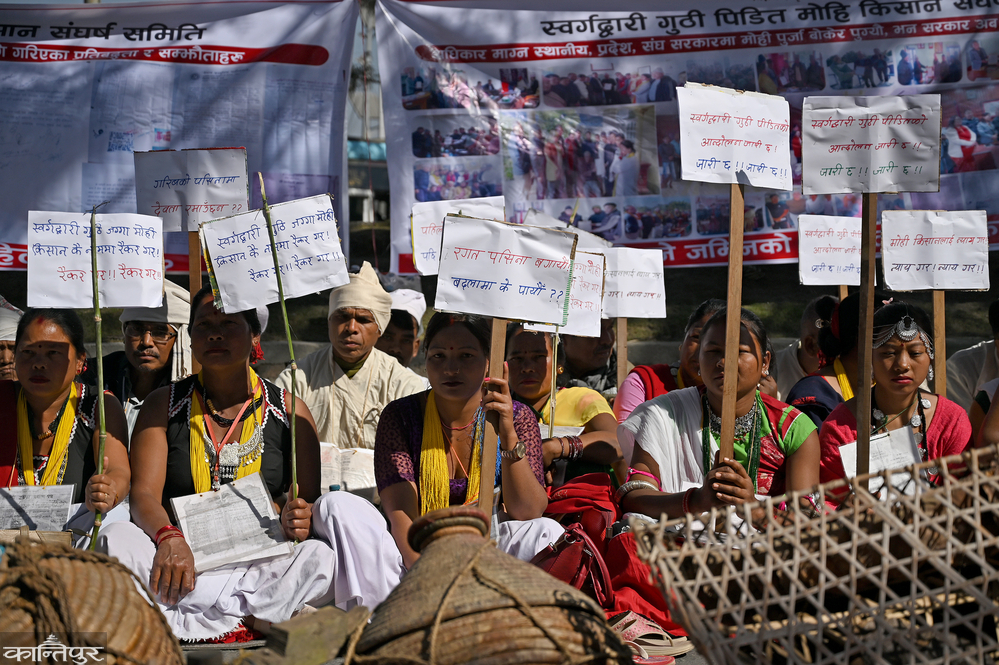
As Asha said, the Tharus have not really carried out the movement with big dreams. They did not protest for leisure. They have demanded the right of the land they are cultivating. Basuram Choudhary says – 'There was no trust even towards the state. The parties also only made promises, but did not fulfill them. What will we eat and where will we go if we have to leave the land one day? We have started to be oppressed by Swargadwari, Samant and even the government. So we are fighting for our own rights.'
is the biggest problem. But even Bass is not on the land of his name. How much pain to suppress. They came to the capital to fight for their rights. How did the sit-in Women and the elderly sit on dharna, huddled on the cold floor. Not that desire at all. Compulsion. It is because of the grief of not having land. Let the day pass. Let the night pass. But now they are not going to return until the demand is met.
The Tharus, who were forced to leave Buhran (land) with the dream of grass, shelter and cotton, were kept there because the land would now become barren. Made the land green. However, he never got to play with his own soil. Couldn't be happy. Made land for sowing and growing. However, he did not own that land. However, he could not leave the cultivated land and go to Buhran. No matter where he went, he had to juggle grass. So Baje's dreams were taken care of by Ba's dream son and took care of that land. Even now they have the same sound – The land is ours. We should give full rights to that.'
Once upon a time the Tharus made the uncultivated land fertile while battling malaria, malaria, snakes and scorpions. Made human habitable. But the land that was supposed to be in their name was measured in the name of different landlords and after land reform was implemented, the Tharus became enamored of their own land. After the delimitation, the landlord did not give that land to the farmer and registered it in the name of Swargadwari Ashram in 2030. Farmers were made raitis of Swargadwari Ashram. Due to similar exploitation, the aggrieved farmers left farming and continued their agitation. There were various stages of agitation for Mohiani Haq. Many agreements were made with the government. But it was not implemented. That's why the farmers have called this movement decisive.
Supreme Court on 14th Chait 2062 issued an order not to fragment the land of the Ashram as Swargadwari is a special type of private Guthi. 753 bighas of 1050 bighas under Swargadwari Ashram in Dang have been encroached upon. 16 thousand farmers of 3 thousand 5 households Dependent on it.
This is a movement of pain by aggrieved farmers. It is a movement for justice. It is a movement to acquire ownership of land. Freedom movement. It is a movement for secure livelihood. A spontaneous movement of soil lovers. Where youth, senior citizens, women have gathered peacefully with determination. They have not asked the state to give the land elsewhere.
Farmers are overwhelmed. After giving up the dream of sadness, he protested many times in search of a dream of happiness. Bachala didn't do it. The dreams that were left behind came true. Tharus who have protested for others many times are organizing their own voice for rights this time. Praveen Dahit, who has been leading the movement for a long time, says - 'Naldi rights are not available. First we fought to send the leader to power. Now we are fighting for ourselves. We are always oppressed until we get the right. Baje Hepi. Baa Hepi. I'm dying. If this is the case, the children will be punished in the same way. After all, the people of Bhuimanche did not benefit from those movements. The benefit was stolen by others. The squatters only built a ladder. There were earthlings who fought. There were others who rose to power. Those who had bas and bales, they were used only. So now the people of Bhuimancha are starting to organize for their own and their community's rights.
Jiju Baje, a farmer who was cheated many times, shed blood and sweat on this soil. They could not go anywhere except this soil. Fought with malaria. Associated with malaria and loo. Struggled with smallpox and cholera. Became the prey of venomous and violent beasts. Hepi from the feudal lords. No matter how Jay-Jay harassed, he did not panic. No matter how hard it was, he continued to love the soil. He did not climb the mountain when he was tired. He did not dream of climbing mountains. He only dreamed of Mana, Nana and Chana. This was the soil that was soiled with the sweat of the ancestors. The aggrieved farmers had their own land in this land. Only if those Bhumiputra farmers are given the ownership of the land based on the usage of this soil, they will get justice.

