We use Google Cloud Translation Services. Google requires we provide the following disclaimer relating to use of this service:
This service may contain translations powered by Google. Google disclaims all warranties related to the translations, expressed or implied, including any warranties of accuracy, reliability, and any implied warranties of merchantability, fitness for a particular purpose, and noninfringement.
In sub-section (3) of clause (g) of Article 51 of the Constitution of Nepal, there is a provision of 'producing and developing renewable energy to ensure adequate and accessible reliable supply of energy to meet the basic needs of citizens and to use energy appropriately'.
Article 30 (1) of the Constitution provides that 'every citizen shall have the right to live in a clean and healthy environment'. For the implementation of these provisions of the Constitution, the development of renewable energy and the proper use, saving and conservation of energy through energy efficiency, increasing the access to modern energy and achieving the goal of sustainable development, the concept of sustainable energy, the reduction of the impact on the environment from greenhouse gas emissions and the promotion of green economy through adaptation, energy integration and energy security. Since it is necessary to create a new law to ensure, the draft of the bill made to regulate renewable energy and energy efficiency has been approved by the Government of Nepal, the Council of Ministers and is under discussion in the National Assembly under the Federal Parliament.
Nepal is a member of the International Renewable Energy Agency and the International Solar Alliance and is a party to the Paris Agreement on climate change. Nepal's international commitments on energy and climate change, including the 2030 Action Plan on Sustainable Development Goals, the Second National Determined Contribution, the Long-Term Strategy for Net Zero Emissions by 2045, the National Adaptation Plan, the Sixteenth Plan, the Action Plan on Electricity Consumption Increase and Mineral Fuel Reduction, 2080, the Energy Development Roadmap and Action Plan, 2081, and the National Renewable energy, energy efficiency and clean energy conversion have been given high priority in the target. By 2035, the installed capacity is 28,500 MW and per capita electricity consumption is expected to increase annually With the target of reaching 1,500 units, in the recently approved 'Energy Development Roadmap and Action Plan, 2081', to provide electricity access to 100 percent of households within the next two years through off-grid solar, wind and small hydroelectricity in places not connected to the national grid, to connect the electrical infrastructure not connected to the national grid to the grid, to produce energy from waste, to arrange the necessary arrangements for buying and selling solar power, to connect wind energy to the grid Conduct feasibility studies, determine electricity purchase and sale rates for grid-connected energy storage systems, create and implement standards for electrical equipment to increase energy efficiency, conduct energy audits, encourage technologies such as electric vehicles, electrical equipment, and green hydrogen for energy conversion, and make legal provisions related to renewable energy and energy efficiency. Various goals related to renewable energy, energy efficiency and energy conversion are covered. According to the Paris Agreement, the third National Determined Contribution that Nepal should submit to the United Nations Framework Convention by February 2025 is currently being drafted.
As the United Nations announced that from 2024, January 26th will be celebrated as the 'International Clean Energy Day', we are in the context of the second 'International Clean Energy Day . To make our energy system sustainable, reliable, quality and uplifting, to reduce the impact created by climate change and to contribute to energy security, promoting energy mix, expansion of renewable energy, adoption of energy efficiency and clean energy transformation has been widely accepted.
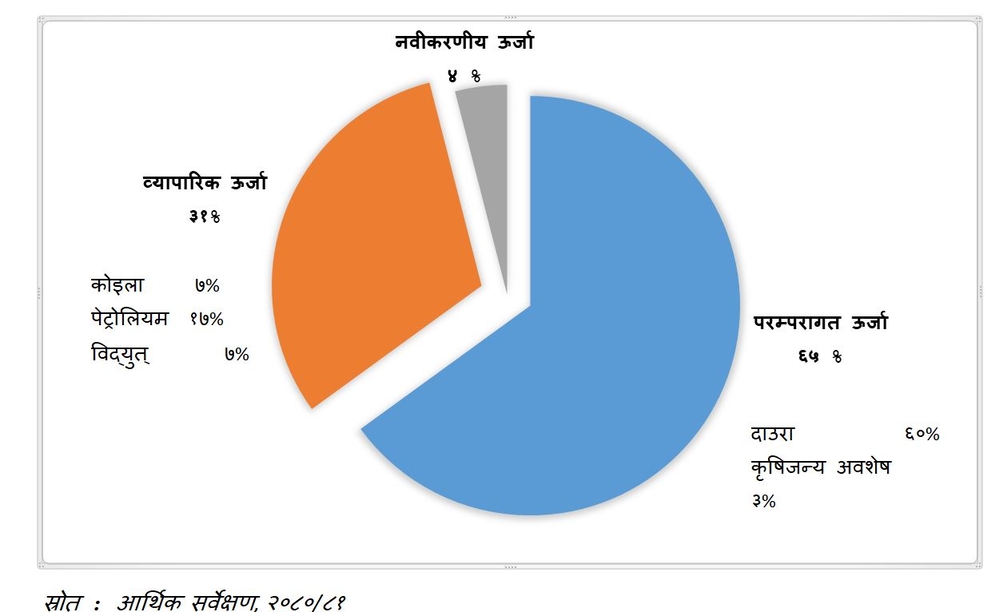
Looking at the state of national energy consumption, it seems that Nepal is still significantly dependent on traditional energy sources. According to the economic survey of the financial year 2080/81 published by the Ministry of Finance, 65 percent of the total energy consumption is conventional energy (firewood 60 percent, agricultural residues 3 percent and straw 2 percent), 31 percent commercial energy (coal 7 percent, petroleum 17 percent and electricity available from national transmission 7 percent) and 4 percent renewable energy (small and small hydropower, solar and wind). Energy and Biogas) is part of . While only 11 percent of clean energy is being consumed, 7 percent from electricity and 4 percent from renewable energy, the remaining 89 percent of energy needs to be converted into clean renewable energy. According to the report of the National Census, 2078, the share of firewood as the main fuel for cooking is about 51 percent, LP gas is 44 percent, coal is about 3 percent, electricity is 0.5 percent and biogas is 1.2 percent. Although the use of electric stoves has become widespread recently, more work needs to be done to achieve the goal of the second national determined contribution of 'increasing the share of electricity as the main fuel for cooking to 25 percent by the year 2030'. appears .
Alternative Energy Promotion Center, the main agency of the Nepal government that works on renewable energy and energy efficiency, has been increasing access to clean energy in geographical locations and households that do not reach the national transmission line through the promotion of renewable energy and energy efficiency for almost three decades, Expansion of clean energy technology for cooking, increasing the availability of clean energy in micro, small and medium businesses, expansion of renewable energy and promotion of energy efficiency in education, health, drinking water, irrigation, industry, business etc. In addition to this, it is necessary to improve the living standards of citizens and contribute to environmental protection by making the use of energy in the total domestic production effective.
Under the United Nations Convention on Climate Change, various funds and carbon trading mechanisms have been established and are active in order to assist developing countries to increase mitigation and adaptation activities. There is an imperative need to increase resource mobilization through climate finance.
Alternative Energy Promotion Center is playing an important role as the first direct access body of Nepal recognized by Green Climate Fund and developer of various carbon projects in the mobilization of climate and carbon finance, while National Nature Conservation Fund and Nepal Investment Mega Bank are also in the process of advancing various projects as recognized bodies of Green Climate Fund . Similarly, Nepal is mobilizing climate finance through various international organizations and development partners, but it seems that in order to make it more widespread, the capacity of national organizations should be increased and activities in this field should be increased .
Alternative Energy Promotion Center has reduced emissions from 8 carbon projects based on biogas, small hydropower, improved watertight and improved stoves under carbon finance and earned more than 35 million US dollars in carbon income through carbon trading. Under Article 6 of the Paris Agreement, large-scale biogas-based carbon projects have been developed. The
center has also been trying to mobilize resources through carbon trading and other financial mechanisms, including the Green Climate Fund. But in order to make these efforts more widespread and for the nation to benefit from all kinds of international mechanisms related to climate and carbon, it is necessary to move forward together with the government institutions as well as the private sector and financial institutions, for which it seems that attention should also be paid to preparing the appropriate policy and legal basis .
When studying the legal arrangements in other countries regarding renewable energy and energy efficiency, it is found that there are three types of arrangements. First, renewable energy and energy efficiency must be addressed in the same law and having an institutional structure; Second, renewable energy and energy efficiency have different laws but the same institutional structure and thirdly, the legal system and institutional structure are different.
For example, Bangladesh, Malaysia, Sri Lanka and Thailand have the same institutional structure for legal arrangements and implementation of renewable energy and energy efficiency and are implemented by the same agency. Similarly, in Germany, United States of America, Philippines and Ghana, although there are separate laws on renewable energy and energy efficiency, it seems that they are being implemented by the same body, while in India and Pakistan, the legal system and institutional structure on renewable energy and energy efficiency are found to be different. After the study of these international practices, it seems that in Nepal, according to the Constitution of Nepal, 2072, in the perspective of a federal structure, renewable energy and energy efficiency are covered by a single law and implemented through a single institutional structure.
When the 'Renewable Energy and Energy Efficiency Bill, 2081', which is currently under discussion in the Federal Parliament, is given the form of an Act, it is expected that much-needed and important progress will be achieved in order to achieve the national energy-related goals and international commitments put forward by Nepal, and to prepare a strong legal basis for advancing the actions related to renewable energy, energy efficiency and clean energy transformation through the mobilization of climate and carbon finance.
After the approval of the Renewable Energy and Energy Efficiency Bill, it is believed that the development of renewable energy in Nepal, the creation of an easy environment for distribution, and the creation of an environment where energy-efficient technologies and equipment can be used will reduce the cost of production of goods and services, and contribute to the reduction of the impact of climate change. Also, the energy saved from energy efficiency will be distributed to the areas with less access to energy and will help in achieving the goal of sustainable development and energy transformation of the state.
Therefore, in order to achieve the goal of clean energy transformation through renewable energy and energy efficiency, there is a need for all stakeholders related to this sector to join hands. The International Clean Energy Day, which is being celebrated with the aim of 'raising awareness for the just and inclusive transformation of clean energy that benefits the earth and the human beings and all the living creatures living on the earth and conducting similar activities', has also absorbed the multifaceted role of renewable energy and energy efficiency in the transformation of clean energy, which directly contributes to building a sustainable and low carbon based economy .

