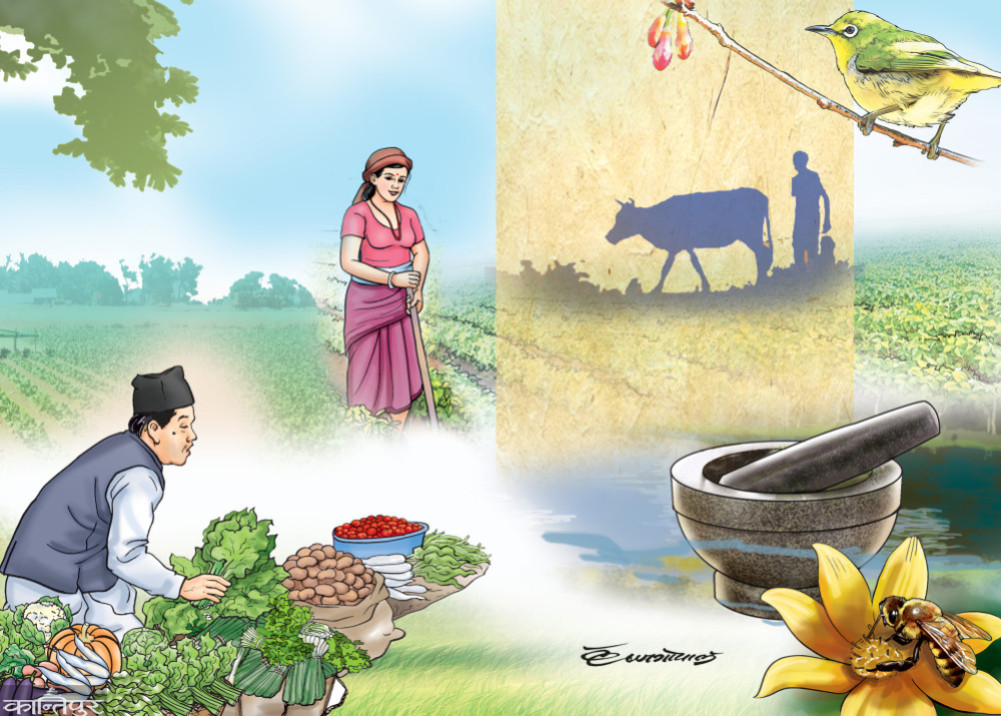
About 28 percent of the 24,000 species found in Nepal are agricultural genetics
We use Google Cloud Translation Services. Google requires we provide the following disclaimer relating to use of this service:
This service may contain translations powered by Google. Google disclaims all warranties related to the translations, expressed or implied, including any warranties of accuracy, reliability, and any implied warranties of merchantability, fitness for a particular purpose, and noninfringement.
The main challenge of almost all countries was the inability to produce food to meet the demand of the growing population worldwide during the Second World War. In order to address the growing demand, the search for new technology and research started to significantly increase the production.
DDT was invented in 1939. DDT, which was developed to control malaria spread among combat troops during the Second World War, was then used in agricultural production. Along with the production and use of DDT, irrigation, the development of hybrid varieties of crops, the use of chemical fertilizers etc. began to be widespread. And the green revolution spread all over the world.
With the geometric increase in production since then, ``Silent Spring'' drew the world's attention to the need to take care of the environmental aspect as well. After the American author and conservationist Rachel Carson wrote in 1962 that the environment is calm even in the spring, the discussion about development and the environment began.
day context
Every year on May 22nd, Biodiversity Day is celebrated worldwide. After the Earth Summit held in Brazil on May 22, 1992, decided to advance the Convention on Biological Diversity, the Biodiversity Day began to be celebrated on May 22, 1994. Biodiversity refers to the huge range of flora and fauna on Earth. Since agricultural biodiversity is a very sensitive issue in developing countries, with special attention to agricultural biodiversity, National Agricultural Biodiversity Year has been started in Nepal since 2079.
In terms of biological diversity, Nepal ranks 23rd in the world and 11th in Asia. There are currently 550 food crops, 200 vegetables and 45 fruit varieties in Nepal. Agricultural biodiversity also contributes to sustainable development, food security and poverty alleviation. Due to the decrease in agricultural biodiversity, the tribal tribes who earn their livelihood from the cultivation of Raithane crops remain sensitive.
Tradition and Agricultural Biodiversity
In Hindu tradition, Tulsi, Var, Peepal, Kans, Bel, Paiyunka Hanga, Dativan, Rudraksha, Babio, Dubo, Kush, Palans, etc. indicate that there is a deep connection between agricultural biodiversity and religious cultural beliefs . Similarly, ginger, turmeric, garlic, bitter gourd, chiraito, etc. also indicate that herbs have religious and cultural significance . Barley, sesame, tika, curd, incense, kush, panchamrit, sandalwood, betel nut etc. are used for various gods and their worship.
Various other examples of the interrelationship between agricultural biodiversity and religious beliefs can be seen. The Chiuri tree has a separate belief and recognition of the Chepang tribe, and the Kulung Rai tribe has a distinct belief with the aloe. The dynasties of Eastern Terai hang garlic and onion outside the house when celebrating the Siruva festival . In Kathmandu Valley, the Newar community worships Red Machhindranath as the god of rain and grain. Saune Sankranti, kheer eating day, tradition of offering sakhar and pina with mustard or mustard oil on giraunla leaves during Jitiya festival, tradition of eating sakharkhand, tarul and pindalu on Maghe Sankranti etc. have shown that there is a close relationship between agricultural biodiversity and traditions .
The condition of agricultural biodiversity
In Nepal, it has been found that the agricultural biodiversity has decreased by 50 percent and 40 percent of the Raithane crop. Likewise, according to the United Nations, the rate of soil desertification is increasing alarmingly. If this rate continues, after the next 60 years there will be a huge decline in agricultural production. Researchers have said that the threat of mass extinction (mass extinction) of animals and plants on Earth is also increasing.
Excessive use of chemical fertilizers and pesticides in the soil has led to a great decline in agricultural biodiversity. Climate change has changed soil structure, temperature and rainfall patterns, while rapid urbanization and deforestation have increased soil alkalinity. The United Nations has expressed serious concern that 33 percent of the world's soil is currently degraded and its amount may increase further in the coming years. It is emphasized that the health of the soil, the source of food for mankind and animals, should be protected, the soil should be monitored and the life of the soil should be saved through proper management.
The decline in agricultural biodiversity has affected agricultural production cycles and systems. The upheaval in the biological diversity under the ecological system will definitely affect the earth's environment . Due to destruction of animal and plant habitats, climate change, diversity in land use, encroachment of invasive species, deforestation, haphazard urbanization, use of chemical fertilizers and pesticides, the condition of agricultural biodiversity is deteriorating .
In Nepal, 40 percent of the agricultural biodiversity of grass crops, livestock, aquatic, insect and micro-bacterial genetic resources have been lost under Raithane crops. Due to lack of research, education and development related to agricultural biodiversity, low utilization of Raithane breed, problems in marketing etc., agricultural biodiversity is decreasing. Similarly, among other reasons, climate change, modern farming systems, environmental pollution, disease outbreaks, urbanization, etc. have been playing an important role in the decline of agricultural biodiversity.
In Nepal, there is a custom of giving special importance to foreign caste than Raithane caste. Jersey cows, rainbow trout, mellifera bees, Boer goats, Japanese mushrooms, etc. have caused many species to disappear.
Policy and Agricultural Biodiversity
In the context of Nepal, the Constitution of Nepal 2072 states that biological diversity is the responsibility of all three levels of government, including the federal, provincial and local levels. Various national policy regulations, including the Biovision Act, 2045, Biovision Policy, 2056, Agriculture Policy, 2061, Biodiversity Policy, 2063, have laid special emphasis on the protection of agricultural biodiversity.
vs. In 2052, Nepal became a member state of the Convention on Biological Diversity. Under the Nepal Agricultural Research Council National Gene Bank was established in 2067 . With the implementation of federalism, the Crop Development and Agricultural Biodiversity Conservation Center has been established under the Department of Agriculture.
vs. In 2051, a community seed bank was established for the first time in Dahchoki and seed bank programs have been taking place at the local level. According to the federal conditional program, there are various programs related to agricultural biodiversity at the provincial and local levels.
Conservation of agricultural biodiversity
In developing countries, there is a tendency to take agricultural biodiversity and environmental importance as light subjects . For conservation of agricultural biodiversity, practice of mixed farming system, integrated pest management (IPM), organic farming, integrated farming can be done.
Raithane should have a program related to the dissemination, marketing and facilitation of crop seeds . The government It has been announced that the 1st of January every year from 2079 will be celebrated as the National Agricultural Biodiversity Year. In order to diagnose the serious problems caused by changing lifestyles in human health, the original food culture and food dishes should be identified and their importance highlighted.
The Constitution of Nepal has put the conservation and sustainable use of biological diversity under the state policy . Although Nepal is rich in biological diversity, climate change and modern farming systems have had a negative impact. Every year in Nepal, National Rice Day is celebrated on June 15th and National Conservation Day is celebrated on October 7th. Similarly, various programs related to environment protection have been held as World Food Day, Environment Day and Biodiversity Day which are celebrated internationally.
About 28 percent of about 24 thousand species found in Nepal are agricultural genetic resources. Farmers raise animals for milk, meat, manure, skin and fur, and friendly insects in crops, economically beneficial insects are also included in the field of agricultural biodiversity . Spiders, caterpillars, bees, agricultural microorganisms, among bacteria, mushrooms, leaves etc. play an important role in maintaining agricultural biodiversity.
There is a situation of not being able to meet the demand of the growing population from indigenous animals towards animal genetic resources. The number of Raithane animal genetic resources of Nepal is decreasing . There is a need to protect various types of Raithane cows, Raithane buffaloes, goats, sheep, chickens, pigs, etc. including Terai, Pahari, Siri, Achhami, Khaila.
Various efforts have been made for the conservation of agricultural biodiversity. According to the place, local, healthy, house, barn, field, terrestrial and protected reproductive practices are adopted. Racial mixing of endangered resources, mutant crop breeding, conservation breeding is done for racial improvement.
It is now necessary to develop a system for acquiring intellectual rights by conducting high-level studies and research on agricultural biological diversity. Raithane should change the comment about 'hela crop' by spreading awareness about the importance of nutrients found in agricultural produce.
The development and promotion of local technology related to Raithane crops, marketing at the international level, agricultural biodiversity conservation programs at the local level through food fairs. Agricultural diversity can be protected by establishing danger zones, danger lists, establishing field gene banks, crop special parks around schools, religious places, border areas, etc.
Conclusion
Agricultural biodiversity has greatly contributed to our food security and nutrition. From the availability of daily food to the production of medicinal products, agriculture must depend on biodiversity.
Agricultural biodiversity protection has become an indispensable topic today for ensuring the habitat of every animal and plant in the whole earth along with human race, protection of ecological system, sustainable development and poverty alleviation.