We use Google Cloud Translation Services. Google requires we provide the following disclaimer relating to use of this service:
This service may contain translations powered by Google. Google disclaims all warranties related to the translations, expressed or implied, including any warranties of accuracy, reliability, and any implied warranties of merchantability, fitness for a particular purpose, and noninfringement.
After watching the exciting match between Nepal and India in the recently concluded SAFF women's football championship, we cricket players also went to a restaurant near the stadium to 'celebrate' happily.
The toilet of that famous restaurant, which is said to have delicious food, has to be counted. I had heard somewhere that if a place's toilet is not clean, its kitchen is not clean either. So, the joy of Nepal winning the game and my enthusiasm for the food was dampened by that humming toilet.
Even though I know that urinating affects health and there is a risk of infection, I feel this compulsion frequently in Kathmandu. Especially during menstruation, having to use a toilet with no dustbin and no water or yellow water is very stressful. Therefore, it is thought that one should not go out as much as possible during menstruation. However, a person like me who has made a career out of 'outdoor sports' is not allowed to go outside the house.
The problem of public toilet is not only me, but every Nepalese woman is facing it. The condition of public toilets in Nepal is not good. Women do not have convenient toilet facilities when they go to market or restaurant. One is that there are not enough number of toilets, even those that are there are such that one would not have to enter. Even in Kathmandu, women-friendly public toilets are few. There is also the experience of getting sick because of using public toilets. Even the toilets of thulthula malls and marts are dirty and disgusting. The toilets of some large malls are full of water and urine, what to talk about in the hospital! If he goes there, it seems that he will bring disease. Public toilets are also not handicap friendly. The sisters and brothers who walk in wheelchairs and who are blind do not drink water since the morning on the day they go out to the field. How ironic is this? Female players also face problems when they go outside the valley for the tournament due to lack of good toilets.
Another concern is that the toilet water is yellow and dirty. How to clean with such water? Many women now use menstrual cups during menstruation. It should be washed and applied frequently. As it goes inside the vaginal canal, it cannot be washed with dirty water. What to do in this case? Toilet waste is taking away women's right to live a healthy life. After using the public toilets in Kathmandu many times, my friends and I have also had problems like urinary infections. It affects our game life.
I use tampons during my period. It was not a matter of haphazardly mixing it up. Some schools, colleges, malls, restaurants, offices and hospital toilets do not have dustbins. In some public toilets, pads, tissue paper, tampons are thrown on the floor, hung on the wall. A dustbin must be placed inside the toilet used by women. Any woman you ask will likely have a urinary tract infection at least once in her life. This has become a common theme, which should not be. During this infection, there is burning of urine, it feels like urinating suddenly, pain while urinating, intense itching, burning. This is called 'urinary tract infection (UTI)'. 60% chance of infection in women and 13% in men. As it is a topic related to sanitation, public awareness is necessary. In order not to get sick from the toilet, I look for a toilet that can be done sitting as much as possible, I am afraid to use the commode. Germs like bacteria can't survive on the toilet seat for a long time, but it seems to last.
I have felt the risk of abuse especially in highway toilets. There have also been cases of men talking indigestion and teasing in the women's toilets. Some women are heard writing/talking about this on social media. It will be fine if the male and female toilets are made slightly apart until they meet.
Public toilets abroad are clean and tidy, can be used with confidence. In South Asian countries, the condition of toilets is almost the same. When I went to Singapore, Korea, Kuwait, Malaysia for games, I was impressed by the toilets there. How clean and safe! In some toilets, space was also allocated for 'breast feeding'. When will this happen in Nepal? Here, I have experienced that some of my friends, mothers, and sisters have health problems because they use public toilets. It has not been raised as much as it should be. Although it may sound small, it is a serious issue that all women experience regularly, directly related to reproductive and physical health.
It is very ironic that someone cannot go to school because of menstruation. Missing school for three to four days in a month may cause girls to fall behind in their studies compared to boys. If men and women are not skilled, equal and conscious in the society, the society will always remain backward. Therefore, this topic should not be dismissed as a small problem, women's pain, the 'misfortune' of being a woman.
It is not that difficult to improve the condition of common toilets in any public place or office, educational institution. Once the concept of 'Public Toilet' was introduced by the Kathmandu Metropolitan City, it was a very good initiative. After that announcement, some restaurants introduced toilet facilities, some still maintain them. But this concept got stuck in the middle. It should be continued. At least women should be able to drink water confidently when they step out of the house. I saw another good example of a public toilet in Patandhoka. I was happy to see the news that the toilets there are clean, have hot water and are women friendly.
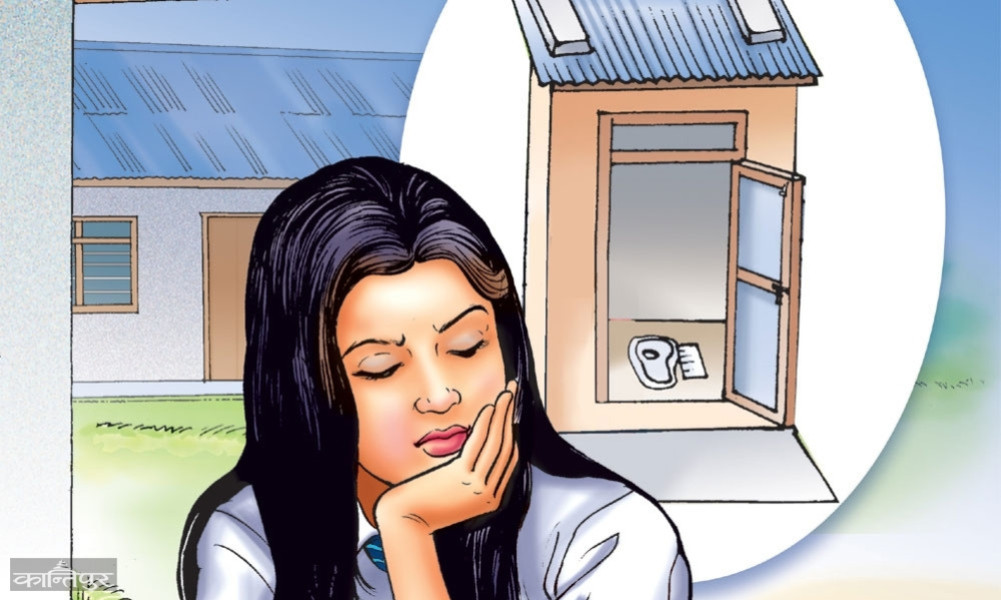
When I studied at Apex School and Mani Mukund College in Butwal, I did not have so many problems regarding toilets. Toilet condition in our school/college was good. I had my first period in school. There was an assistant sister who looked after the students. He taught about cleanliness. The school used to get free pads. Pads should be made mandatory in educational institutions and offices. This is not an extra feature, but a grateful necessity.
It is still heard from time to time in the villages that many sisters do not go to school during menstruation. Lack of proper arrangement of toilets, lack of access to pads is also the reason for this. Menstruation is still considered as a 'taboo'. This happens even in today's times and it sounds like saying but it is true. There is very little public awareness about 'menstrual hygiene' in Nepal. Both men and women need to be educated about this. The issue of clean toilets is directly linked to 'menstrual hygiene'. Earlier, an organization called Mitini used to put pad boxes in women's toilets, but now that too seems to be closed. Such initiatives can be taken up by our local bodies, the Ministry of Women and Children or the Ministry of Health.
In the recently concluded 16-day campaign against gender-based violence, is it not time to think seriously about the problems faced by women in the context of the discrimination and difficulties faced by women?
– Burma is the captain of the Nepalese national women's cricket team.