We use Google Cloud Translation Services. Google requires we provide the following disclaimer relating to use of this service:
This service may contain translations powered by Google. Google disclaims all warranties related to the translations, expressed or implied, including any warranties of accuracy, reliability, and any implied warranties of merchantability, fitness for a particular purpose, and noninfringement.
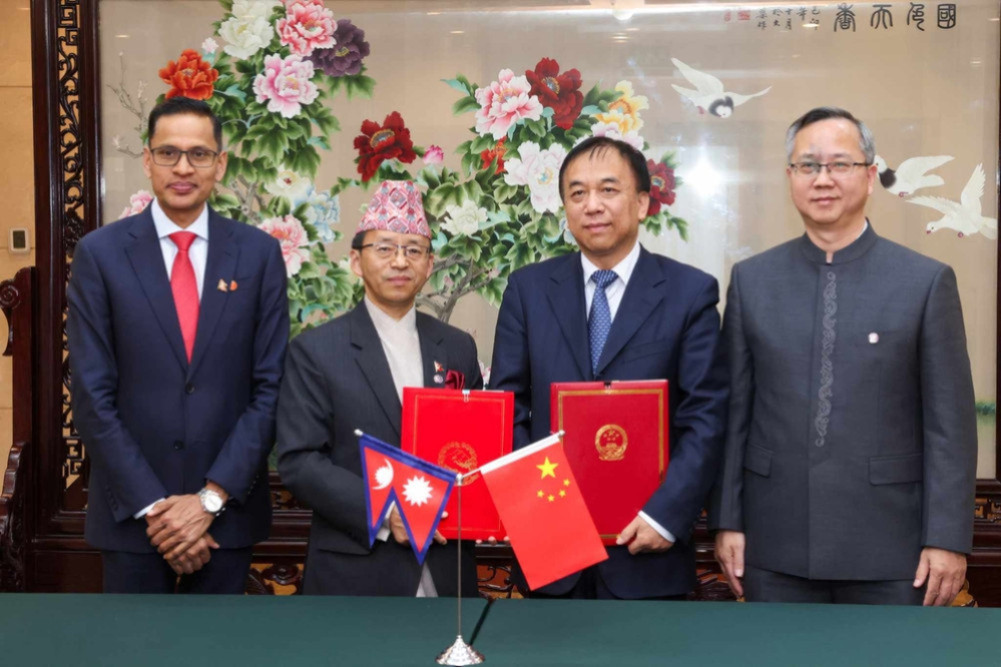
Although it is said that the project under the 'Technical Support and Aid Financing Modality' under BRI has been signed between the responsible officials of the Government of China and Nepal, it has not yet been revealed whether there is an agreement on loans or grants.
In political economy, aid means loan and grant means money that does not have to be paid. Well, it seems that the project under BRI in Nepal will go ahead. But BRI implementation is very challenging in Nepal, which is facing complicated geopolitics and pressing economic politics.
The relationship between these two countries, which established diplomatic relations in 1955, is based on the Panchsheel principle. Nepal and China have had relations since historical times. The lifestyle, dress, language, culture, religion, faith and Chinese lifestyle of the Nepalese living in the Himalayas are similar. This is considered cultural exchange. Nepal is a country committed to China policy. Nepal needs financial and technical support from China in the fields of transportation, tourism and production. Cooperation with China in the fields of education and health can also be in the country's interest.
Nepal-China relations seem to have been strengthened and strengthened by high-level state visits in different periods. During his visit to China in 2013, the then Prime Minister Tank Prasad Acharya had said that if China offered aid from Hong Kong, it would definitely be accepted. Similarly, Nepal's first elected Prime Minister BP Koirala visited China in February 2016 at the invitation of Chinese Prime Minister Chou En Lai. Koirala met the then Chairman of the Chinese Communist Party, Mao Tse Tung, while sitting on the banks of a lake in Hyog Chau near Shanghai. It was agreed upon not interfering in each other's internal affairs, keeping equality and mutual interests in mind, increasing friendship and cooperation, opening embassies in Kathmandu and Beijing.
During the visit of Koirala, the agreement regarding the Nepal-China border will be based on the traditional border line, the agreement that armed personnel will not be sent to 20 kilometers on both sides of the border and administrative officers will be placed on both sides of the border to maintain peace and friendly atmosphere is considered as the basis of friendly relations between the two countries. Koirala mentioned in his autobiography that in the meeting and discussion with the Chinese leader Mao, there was talk about 'Mount Everest', the relationship between small and big countries, and technology should also be of its own type after the capital is reduced. BP made its stand by citing the fact that the Chinese Prime Minister said that the entire Mount Everest belongs to China. Mao also chose the path of consensus after talking about resolving it and moving forward because he was connected to his feelings. After he talked about the northern part of China and the southern part of Nepal, BP brought up the peak. In this way, the BRI project should be used by the Nepali responsible leadership in the interest of the country, bearing in mind the history that the Everest dispute was resolved by mutual agreement.
China has become a powerful, prosperous and prosperous country in the world. China has the world's largest population and economy. China's development model is famous all over the world. China's products have captured the world market. The study, research and adoption of Chinese development model and market strategy can be effective for the prosperity of Nepal. In order to restore unity, stability and prosperity in Nepal, there is a situation where the laws, policies and rules of the state must be ruthlessly attacked. We have political corruption. Corruption control is not possible without reforming politics, bureaucracy and technocracy.
International recognition is developing that China can maintain the political and economic balance of the world. China has expanded the much-touted BRI project to expand global political, economic and strategic thinking. If Nepal can use BRI for the benefit of the country without compromising on democratic values and nationalism, Nepal will not have to wait long to become a prosperous country. In order to do this, Nepalese politicians need to have the ability, willpower and strength to exercise knowledge and courage.
The Chinese-led strategic project BRI is said to develop, expand and exchange the culture and civilization of Asia, Europe and Africa. BRI has put forward the multi-ambitious Strategic Silk Road concept for trade and cultural exchange. China aims to cover more than 140 countries in the world, benefit 75 percent of the population, and account for half of the world's GDP. It is estimated that China, the super power of the world, can implement the BRI project along with the construction of infrastructure, roads, bridges, railway networks and the Asian currency.
It is necessary to adopt a balanced foreign policy after a thorough analysis of the fact that an agreement with a friendly country may shock diplomatic relations with other friendly countries. This is called clever diplomacy. Nepal should be able to benefit from the BRI project on the basis of geo-situation, geopolitics, strategic importance and friendship with its ally China. A country with a small economy should not fall into the trap of bad debt.
– Dahal is a lawyer.