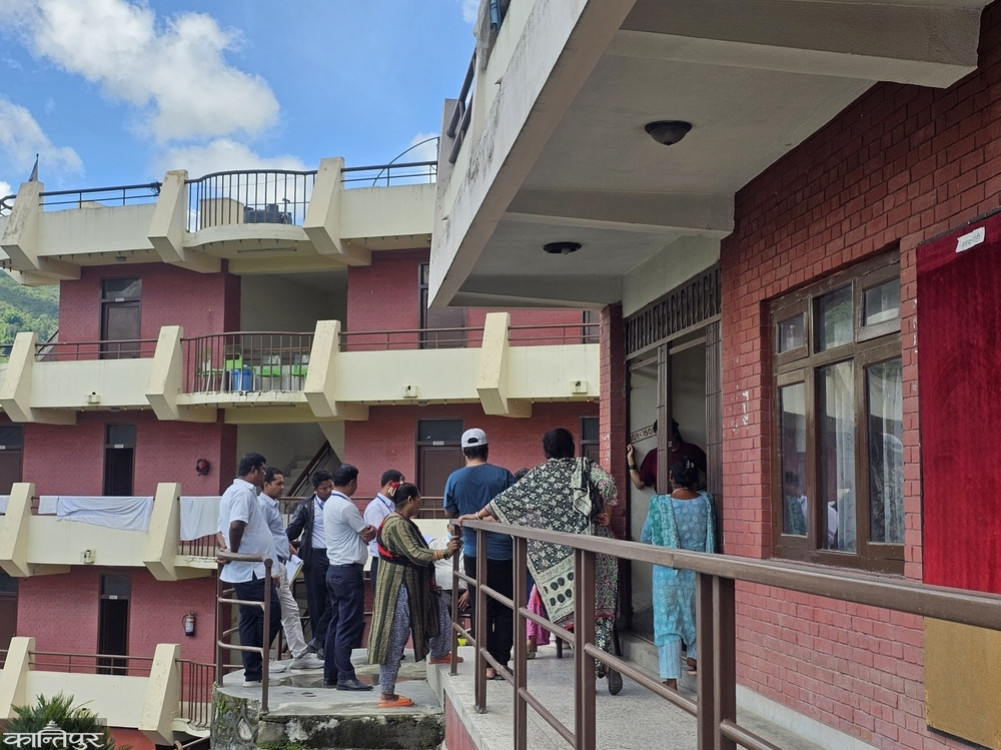
During the discussions, the Bagmati Civilization Integrated Development Committee with full authority stated that, except for the four displaced squatter families in Budol, Banepa, others have agreed to move to Ichangu Narayan in Kathmandu.
We use Google Cloud Translation Services. Google requires we provide the following disclaimer relating to use of this service:
This service may contain translations powered by Google. Google disclaims all warranties related to the translations, expressed or implied, including any warranties of accuracy, reliability, and any implied warranties of merchantability, fitness for a particular purpose, and noninfringement.
Some displaced squatters residing at the Nepal Red Cross Society’s holding center in Budol, Banepa Municipality–6, have expressed dissatisfaction, saying the government is trying to move them to another holding center without ensuring permanent settlement. They have insisted that the authorities must first determine a place or land for them to live before they will leave the holding center.
Kuntimaya Pulami, who has been staying at the holding center, said that although they have been relocated several times, no permanent solution has been provided. According to her, after the relief distribution stopped, they went hungry for five days. Although some supporters later provided food, she complained that the government agencies did not show the necessary concern.
She alleged that even though a government team recently visited and reported that they had already left the holding center, the actual situation had not reached the concerned authorities. “We were here, but we don’t understand how a report was submitted saying we had already left,” she said.
According to Pulami, out of the 45 families at the holding center, only 8 names have been included in the land management process. “If our names are not included, why not? If we have ancestral property, show it to us; if not, the government must provide us with land to live on. Until then, we will not go to another holding center,” she said.
Similarly, Hemkumari Dahal said that the government has been relocating them to various places but has not provided a permanent solution. “First Balaju, then Bhaktapur, then we were brought to Banepa. Now they are trying to take us to Ichangu Narayan. We no longer have any faith in where they will take us,” she said.
Dahal complained that after the food relief was stopped, they survived on beaten rice and lentil snacks at the holding center, but her name still has not been included in the resettlement process. “We don’t want another holding center; we want a permanent place to live,” she said.
She said she is a single woman, has had no place to stay since the settlement was cleared by bulldozers, and has not been able to work for three months. “If the government shows us the land our names are on, we will go ourselves. Otherwise, they must arrange for our settlement,” she said.
The government, meanwhile, has been transferring the remaining families at the Budol holding center to the Ichangu Narayan holding center in Nagarjun. However, some displaced people have insisted they will not move to another holding center until permanent resettlement is guaranteed.
According to sociologist Khagendra Bista of the Bagmati Civilization Integrated Development Committee, the process of moving people out of the holding center was advanced by providing 25,000 rupees in relief and 15,000 rupees for three months’ rent, as per the decision of the Council of Ministers, with the aim of reintegrating the displaced into society.
According to him, a notice was initially issued to vacate the holding center by 12 Asar. However, as some families could not arrange alternative housing, the deadline was extended to 19 Asar.
During that period, most of the approximately 45 families staying there left the holding center, but 10–11 families remained because they could not find a room outside, had no arrangements to stay with relatives, and could not immediately arrange alternative housing.
Bista said that after learning through coordination with the Red Cross that 10–11 families were still staying there, problems began to arise regarding food and other management for them. After those families also complained to the committee, alternative management was sought, he said.
According to him, since some rooms are vacant at the Ichangu Narayan holding center, it was decided to transfer them there. That holding center already houses people displaced from various places, persons with disabilities, children, and other vulnerable families.
Bista said that after discussions with the displaced families in Budol, all but four families agreed to go to Ichangu Narayan. According to him, all families who expressed willingness to go have been transferred, and for those who do not wish to go, the committee will not intervene if they can manage on their own.
He stated that it is not appropriate to keep displaced people in the same holding center for a long time, and that the government’s objective is to reintegrate them into society.