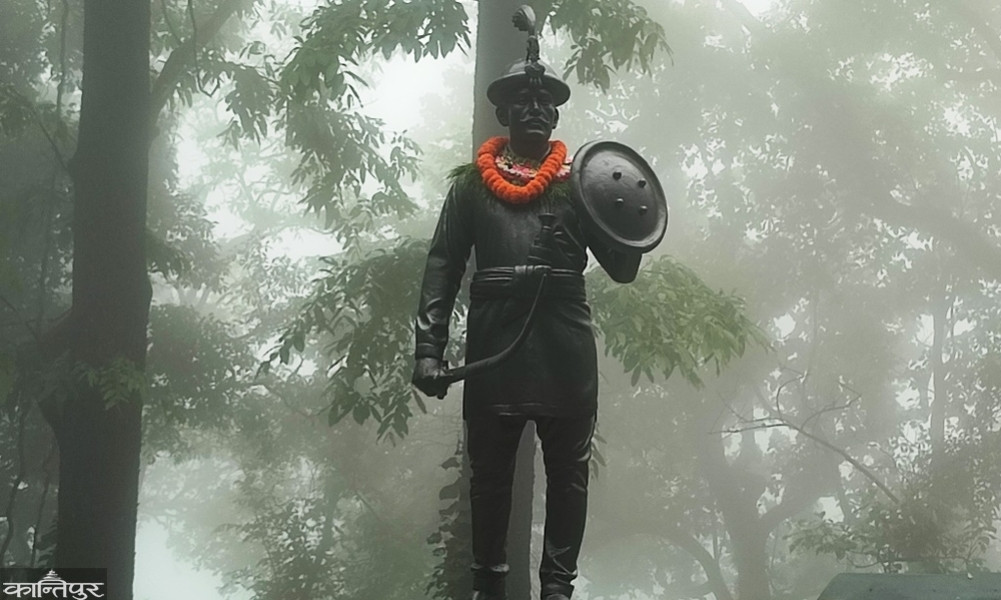
The statue of Abhiman Singh Basnyat, the leader of Nepal's unification, has been unveiled in the historic Someshworgadhi area near the Nepal-India border.
We use Google Cloud Translation Services. Google requires we provide the following disclaimer relating to use of this service:
This service may contain translations powered by Google. Google disclaims all warranties related to the translations, expressed or implied, including any warranties of accuracy, reliability, and any implied warranties of merchantability, fitness for a particular purpose, and noninfringement.
The statue of the historic military figure Abhiman Singh Basnyat was unveiled on Saturday in the Someshworgadhi area of Madi, right next to the Nepal-India international border. History records that Basnyat led the unification campaign to annex Chitwan, which was then under the Sen kingdom of Tanahun, into Nepal.
On the 26th of Saun, 1834 BS, a battle took place at Someshworgadhi between the Gorkhali army and the Sen soldiers. The army led by Basnyat emerged victorious in that battle. According to Devi Prasad Kandel’s ‘Historical Outline of Chitwan (From Prehistoric Times to 2007)’, published in ‘Chitwan Darpan’ by the District Coordination Committee (DCC) Chitwan, a fort was built on the summit of Someshwar hill during the reign of Sen dynasty king Manimukunda Sen. As soon as the Gorkhali army captured that fort, Chitwan became part of unified Nepal. However, in Chaitra 1835 BS, the Sen king of Tanahun regained control over both the hill and Terai parts of his kingdom.
After that, counterattacks began, and by 1837 BS, the Sen kingdom of Tanahun was limited to the hill region only. The southern watershed of Someshwar hill lies in Indian territory. During the Sen era, their kingdom extended from Someshwar southward to present-day Ramnagar in Bihar. The British in India posed a threat of entering Nepal’s hill region via Ramnagar, passing through Someshwar and Chitwan. Basnyat, who had reached the eastern Kirat region, was deployed to Kavilas and Someshwar in Chitwan.
According to historian Devi Prasad Kandel, on the 3rd of Saun, 1834 BS, a battle took place at Kavilaspur Gadhi with the Sen soldiers. After victory there, the advancing Nepali army reached Someshwar. The statue of Basnyat has been erected about 500 meters from the Someshworgadhi area. Someshworgadhi is located right next to the Nepal-India border. Someshworgadhi is an important tourist destination in Chitwan. The statue of Basnyat was sculpted about seven years ago during infrastructure development.
The statue was unveiled this time after being crafted based on various historical studies and documents to accurately represent Basnyat. The chief guest at the unveiling ceremony was Brigadier General Bishnu Kumar Khadka, Division Commander of the Nepali Army’s Central Division. The program mentioned that Basnyat was the leader of Nepal’s unification campaign, holding the title of Kaji, or Commander-in-Chief. Speaking at the event, Bagmati Provincial Assembly member Thakur Dhakal said that building statues of such historic figures would inspire national sentiment among the new generation.
According to ‘Nepal’s Military History–2049’, published by the Secretariat of the National Security Council, Commander-in-Chief (Kaji) Abhiman Singh Basnet, one of the main military commanders of the unification campaign, received a royal decree (Lal Mohar) from then King Pratap Singh in 1834 BS. Under his leadership, the army captured Kavilaspur Gadhi, Uparadang Gadhi, Parewakot Gadhi, and Someshworgadhi, all under the Sen kingdom of Tanahun, and incorporated them into Nepal.
This victory strengthened the defense system of Nepal’s southern border and gave the unification campaign greater strategic depth, as mentioned in Military History–2049. The New Gorkha Battalion, deployed for the security of Madi Municipality and Chitwan National Park, jointly worked to create a new and accurate statue of Abhiman Singh Basnyat. Along with the statue, structures such as a stone spout and rest stops were also constructed. Mayor Tarakumari Kaji Mahato of Madi Municipality inaugurated them.
The Someshworgadhi area’s Someshwarkalika temple is a site of deep faith and devotion not only for Nepalis but also for Indians. During Ram Navami, Indians trek the difficult and remote jungle path to reach Someshwarkalika. Speaking at the statue unveiling ceremony, Mayor Mahato said that the religious and historical aspects of the Someshwar area have also been highlighted.
The indigenous Tharu community also holds faith and belief in the Someshwar area. “The collaboration between the municipality and the Nepali Army has resulted in a new and exemplary achievement. Someshwar has always connected us to religious faith. This initiative has further highlighted the area’s historical and national significance. It will also help promote tourism,” said Mayor Mahato. The Someshworgadhi area is included among the government of Nepal’s top one hundred tourist destinations.