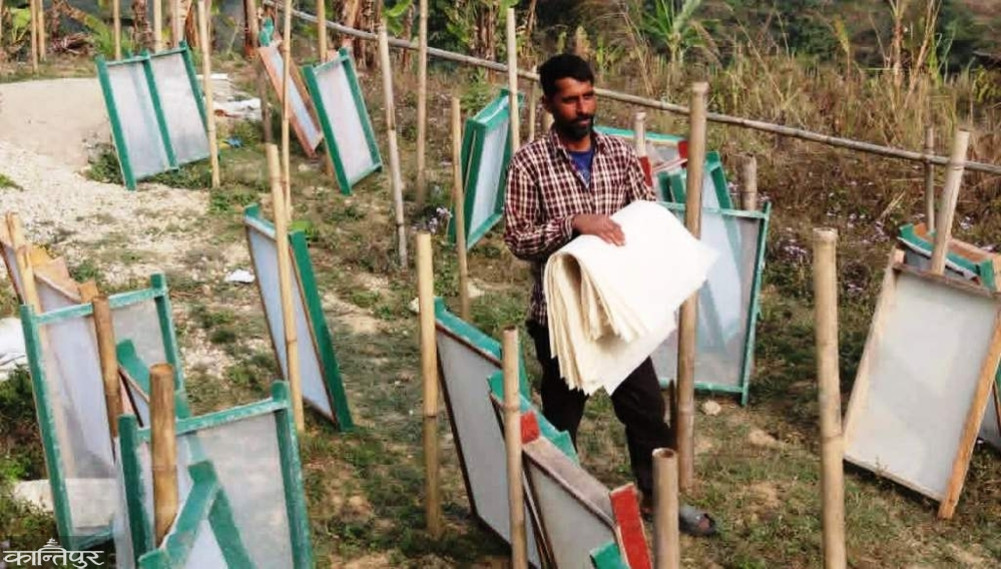
Prem Prasad Timalsina, who returned after working in Saudi Arabia for eight years, is earning an income by running a handmade paper industry from a banana plantation in Makawanpurgadhi.
We use Google Cloud Translation Services. Google requires we provide the following disclaimer relating to use of this service:
This service may contain translations powered by Google. Google disclaims all warranties related to the translations, expressed or implied, including any warranties of accuracy, reliability, and any implied warranties of merchantability, fitness for a particular purpose, and noninfringement.
After passing the 12th standard in 2011, Prem Prasad Timalsina had a dream of doing something in his own country. But he did not have the capital to fulfill his dream. So, with his driving skills, he went to Saudi Arabia for employment. He worked abroad for eight years. He returned to Nepal with the money he earned there, but not to take a job, but to set up an enterprise in his village.
Timalsina Handmade Paper Industry, operating in Devidanda, Makawanpurgadhi Rural Municipality-3, is the result of that decision. By producing handmade paper from banana peels thrown away in his village, he has opened the door to new possibilities for rural entrepreneurship. ‘Foreign money is like running water,’ said Timalsina, ‘If you can set up a business in your own place, it becomes a lifelong asset. Your children also learn, and the country also benefits.’ Living abroad taught him discipline and constant hard work. ‘I learned abroad that it is not difficult to earn money if you work hard and honestly, no matter where you are,’ he says.
While in Saudi Arabia, he saw a video on YouTube of an engineer couple from Karnataka, India, making paper from banana peels. That scene stuck in his mind. ‘My village is a pocket area for banana production. I used to see banana peels thrown away everywhere. At that time, I thought that this waste could also be used as a resource,’ he said. After returning to Nepal, he did many jobs including goat farming, veterinary services, and driving. But finally, he decided to pursue his dream of converting discarded raw materials into valuable products. He established a handmade paper industry in his village in 2081 BS.
The biggest challenge when starting the industry was convincing his family rather than capital. Everyone thought that this job would not bring in money. I worked alone for 6 months. ‘When the product started selling and the hard work started converting into money, only then did the family start believing,’ he said. Currently, the handmade paper industry is being operated with the active participation of the family. With the expansion of the business, preparations are underway to hire more employees from next year. The banana stalks, which are left to rot in the fields after harvesting, are the main raw material of the industry. First, the fiber is extracted from the stalks using a special machine. It is dried and cooked with babio. After processing, the pulp is made and handmade paper is prepared from that pulp.
According to Timalsina, 50 to 60 20/30 inch papers are produced from one kilo of fiber. He says that when the industry is operating at full capacity, up to 500 pieces of paper can be produced daily. He has experience that the amount of fiber in bananas from Makwanpurgadhi is higher than that of the Terai. He said that in the Terai, about 20 kg of fiber is produced from a tractor, while here 70 to 80 kg of fiber can be produced.
Makawanpurgadhi Rural Municipality alone has stated that it will purchase handmade paper worth about 100,000 rupees. Currently, his paper is being used for incense industry, handicrafts, paper bags, paper boxes and other environmentally friendly packaging. ‘Our goal is not to be an alternative to Lokta, but to establish the identity of another Nepali handmade paper along with Lokta,’ he said.
Timalsina claims that if the industry is fully operated, he can earn about 100,000 rupees per month. Currently, he earns more than 60,000 rupees per month. He plans to employ three or four people after the business expands. Currently, people from different areas come to his industry to observe.
Timalsina says that the biggest problems in operating the industry are roads and electricity. He said that due to the lack of roads to the industry, it is not possible to transport raw materials during the rainy season and the industry has to be closed for three to four months. He said that in addition to this, it is difficult to operate modern machines due to the lack of sufficient electricity voltage and three-phase lines. He has experience that if you start a business with a 5/10-year plan, you can build a future in Nepal. Now his plan is, 'To produce handmade paper required for government purposes in Makawanpur from our own industry and provide employment to at least 20 people.'