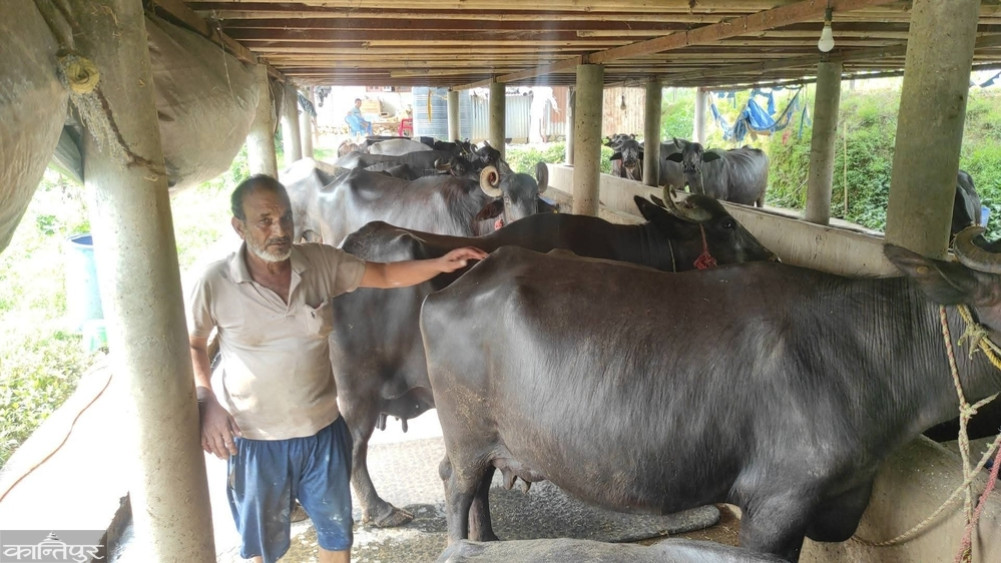
Tanka Prasad Dhungel has been earning more than 4 million rupees annually in Makawanpurgadhi by investing 20 million rupees in buffalo farming and organic fertilizer production.
We use Google Cloud Translation Services. Google requires we provide the following disclaimer relating to use of this service:
This service may contain translations powered by Google. Google disclaims all warranties related to the translations, expressed or implied, including any warranties of accuracy, reliability, and any implied warranties of merchantability, fitness for a particular purpose, and noninfringement.
Tanka Prasad Dhungel of Makranchuli, Makawanpurgadhi Rural Municipality-3, has set an example that agriculture and animal husbandry can be established as a respectable business, not a means of livelihood. He has established a successful enterprise in his village by combining buffalo farming with organic fertilizer production.
His multipurpose animal and agricultural farm, established in 2076 BS, is now known as the model buffalo farming farm in Makawanpurgadhi. The farm, which has an investment of about Rs 20 million, currently has 35 buffaloes, both small and large. Out of these, 17 dairy buffaloes are producing about 150 liters of milk daily.
The milk produced is sold through village shops, food industries and Manakamana Dairy Cooperative. He has been selling milk at a rate of Rs 110 per liter. He himself handles most of the responsibilities from production to marketing.
While most of the farmers in the village are attracted towards cattle farming, Dhungel chose buffalo farming. In his experience, buffalo farming is comparatively easier and more profitable than cow farming. His wife and one son have also fully supported him in the business. From morning to evening, family members are busy taking care of the cowshed, milking the milk and transporting it to the market. 'We have reached this point only with the support of the family and continuous hard work,' said Dhungel.
He has also run an organic fertilizer production industry using buffalo excrement. The industry, which was established with an investment of about 2 million rupees, received a grant of 600,000 rupees from the Agricultural Knowledge Center for the purchase of machinery. He raised the remaining amount from his own investment.
The organic fertilizer produced by the industry is now being sold in Makwanpurgadhi and surrounding areas. He sells the fertilizer for 500 rupees per bag, while it is also being sold retail for 20 rupees per kg from a shop in Sanopokhara, Hetauda. The farm has an annual turnover of more than 600,000 rupees, including milk and organic fertilizer. Dhungel says that after deducting all expenses, he earns more than 400,000 rupees annually.
'Around three and a half lakh rupees are saved monthly,' he said.
He complains that the biggest problem in expanding the business is the electricity supply. He says that the machine cannot be operated regularly due to the lack of sufficient voltage in the line reaching the industry. 'We have to pull a black wire from about 130 meters away and install a meter,' he said. 'If four electricity poles were added and the line was extended nearby, the industry would operate much easier.' He said that there is a plan to start producing DAP compost fertilizer if sufficient electricity is available.
According to Dhungel, farmers still have not fully understood the importance of organic fertilizer. Compared to chemical fertilizers, organic fertilizer increases the fertility of the soil, loosens the soil, and has an effect on up to two crops when used once, so there is a need to increase its use.
He claims that organic fertilizer will be very useful, especially for dragon fruit cultivation, which is expanding in the Makwanpurgadhi area. Therefore, to inform farmers about its effects, they are providing up to one sack of fertilizer free of charge to interested farmers.
He says that the local government's support is needed to make the business more organized. He believes that both production and marketing will be facilitated if the roads leading to the farm are upgraded, slab slopes are installed in the industrial area, and electricity infrastructure is improved. 'There are many problems, but I have moved forward with the belief that good things can be done even in the village,' Dhungel said. 'There is still a lot of potential in agriculture and animal husbandry for those who are ready to work hard.'