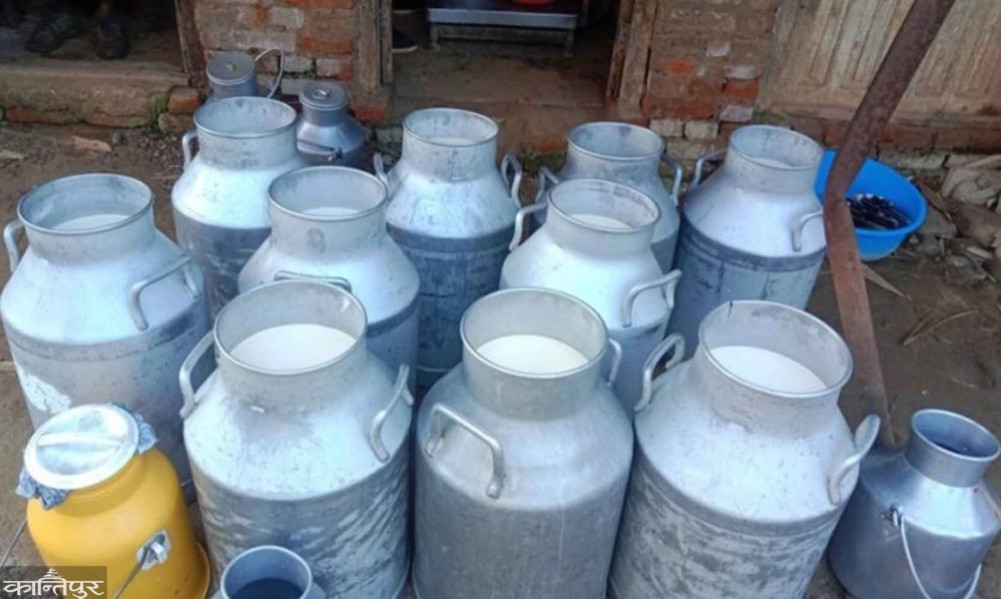
More than 1,400 dairy farmers are affiliated with six dairy cooperatives in all nine wards of Manahari Rural Municipality.
We use Google Cloud Translation Services. Google requires we provide the following disclaimer relating to use of this service:
This service may contain translations powered by Google. Google disclaims all warranties related to the translations, expressed or implied, including any warranties of accuracy, reliability, and any implied warranties of merchantability, fitness for a particular purpose, and noninfringement.
With the market guaranteeing payment along with the guarantee, dairy farmers in Manahari Rural Municipality of Makawanpur are confident. After Manahari Rural Municipality took over the responsibility of paying the farmers, who were disappointed after not receiving the money for selling milk on time, there has been enthusiasm in animal husbandry.
The municipality has started taking responsibility for the sale and payment of milk produced by farmers since last Kartik. The municipality has stated that farmers' attraction towards animal husbandry is increasing after the payment has started becoming regular.
According to the municipality, about 290 million rupees were earned from the sale of 40 lakh 44 thousand 496 liters of milk in Manahari in the 11 months of the current fiscal year (Asar-Jeshtha). Earlier, milk was being sold through the District Milk Producers Cooperative Association Makawanpur. Since the payment from the district association was delayed, Manahari Rural Municipality has made arrangements for the sale and payment of farmers' milk by signing an agreement with Hetauda Dairy Industries in Newarpani, Hetauda-19.
According to the statistics of the agriculture branch of the rural municipality, 342,606 liters of milk were sold in Shrawan, 332,163 liters in Bhadau, 336,189 liters in Asoj, 334,495 liters in Kartik, and 351,300 liters in Mangsir. Similarly, 388,824 liters in Poush, 369,829 liters in Magh, 417,149 liters in Falgun, 389,330 liters in Chait, 392,330 liters in Baisakh, and 456,899 liters in Jestha.
Milk is being collected from all nine wards of the rural municipality through six dairy cooperatives. More than 1,400 dairy farmers are affiliated with these cooperatives. In the fiscal year 2080/81, 2165,607 liters of milk were produced annually, and daily milk collection has increased from 4,600 liters to about 14,000 liters after the rural municipality ensured payment.
Rural municipality chairman Ranjan Kalakheti said that there has been a significant increase in both milk production and animal husbandry after the timely payment of milk produced by farmers was arranged. He claims that the timely payment arrangement has increased farmers' confidence in the animal husbandry business.
Pradeep Bartaula, officer of the rural municipality's livestock development branch, said that the rural municipality has been providing a subsidy of Rs 3 per liter based on production. In the current fiscal year, Rs 9.5 million has been distributed as milk production subsidy. In the upcoming fiscal year as well, GAP has made a budget arrangement for subsidies based on milk production.
According to branch officer Bartaula, an animal insurance program has also been run with 80 percent investment from the federal government and 20 percent from farmers. Similarly, Bagmati Rural Municipality of Makawanpur has also arranged to provide a subsidy of Rs. 5 per liter of milk production to encourage dairy farmers from next year.