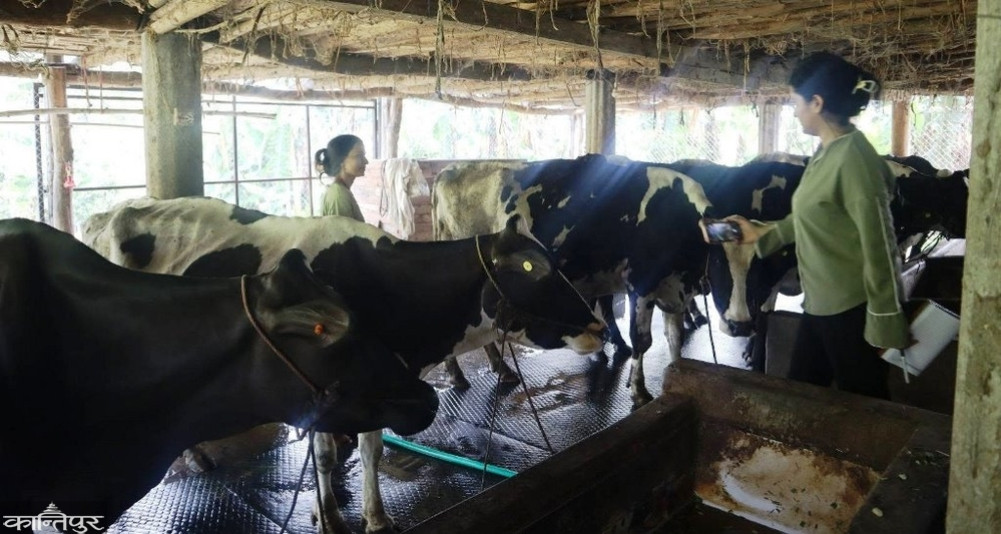
Madhusudan Dahal of Makawanpurgadhi-3, who started the business with 9 cows in 2076 BS, has now grown to 49 cows and an annual income of more than Rs. 3.5 million.
We use Google Cloud Translation Services. Google requires we provide the following disclaimer relating to use of this service:
This service may contain translations powered by Google. Google disclaims all warranties related to the translations, expressed or implied, including any warranties of accuracy, reliability, and any implied warranties of merchantability, fitness for a particular purpose, and noninfringement.
A young man from Makawanpurgadhi Rural Municipality-3, Marange, has shown an example of how success can be achieved if you work consistently with a plan in the village. At a time when the youth of the village are forced to go abroad by taking out loans for income, 36-year-old Madhusudan Dahal has succeeded in earning more than 3.5 million rupees annually by rearing cows.
The cattle breeding business that started with 9 cows in 2076 BS has now flourished and transformed into a well-managed agricultural farm with 49 cows. Through Lakshminarayan Multipurpose Agricultural Farm, he has not only produced milk, but is also establishing the farm in the production of advanced breeds of cows and calves. Currently, there are a total of 49 cows on the farm, including 24 male cows and 25 female cows. 16 cows are giving regular milk, while eight are preparing to calve.
Madhusudan prioritized quality breed development over increasing the number of cows. He emphasized on producing high-yielding heifers through artificial insemination (AI) using advanced semen. This is why 42 of the 49 cows currently on the farm were born on his own farm. ‘The number was not increased by buying cows from outside,’ said Madhusudan, ‘the farm was expanded by raising heifers born in his own barn.’
He has also been selling high-yielding heifers for the past two years. The farm has a Holstein bull brought from India. The bull is a bull with high genetic potential of American ABS. His farm has a record of producing up to 42 liters of milk per day from cows of this breed. Based on such genetic qualities, he aims to produce high-yielding cows in the future.
Some cows on his farm will give up to 32 liters of milk per day. He sells 240 liters daily to the Manakamana Dairy Cooperative Society in the village. From Shrawan to Jestha of the current fiscal year, 57,000 liters of milk have been sold from the farm.
Madhusudan, who started his business by investing about 1.1 million rupees in 2076 BS and purchasing nine cows, spent about 1.7 million rupees on building a cowshed and developing infrastructure. Since then, he has been reinvesting the income from the farm and expanding his business. His current goal is to make the farm more modern and organized. He is building a modern cowshed with a system to bathe the cows and let them enter, milk them systematically and exit from the other side. Work is also underway to build a structure to store separate stores for feed, bran and animal feed, and chaff and straw in the upper part. He plans to develop the farm as a systematic and model dairy farm.
Six people, including family members, have found employment on the farm. To become self-sufficient in animal feed, he has planted perennial grasses such as Napier, Super Napier, and Red Napier on four bighas of land. He has also cultivated seasonal grasses like Stylo, Barsim and Jai as well as maize on leased land.
He has the experience of not receiving the expected grant amount despite investing heavily in infrastructure construction after signing a grant agreement with the Bagmati Province government. Farmer Dahal says that expanding the business based on his own production and income is safer than hoping for grants.
Madhusudan, who is earning more than Rs 3.5 million annually by cutting expenses, seems completely satisfied with his cattle farming business. According to him, the biggest feature of this business is continuous income. ‘You don’t have to go abroad to earn money,’ he says. ‘You can build a good future by staying with your family and in your own village.’ According to him, success in cattle farming requires continuity, not large capital. He said, ‘If you are going to raise cows, let’s increase the quality rather than increasing the number, use good semen, and produce calves in our own barn.’