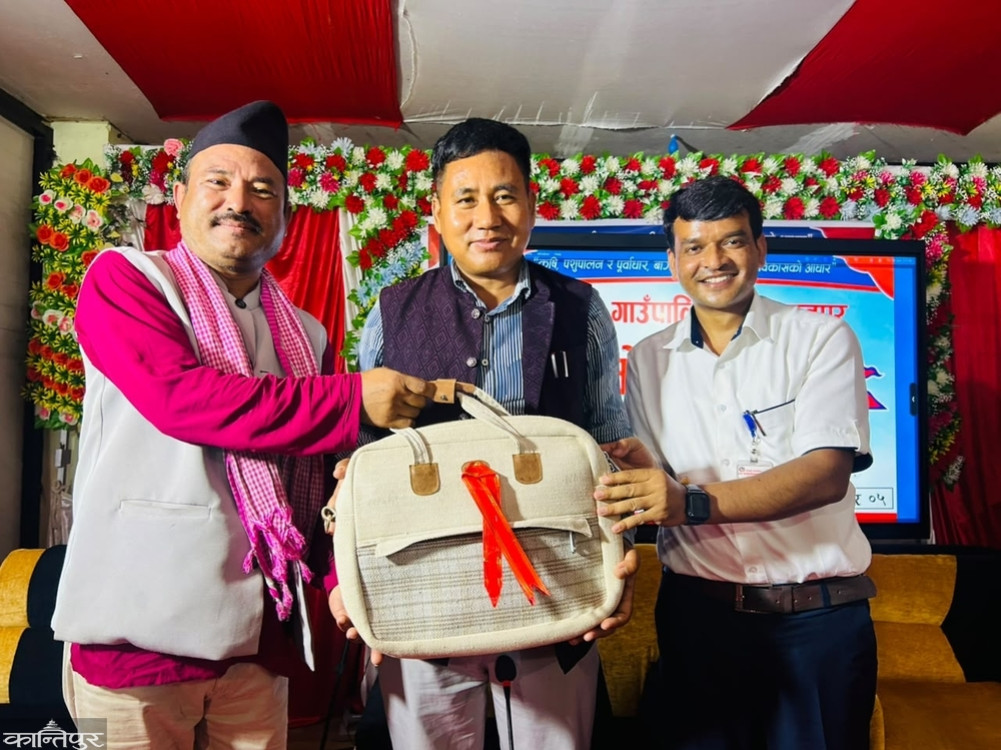
Most municipalities in the district have made their budgets public, prioritizing roads, buildings, drinking water, education, health, agriculture, and social development programs.
We use Google Cloud Translation Services. Google requires we provide the following disclaimer relating to use of this service:
This service may contain translations powered by Google. Google disclaims all warranties related to the translations, expressed or implied, including any warranties of accuracy, reliability, and any implied warranties of merchantability, fitness for a particular purpose, and noninfringement.
Hetauda Sub-metropolitan City has brought a budget of Rs 2.85 billion 5 lakh for the upcoming fiscal year. Indrasarobar Rural Municipality, which is small in terms of geography and population in the district, has already passed a budget of Rs 422 million 30 thousand. Raksirang Rural Municipality, on the other hand, could not present its budget.
Nine of the 10 local levels of Makawanpur have already made their policies, programs and budgets public for the upcoming fiscal year 2083/084. Some have also passed their budgets. The total budget of the nine municipalities that have been made public so far has reached more than Rs 8.9 billion 94 million 35 thousand. In the budget, most municipalities have prioritized roads, buildings, drinking water, infrastructure, footpaths, ward-level plans and local infrastructure construction.
Hetauda Sub-metropolitan City, Thaha Municipality, Manahari, Makawanpurgadhi, Bhimphedi, Bakaiya, Bagmati, Indrasarobar and Kailash Rural Municipality have already made the budget public for the coming year. Raksirang Rural Municipality has stated that it is preparing to hold a village assembly and present the budget by the end of Ashar.
Amid weak internal resources, dependence on federal and provincial grants, increasing pressure on current expenditure and the challenge of implementing capital expenditure, the municipalities have set development priorities for the coming year.
The largest budget made public for the coming fiscal year belongs to Hetauda Sub-metropolitan City. Being the only sub-metropolitan city and the largest local level in the district, Hetauda's budget is naturally larger than other municipalities.
Hetauda has presented a budget of Rs 2.85 billion and 5 million for the coming fiscal year. The sub-metropolitan city, which has brought a budget of Rs 50 million less than the current fiscal year, has allocated Rs 670 million 1981 thousand for infrastructure development alone. Rs 480 million 4062 thousand has been allocated for ward-level plans and programs. Road safety, bright city, CCTV installation, drinking water, integrated bus park, terminal building and urban development program, and mini zoo are among the priorities of Hetauda.
After Hetauda, Manahari Rural Municipality is ahead in terms of budget size. Manahari has brought a budget of Rs 985 million 763 thousand for the upcoming fiscal year. Infrastructure development has become the largest area in the rural municipality's budget.
Manahari has allocated Rs 349 million 1966 thousand for infrastructure development, while Rs 281 million 188 thousand has been allocated for social development. The rural municipality considers the sale of river products as its main source of income. It is estimated that 267.482 crores will be earned from the sale of seventy-two units alone.
Thaha Municipality has unanimously passed a budget of 909.744 crores. In the budget presented by Deputy Mayor Bharat Gopali, priority has been given to increasing agricultural production, construction of local roads and infrastructure, drinking water, education, health, youth and sports, environmental protection and tourism promotion. It is estimated that 558.491 crores will be received from the federal government and 126.252 crores from the provincial government.
Bakaiya Rural Municipality has proposed a budget of 895.44 crores. In the budget presented by Vice-Chairman Bhakta Bahadur Khatri, health, education, agriculture, tourism and environment-friendly infrastructure have been considered as the basis for building a prosperous Bakaiya. Out of the total budget, 631.119 crores have been proposed for current expenditure and 253.725 crores have been proposed for capital expenditure. 93.75 million has been allocated for infrastructure development and 39.67 million for economic development.
Bhimphedi Rural Municipality is next in the budget size. Bhimphedi has made public a budget of 831.62 million. The rural municipality has prioritized tourism, agriculture, infrastructure, education, health and good governance. The budget includes plans to develop the Latarmeshwor Mahadev Temple area as a tourist destination, build a trekking route from Hawabhanjyang to Latarmeshwor, upgrade the Kogate-Dharke-Mahabhir-Phaplad road and continue the millet cultivation incentive program. According to Chief Administrative Officer Chetnath Neupane, the budget is based on federal and state grants, revenue sharing, royalty, vehicle tax and internal resources.
Bagmati Rural Municipality has brought a budget of 732 million rupees. In the budget presented by Vice President Phanindra Timalsina, education, youth and sports, health, infrastructure and agriculture sectors have been prioritized. Rs 161.9 million has been allocated for infrastructure development. Rs 50 million has been allocated for the operation and management of the Bagmati Football Academy and Rs 40 million for the National Bagmati Gold Cup. Rs 10 million has been allocated to provide a maximum subsidy of Rs 5 per liter on milk produced by farmers.
Makawanpurgadhi Rural Municipality has brought a budget comparable to Bagmati. Makawanpurgadhi has presented a budget of Rs 727.523,120. The rural municipality has put forward agriculture, education, health, tourism, infrastructure, good governance and environmental balance as the seven pillars of development. The highest amount of Rs 321.78120 has been allocated in the social development sector. 233 million has been allocated for infrastructure development, 545 million 10 thousand for economic development and 102 million 25 million for office operations and administrative expenses.
Kailash Rural Municipality, which has a remote geography, has brought a budget of 558 million 469 thousand. In the policy program presented by Rural Municipality Chairman Lok Bahadur Muktan, priority has been given to women, children, senior citizens, youth-targeted programs, girl child promotion, one house one tap, complete sanitation, indigenous crop protection, health service expansion and infrastructure development. Rural Municipality Chairman Lok Bahadur Muktan said that the girl child promotion program has been continued, emphasizing the reduction of child marriage and adolescent education.
The smallest size of the public budget belongs to Indrasarovar Rural Municipality. Indrasarovar has presented a budget of 422 million 30 thousand rupees. In the budget presented by Vice Chairman Uma Lama, tourism, agriculture, infrastructure and good governance have been given the main priority. Rural Municipality Chairman Devkrishna Pudasaini said that tourism has been made the basis of economic development by focusing on the Kulekhani reservoir. Programs for promoting homestays, building tourist trails, promoting off-season vegetables and fisheries, and establishing cold storage and collection centers have been included in the budget.
Among the 10 municipalities in Makawanpur, only Raksirang Rural Municipality is yet to bring the budget for the upcoming fiscal year. Chairman Rajkumar Malla said that the rural municipality is preparing to hold a village assembly by the end of Asad. According to him, the size of the budget has not been finalized. But it is estimated that the budget will be around Rs 500 million. He informed that budget preparation is challenging as internal resources are weak and grants from the federal and provincial governments are also decreasing.
According to Malla, Raksirang is preparing to prioritize education, health, and human development programs in the upcoming budget over large infrastructure projects. He said that although the development budget may be weak, there is no intention to reduce the budget for education and health. He said that since the plans for the current fiscal year are still in the implementation phase, more plans are expected to be completed by the end of the year.
Overall, the budget of the municipalities of Makawanpur still focuses on infrastructure as the development priority at the local level. A large amount has been allocated for roads, buildings, drinking water, urban infrastructure, hiking trails, sports infrastructure and administrative structures. However, the budget has also made an effort to advance education, health, agriculture, tourism, sports and social inclusion. Stakeholders say that the municipalities, which are facing the challenge of weak internal resources, dependence on grants and spending the capital budget on time, are in a position to face the same challenge in the coming fiscal year.