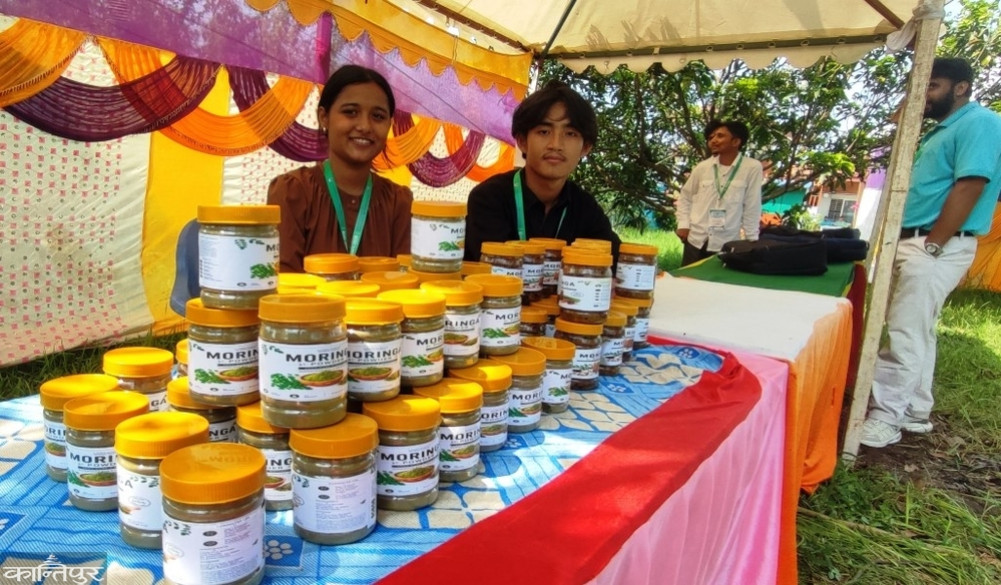
Thirteen groups from the University of Agriculture and Forestry have taken loans and started business projects such as potato chips, fish, plants, and pickle production.
We use Google Cloud Translation Services. Google requires we provide the following disclaimer relating to use of this service:
This service may contain translations powered by Google. Google disclaims all warranties related to the translations, expressed or implied, including any warranties of accuracy, reliability, and any implied warranties of merchantability, fitness for a particular purpose, and noninfringement.
Anand Kumar Yadav from Saptari is a final-session student of the Natural Resources Management College, Madichaur, a constituent campus of the University of Agriculture and Forestry. Yadav and four friends are currently preparing potato chips in Rolpa and bringing them to the market.
Yadav and his friends Himalta Budhamagar, Shailesh Singh, and Purnamaya Chaudhary have been provided interest-free money by the university to start such a project. ‘We had received Rs 150,000 from the university on the condition of repayment. We started this project a year ago. We have already returned the interest-free money,’ said Anand Kumar.
The potato chips they prepared are not ready-made. They can be bought and taken home and fried in oil. The packet also contains spices along with the chips. ‘When were the chips that can be eaten directly prepared? What kind of oil were they cooked in? It may be a dharma . It seems that such chips are not healthy . That is why we made a packet of healthy chips in a way that you can take them home and eat them,’ he said .
The chips they prepared are sold locally. Teachers and students of various colleges affiliated to the University of Agriculture and Forestry buy them as snacks when they visit. That is why they are excited, Yadav said.
Ashish Shrestha is a postgraduate student in the Faculty of Fisheries. ‘We have started a company called Matsya Bheda . Nepali consumers are now becoming aware and conscious of the source of vegetables and fish they eat ? How clean and healthy it is . We created this company by bringing good products from farmers and giving them to consumers,’ Shrestha said .
They are now starting work with fish . Fish contains nutrients useful for the body. ‘But where did you get that fish from? How was it kept?’ It also makes sense. We are committed to delivering fish to customers in a healthy way. Fish should be kept in a cool place. It should be delivered to customers cold. This is called maintaining the cold chain. We maintain it,’ said Shrestha. The university has confirmed that their group will be given a grant of Rs 400,000.
Nawaraj Dawadi is studying for a master’s degree in horticulture at the Faculty of Agriculture. Their group is going to create a nursery of various valuable plants used for decoration by using tissue culture. For this, they have also received a grant from the university. Muskan Bista is a student of Bardibas College. Their group makes pounder fruit pickles from sheetal sugar leaves. ‘We have used no chemicals in this pickle, but only household methods. We have made it healthy,' said Bista.
Subha Rai, a group of students from Dhankuta Parkhibas College, prepares 'Purveli Dhule Achar' and takes it to the market. Dhule Achar is made by using silam, sesame seeds, and filunge found in the village. Although it is sweet, it is customary to eat it only during Dashain in the villages. Subha said that she is trying to make it commercial. 'Silam and sesame seeds are nutritious. We have taken up this business because we believe that local products are good for both the consumer and the seller,' she said.
Thirteen groups of students from the University of Agriculture and Forestry have started this business. The Directorate of Research and Extension (DOREX) of the University of Agriculture and Forestry has run the University Business Incubation Center. DOREX has been selecting various schemes that have come there and providing grants to suitable schemes. Dorex Director Ujjwal Tiwari said that this project has come up with the aim of making the students who are studying entrepreneurial.
For this, the university provides interest subsidy of up to Rs 5 lakh. In this program, which started a year ago, 13 groups, seven in the first phase and six in the second phase, have taken money from the university as seed capital for investment. For this, students have to form groups of three to five people with at least one woman.
Tiwari said that they will invest in new thinking and style business plans by looking at the market potential. He said that it will take about three months to select the plan. The amount taken should be returned within one and a half to three years. Tiwari said that this plan has been introduced to focus on creating employment for students.