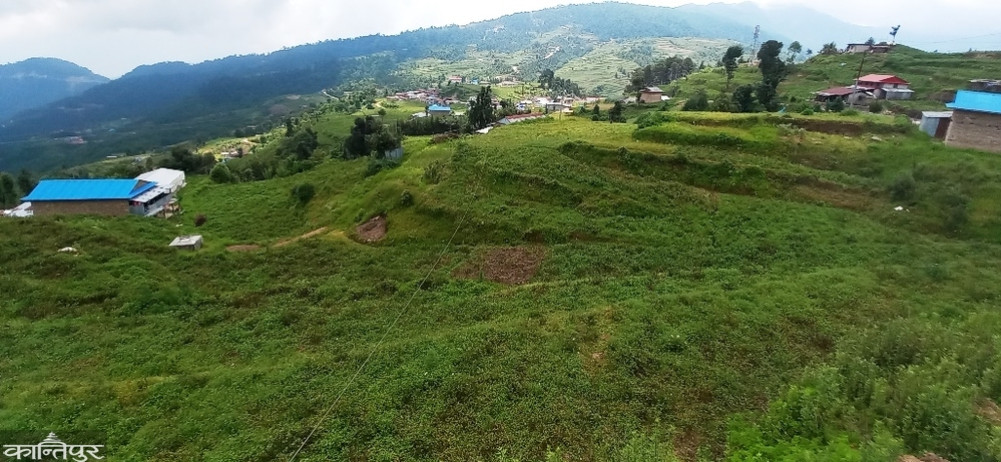
Technicians estimate that potato production will decrease by 40-50 percent this year in the mountainous regions of Dolakha, Sindhupalchowk, and Ramechhap due to continuous rains, sudden temperature increases, and late blight disease.
We use Google Cloud Translation Services. Google requires we provide the following disclaimer relating to use of this service:
This service may contain translations powered by Google. Google disclaims all warranties related to the translations, expressed or implied, including any warranties of accuracy, reliability, and any implied warranties of merchantability, fitness for a particular purpose, and noninfringement.
Padamkumari Shrestha of Shailung Rural Municipality-6 is worried after the potatoes planted in her garden started drying up instead of blooming. Her main source of income is potatoes. This year, her young potato plants have died due to the change in the seasonal cycle.
Potatoes, planted in the months of Poush-Magh and dug in the rainy season, are the main cash crop of farmers in the Lekali region of the district. But this year, farmers who cultivate potatoes across the district are worried. There was no snow during planting. Hail destroyed the seedlings when they were growing. The potatoes that had barely sprouted died when they were about to sprout. Shrestha said that the scorching heat throughout the day and the continuous rain after sunset prevented the potatoes from growing.
She sold potatoes worth Rs 4 lakh last year and is hoping to barely make half of that this year. ‘The hail didn’t cause much damage to the potatoes,’ she said, ‘but when the rain stopped, the plants started dying, and it was not clear what disease they were suffering from.’ She said she was worried that she wouldn’t be able to cover the cost of planting the potatoes. She said, ‘The plants are drying up in everyone’s fields, and the seeds are also small.’ She said she was worried that the potatoes wouldn’t be sold because the seeds are also small. ‘The cost of planting the potatoes would have been covered,’ she said, ‘but it seems that the cost of planting them hasn’t been covered, and the seeds are also small.’
Potatoes planted in winter in the 3,700 hectares of mountainous and high-mountainous areas of the district will start being dug from the first week of Asar. Potato farming is the main source of income for farmers in the upper reaches of all nine local levels of the district. Balkumari Shrestha, 77, of Shailung-6, said she had never seen potato plants dry up like this during flowering.
Potato cultivation has been going on in 750 hectares of Shailung. Last year, 38,000 metric tons of potatoes were exported from Shailung, generating a turnover equivalent to 40 barodas. According to the Agricultural Knowledge Center Ramechhap, 85,000 metric tons of potatoes were produced and exported from all local levels of the district.
Last year, farmers across the district sold potatoes worth Rs 820 million. This year, the monsoon cycle has affected potato farming. Farmers expect that continuous rain since Falguna and hailstorms during the growing season will reduce potato farming across the district.
According to a study conducted by Rajan Dhamania, Crop Protection Officer of the country's only Potato Development Center in the district, continuous rain has affected potato cultivation. 'The main reason for the damage to the potato cultivation planted by farmers this year is continuous rain and high temperature,' he said. 'Due to the mismatch between rain and temperature, the disease of scab has appeared widely in potato cultivation.' He said that the scab will kill the plants and reduce production.
He said that the scab outbreak is expected to reduce potato production by 40 to 50 percent in the Himalayan and high hilly areas. 'It is not a problem with the potato seeds or soil planted by farmers,' he said. 'This year, it is due to the monsoon cycle, due to which scab has spread in the potato crop, which has led to a significant drop in production.'
He said that the center has recommended farmers in the Himalayan and high-hill areas to plant 10 varieties of potatoes, including Rosita, Khumal-4 Cardial. He said that this disease has also appeared in potatoes planted in 150 ropanis by the center. ‘Although pesticides should be used to treat scab, farmers in the Himalayan and high-hill areas do not use pesticides on potatoes,’ he said. ‘Even though we try to protect the potatoes planted at the center by using a small amount of pesticides, it is seen that the production will decrease by 20 percent.’
Last year, 1.56 million metric tons of potatoes were produced in the Himalayan and high-hill areas across the country. But this year, potato production is projected to decrease by 40 to 50 percent in Dolakha, Sindhupalchowk and Ramechhap, he said. He said that although the hailstorm that hit the potato seedlings did not cause much damage, the continuous rain damaged the potatoes. He said that due to hailstorm, the plants dry up and die in the field and even the saved plants bear fruit, only small seeds.