A struggle was waged against 'Sahu Mahajan' led by indigenous Chepangs in Jugedi, Chitwan, under the leadership of Ruplal Bishwakarma. The government has declared two Chepangs who were killed in police action during the struggle on Asad 2034 as martyrs.
We use Google Cloud Translation Services. Google requires we provide the following disclaimer relating to use of this service:
This service may contain translations powered by Google. Google disclaims all warranties related to the translations, expressed or implied, including any warranties of accuracy, reliability, and any implied warranties of merchantability, fitness for a particular purpose, and noninfringement.
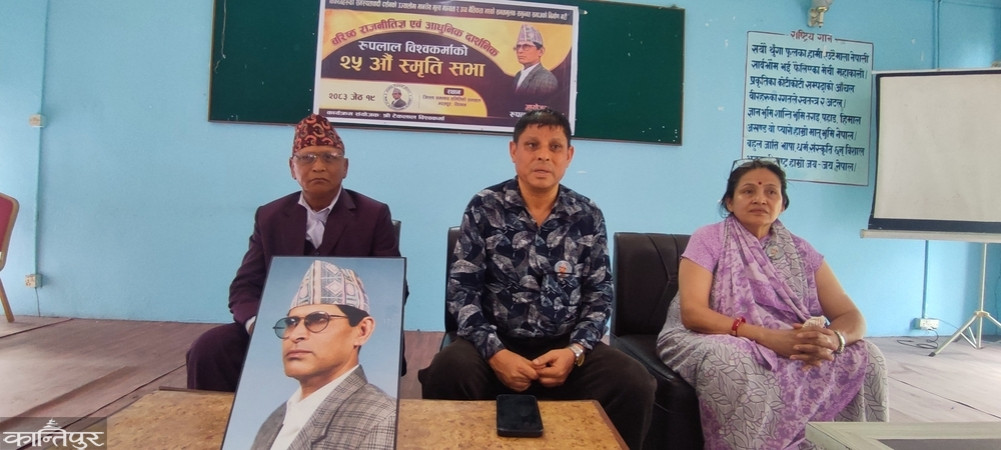
A program was held in Bharatpur on Tuesday in memory of the old political figure Ruplal Bishwakarma. Although active in leftist politics, Bishwakarma had recently embraced different views. Bishwakarma passed away on 19 Jestha 2058, the day the Rajdurbar massacre took place. Ruplal, who started his political career from Chitwan and rose to the central leadership, is known as a leader who mobilized the locals to take the lead in local issues. At a program organized by the Ruplal Bishwakarma Foundation, Tulak Bishwakarma narrated Ruplal's biography. Ruplal, who was born in Parbat on 10 Baisakh 1997, migrated to Chitwan in 2016. He joined the Communist Party in Chitwan in 2018. Ruplal had given Pushpa Kamal Dahal the Communist Party membership in 2028 when he was a member of the Communist faction of the Pushpalal group.
Under the leadership of Ruplal, there was a struggle against 'Sahu Mahajan' led by indigenous Chepangs in Chitwan Jugedi. The government has declared two Chepangs who were killed in police action in the struggle on Asar 2034 as martyrs. After Jugedi, Ruplal also fought a political struggle in Jutpani of Chitwan.
Ruplal's party, the Proletarian Workers' Organization, had decided to wage an armed struggle to bring a communist regime 'New Democratic System' in the country and prepare an army for the struggle. To raise financial resources for that, in mid-Asar 2041, he took control of the security personnel and employees of a bank in Gulmi's Purtighat and seized the cash and jewelry there. Which Ruplal's followers call the 'Purtighat Money Action'. This 'action' had shaken national politics.
In 2047 BS, leaders including Pushpa Kamal Dahal, Nirmal Lama, Ruplal Bishwakarma and others unified the various communist parties under their leadership. The name of which was CPN (Unity Center). Later, this party also split and Pushpa Kamal Dahal formed the NCP (Maoist).
Ruplal also did not stay in the Unity Center. Nor did he go with Dahal. On Jestha 15, 2053 BS, he announced his separation from the Unity Center. 'He disagreed with the Leninist organizational system adopted by the communists. He said that the principle that the minority party is subordinate to the majority in the party is not right,' said Amar Bishwakarma, chairman of the Ruplal Bishwakarma Foundation. He said that Ruplal had proposed the idea of 'the similarity of opposites'. Amar Bishwakarma has been involved in Ruplal's political campaign since 2033 BS and is still active in promoting Ruplal's ideas and contributions.
'There is unity among opposing ideas according to necessity and separation when there is no necessity.' This is his philosophy, said Amar. The chief guest of the Kamaryakram, chaired by the late Ruplal's brother Teklal Bishwakarma, was Ruplal's old political colleague Gopinath Bishwakarma of Madi.