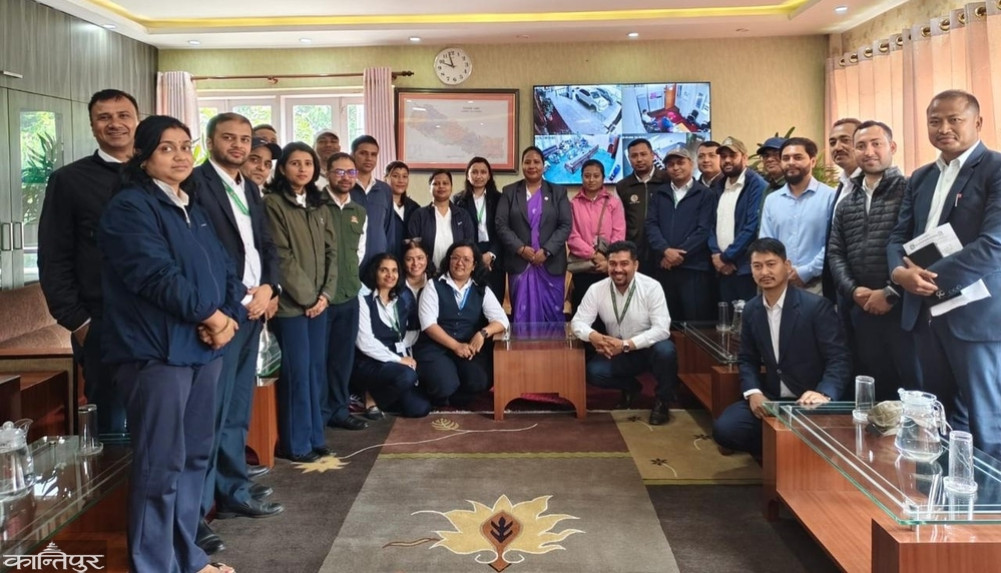
A six-point memorandum was submitted to the Forest Minister.
We use Google Cloud Translation Services. Google requires we provide the following disclaimer relating to use of this service:
This service may contain translations powered by Google. Google disclaims all warranties related to the translations, expressed or implied, including any warranties of accuracy, reliability, and any implied warranties of merchantability, fitness for a particular purpose, and noninfringement.
Employees working in the Nepal Forest Service, National Park Group and Elephant Group under the Department of National Parks and Wildlife Conservation have demanded that those who work at risk be provided with appropriate service facilities. They have put forward this demand by submitting a six-point memorandum to Minister for Agriculture, Forest and Environment Geeta Chaudhary recently.
They have demanded legal recognition of special services, provision of compensatory leave, fair arrangements for additional risk allowance and posts and promotions, provision of facilities for pregnant and postpartum employees, and adjustment of ration and local allowances. They claim that 40 people from the park and 35 from Elephant Group have died in the course of conservation so far.
‘Despite performing sensitive and high-risk work, employees working in this service have not been able to receive service facilities, security and incentives like employees of other services,’ the memorandum states. Pregnant and postpartum female employees are working at risk to their own health and safety and that of their newborns, the employees say.
Employees working in protected areas are actively involved in day and night patrols, special operations related to poaching control, wildlife monitoring, rescue and management, disaster and emergency rescue. They say that they should be deployed in the management of tourism activities and in risky and special services around the clock.
‘Therefore, this group should be included in the draft amendment to the Civil Service Act and Regulations to clearly include it under special services,’ is the first demand of the employees.
Their second demand is that employees in protected areas should be provided with clear arrangements for compensatory leave as per the prevailing legal provisions when working on public holidays, weekly holidays and major festivals. Similarly, they have demanded a clear provision for additional risk allowance or special incentive allowance up to 100 percent of the basic salary in the Civil Service Act.
While timely and fair promotion arrangements are necessary for the mental health, career development, work motivation and enhancement of institutional efficiency of employees, they have also demanded a change in the situation where it takes an extremely long time, about 17-18 years, to be promoted from senior game scout to ranger, from ranger to officer, and from officer to deputy secretary.
Considering the geographical conditions and nature of work in the conservation area, they have also demanded that a provision be included in the Civil Service Bill to provide at least 6 months of leave with full pay to pregnant and postpartum employees. They demand that the provision that provides only 50 percent of the local allowance to employees receiving ration allowance be revised and a legal provision be made to provide 100 percent local allowance to employees working in protected areas while maintaining the currently prevailing ration allowance.