Ayushma Chepang, who passed grade 5 in Kamalpur, Chitwan, was forced to repeat the grade to bring her siblings to school. This time, she has been admitted to grade 5 again.
We use Google Cloud Translation Services. Google requires we provide the following disclaimer relating to use of this service:
This service may contain translations powered by Google. Google disclaims all warranties related to the translations, expressed or implied, including any warranties of accuracy, reliability, and any implied warranties of merchantability, fitness for a particular purpose, and noninfringement.
After passing the lower class, one can study in the higher class. But Ayushma Chepang, who passed the 5th class, is studying in the same class again. Ayushma, including four students, is studying in class 5 at the National Basic School in Kamalpur, a hilly village in Bharatpur Metropolitan City-29, Chitwan.
Even though Ayushma passed the 5th class in the last exam, she has to repeat the class to study in the same class. She was forced to repeat the class for the education of her brothers Ayun and Ayush Chepang. 'There were four students in class 5 in the last academic session. Even though all of them passed, Ayushma has the responsibility of taking care of her younger brothers and bringing them to school to study,' said the school's principal, Badri Prasad Poudel.
Ayushma's mother got married elsewhere. Her father is also not at home. Their house is in a village called Duighare, which is a little further from the school. There is also an elderly grandmother at home. ‘Ayushma has been taking care of her brothers since she was little. She has also cooked and fed them since she was a child. Now her younger brother Ayun is studying in the Early Childhood Development (ECD) class and another Ayush is studying in class 1. Without her, these two children would hardly have come to school,’ said Principal Poudel.
It is difficult for young children to travel to and from school on their own due to the steep slopes on the way and the steep slopes on the way. The distance between school and home is about an hour. Ayushma travels with her brothers. Last year, she used to bring her brother Ayush. This time, Ayush was also added. Three other students who passed class 5 last year have started studying sitting on the same bench. Ayushma did not even have the opportunity to study sitting on the bench. She did not have any parents or relatives there.
There is a school in Chowkidanda, a little further from the village, that offers classes up to grade 10. But to get there, you have to walk for about two hours through the forest. ‘Since I don’t have any friends from the village who go there, it was not possible to send Ayushma to Chowkidanda,’ said Principal Poudel. Ayushma, who was about to drop out after completing grade 5, was re-admitted to the school. Due to this, it has become easier for her younger siblings to come to school. ‘Since they have to walk uphill from far away, we also provide breakfast here.’ Ayushma takes care of everything else for them,’ said Principal Poudel.
Ayushma’s grandmother, Phulmati Chepang, said that when her youngest grandson, Ayun, was 15 months old, her daughter-in-law left her and married someone else. ‘Indra Bahadur is my youngest son. Ayushma, Ayun and Ayush are his daughters. The daughter-in-law has gone. The son also does not live at home. He lives in Narayangadh,' said Phoolmati.
66-year-old Phoolmati has been taking care of these three grandchildren at home. She said that her son got remarried in Narayangadh and comes home once or twice a year. 'He rarely comes home. It's not that he doesn't look after his children. Sometimes he sends rice. Both the grandchildren are young. Ayushma also repeated the fifth grade for her brothers. Otherwise, he would have studied in the sixth grade,' said Phoolmati.
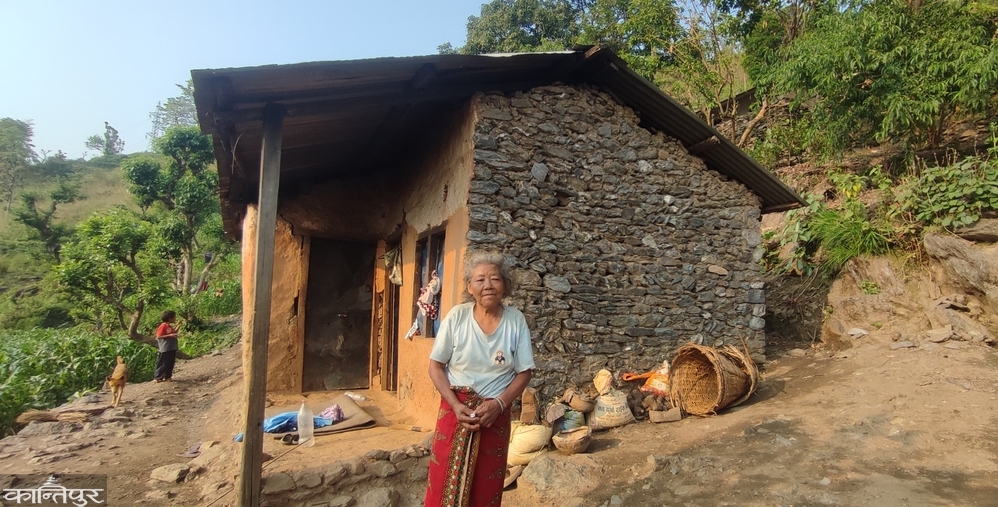
Ayushma's aunt Indra Kumari Chepang said that she sometimes comes and takes care of them. The mother abandoned her youngest son Ayun when he was 15 months old. Ayun turned 4 in April. 'My brothers don't want to come to school without my sister. That's why I enrolled him again in 5th grade. We have to find a room downstairs to keep him for 6th grade. It's difficult to keep him that way. My father also takes more care of him because he has another wife. I see it will be difficult to send Ayushma to the upper grades,' said Aunt Indra Kumari. Ayushma said that she wanted to study in the upper grades but could not.
School in Saksa too
Kamalpur's school was established in 2028 BS. The school, which offers education up to grade 5, currently has a total of 18 students. Of these, 8 are from the Gurung community. 7 children from the indigenous Chepang community, which is a highly marginalized group, study. Three are from the Dalit community. As the number of students is decreasing, the old school in this area is in a dilemma to save its existence. Why not merge the school with the metropolitan city? The question has been asked.
Kamalpur is a hilly village within the metropolis. After going 17 kilometers from the Narayangadh-Muglin road, you have to climb uphill to reach Kamalpur. The road that can be ridden by motor vehicles has just been built. The village is narrow. Therefore, regular vehicles do not ply. Other small vehicles cannot ply easily. Motorcycles, Boleros and autorickshaws rarely reach the village. There is a Gurung settlement near the school. Chepang families are scattered a little below. Dalit communities also live near the school. 'The new generation of Gurungs are mostly not in the village. They do small business and do whatever they can.' They are staying in Bharatpur or Jugedi. They take their children there and educate them. That is why there are very few school-age children in the village,' said Professor Poudel.
A school that once had a capacity of 100 students now has difficulty admitting even 20 students. There are no other schools nearby. They have to walk uphill and downhill for at least 2 hours to reach Ratmate or Chowkidanda. Only those who have no other means of earning a living have stayed in the village. Professor Poudel said that the question of what will happen to their children if the school is closed will arise. He said, 'There are at least 20/22 children in the village. If there is no school here, how will they go to school after walking for two and a half hours? How long will the school run even with so few children? The situation is serious. We are working hard to ensure that parents who have gone down to this school and have been educated well will also return with their children.’

