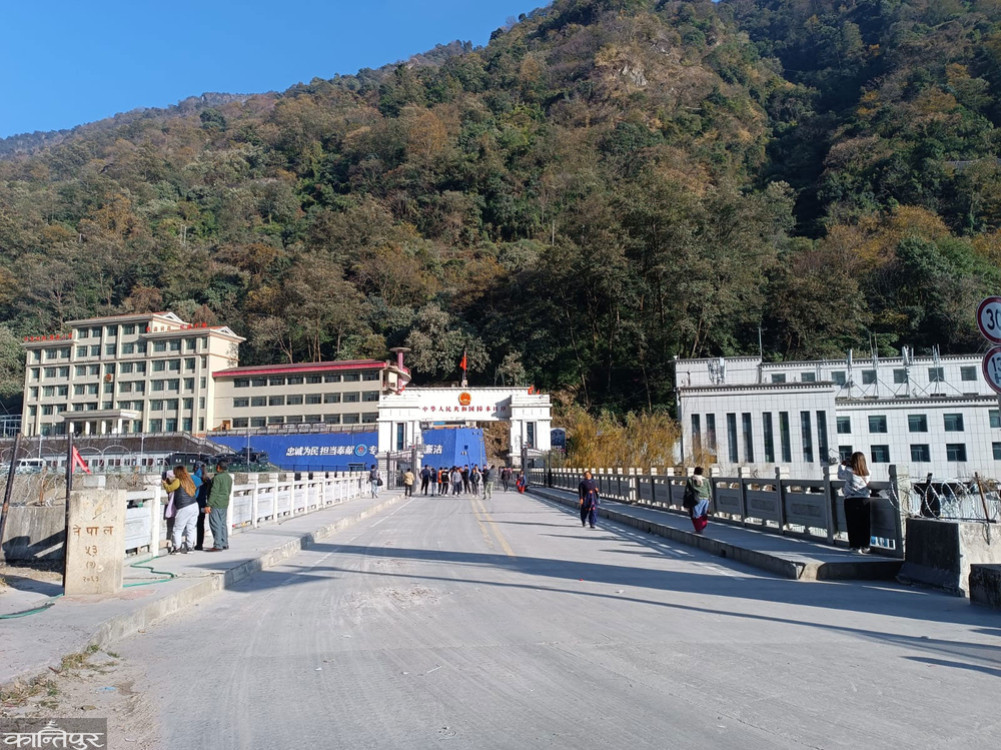
The hustle and bustle of locals who used to reach the Chinese market, Jhamu Bazaar, early in the morning and return in the evening with bags full of goods has suddenly come to a halt with the implementation of new government rules.
We use Google Cloud Translation Services. Google requires we provide the following disclaimer relating to use of this service:
This service may contain translations powered by Google. Google disclaims all warranties related to the translations, expressed or implied, including any warranties of accuracy, reliability, and any implied warranties of merchantability, fitness for a particular purpose, and noninfringement.
The Tatopani border crossing on the Nepal-China border has become unusually deserted. The hustle and bustle of locals who used to reach the Chinese market Jhamu Bazaar early in the morning and return in the evening with their bags full of goods has suddenly stopped with the implementation of the new government rules.
The Tatopani Customs Office has stopped bringing food and plant quarantine materials from the passenger branch in Miteripul, bringing to a standstill the bag-poke trade in the border area. Hundreds of families in Bhotekoshi Rural Municipality and the surrounding areas have been directly affected by this. Kumar Shrestha, ward chairman of Bhotekoshi Rural Municipality-2, said that the new system has put the daily lives of the locals in danger. ‘Many families in the border area depended on this small business. Now they are almost jobless,’ he said.
Earlier, locals from areas like Tatopani, Listikot, Phulpikajhi Marmi and others used to go to the Chinese market in Jhamu daily to sell food, household and electronic goods. Locals say that they have been paying for household expenses, children's education and managing loans with that income. Shanta Shrestha, who is involved in the jholepoke business, complained that the government has blocked the livelihood of the poor community. 'We are not industrialists, we are people who run their homes by selling the goods we carry all day,' she said.
According to locals, for the last one month, practically no food items have been allowed to be brought from the passenger branch. This has also affected small shops and workers across the border. Many retail shops in Jhamu, which rely on Nepali customers, have become deserted, while Nepali workers working there have started returning to their villages. Local Sete Shrestha said that due to the geographical difficulties of the Bhotekoshi region, the possibility of alternative employment is low. ‘There is no cultivable land here, no industry. Small trade across the border was the main source of income,’ he said. Bhotekoshi Chamber of Commerce President Funu Sherpa said that despite discussions at various levels to resolve the problem, no solution has been found. ‘The locals, who were hoping for a big opening, are now under additional stress as they are not able to bring even basic household goods,’ he said.
The Tatopani border crossing has been repeatedly affected by incidents such as earthquakes, floods, landslides, COVID-19 and fires in the past. A few months ago, the border crossing was also affected due to a fire on the Chinese side. Tul Bahadur Pandey, Information Officer at the Tatopani Dry Port and Customs Office, clarified that food items without quarantine permits have been stopped as per the government’s new arrangement.
According to him, there is a provision that commercial firms registered with VAT can import goods only after completing the necessary procedures. ‘Quarantine has been made mandatory for food items. Currently, no goods are being released without customs clearance,’ he said. Before the new rule was implemented, it was customary to bring goods worth Rs 5,000 through customs.’ After the new government was formed, traders have complained that they were not allowed to bring any goods through the border.