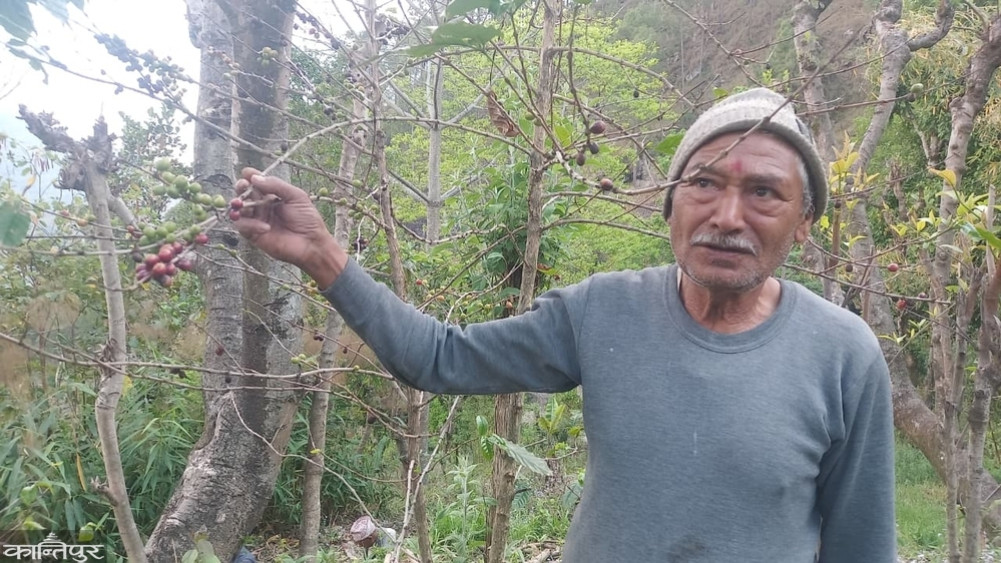
Commercial coffee farming has been expanded by planting 1,700 seedlings in Katike, Bhimeshwor Municipality-5, in collaboration with farmers, cooperatives, and the local government.
We use Google Cloud Translation Services. Google requires we provide the following disclaimer relating to use of this service:
This service may contain translations powered by Google. Google disclaims all warranties related to the translations, expressed or implied, including any warranties of accuracy, reliability, and any implied warranties of merchantability, fitness for a particular purpose, and noninfringement.
45 years ago, the current Bhimeshwor Municipality-Kirantichap under the then Mati VDC was famous as the commercial center of the district. Ramsharan Budhathoki of the current Bhimeshwor Municipality-5 Katike used to teach in the same business and in the nearby school.
At that time, a horticulture center was operating in Kirantichap. The Swiss government had brought the horticulture center into operation to develop the cultivation of fruits according to geography, including mango and litchi. Ramsharan had brought a coffee plant that he had received as a gift from the same firm to his home. But he was not aware of the gift plant. The coffee plant of the 'Arebica' variety brought at that time is still in his garden. The coffee produced from the same plant has reached 40 plants around his house. But he had not paid attention to the matter of coffee farming.
He said that he had planted coffee only for fun because he had no knowledge or market for commercial cultivation. ‘I don’t know how to use the coffee grown in my own garden yet,’ he said, ‘how can I do this cultivation commercially?’ He said that he had been told that it was given to him by a foreigner. ‘I had only heard about coffee, but I had not seen it growing,’ he said. ‘I didn’t care much when the red beans grew on the plant, but later I realized that it was coffee.’ After 4 decades of planting coffee, Katike is being expanded as a pocket area for coffee cultivation.
After seeing that the soil and weather are favorable for coffee, our Jankalyan Savings and Loan Cooperative has purchased 1,700 plants from 13 farmers in the area and allowed them to plant them commercially. There are currently 40 coffee plants in Ramsharan’s garden. An additional 100 new plants are growing in his garden. The cooperative has linked up with the local government to expand coffee farming in Katike. The investment from the local government has formally entered the village as a coffee pocket area. He said that since the soil and weather are favorable for coffee, they started commercial coffee farming 45 years after planting.
Currently, farmers in the area have also formed the Kiranteshwor Organic Coffee Farmers Group to expand coffee farming. The group currently has 30 farmers. He said that 13 of these farmers are commercial coffee farmers. The cooperative manager Deepak Basnet said that the farmers of Katike, who are currently cultivating coffee on 15 ropanis, plan to expand coffee to 50 ropanis. He said that all members of the group will be involved in coffee farming. He said that 7,000 coffee plants will be planted in Katike alone. He said that they are involved commercially because the coffee market has increased. He said that the coffee they produce has not reached the market so far.
Bhimeshwor Municipality has invested 50 percent, or 2 million, in collaboration with the locals to develop Katike as a coffee pocket area and has invested 1 million. The remaining 1 million will be borne by local farmers. Which is for planting irrigation. Manager Basnet said that the cooperative will invest in coffee marketing and tools. 'The main objective of the cooperative is to provide coffee farmers with concessional loans for processing machines, marketing, etc.,' he said, 'We are working as a bridge between farmers and the local government so that farmers can earn income from coffee farming.' He said that once farmers increase production, investment will be made in coffee processing technology. After that, he said that they will also help in marketing the farmers.