In Chitwan, locals are converting government forests, whose status has deteriorated due to various reasons, into concession forests and generating income by selling everything from grass to firewood, fruits, and even timber.
We use Google Cloud Translation Services. Google requires we provide the following disclaimer relating to use of this service:
This service may contain translations powered by Google. Google disclaims all warranties related to the translations, expressed or implied, including any warranties of accuracy, reliability, and any implied warranties of merchantability, fitness for a particular purpose, and noninfringement.
The hill near the house of Larimaya Gurung of Gairibari, Kalika Municipality-8, is covered in greenery. The hill, which looked deserted 25 years ago, has been transformed with the help of Larimaya and her neighbors and government agencies.
After the hill became deserted, 12 locals decided to save the forest. There is a government rule that allows government forests near settlements that are becoming deserted due to various reasons to be made into concessions. The locals took charge of the forest.
Locals can also plant, grow and sell fruits and other crops in concession forests to earn income. ‘We used to cut the grass that grew here and sell the bamboo that we planted. This time, we earned 756,000 rupees from the sale of Sal wood alone,’ said 60-year-old Larimaya. They were given the responsibility of the concession forest for 40 years in 2057 BS. This year, they have earned income by selling sal wood for the first time. Bishnu Prasad Acharya, Divisional Forest Officer (DFO) of the Divisional Forest Office, Bharatpur, said that the locals can be given the responsibility to protect the deteriorating government forest area near the residential area by converting it into a concession forest.
The name of the concession forest group in Gaeribari is Chuwad Tandi. They made an area of 5.19 hectares green. There were some sal trees here even before the locals converted it into a concession forest. Larimaya said that when the then Maoist army built temporary barracks in Shaktikhor after the peace agreement in 2063 BS, 40/42 green trees from the forest were cut down. 'We tried to stop them by hugging the trees so that they would not take our forest.' They didn't even listen to us about the forest that we had just saved by becoming shepherds,' she said. At that time, the locals said that they had reached the District Forest Office and the Ministry of Forests, but nothing was heard.
She still hasn't forgotten the pain of having to watch others forcibly cut down and take away the green trees from the forest they had saved. 'Others cut down the green trees.' But the locals were not allowed to use the fallen/dry trees of the concession forest either. After the community took charge, they were allowed to use the grass, bamboo and other plants planted. The original rule of the concession forest was that old trees should not be used,' said DFO Acharya.
In 2079, the regulations were changed and a provision was added to allow the removal of large, dry/fallen trees of the concession forest. He said that although the regulation has been added to the regulations to include 50 percent of the income generated from auctioning the collected timber and 50 percent for the bonded forest group, it has not been implemented. DFO Acharya said that after receiving complaints that fallen/dry wood in the forest rotted and burned but could not be sold, the wood was collected and auctioned as per the provisions in the regulations. According to Usha Kunwar, the division supervisor of bonded forest, there are 443 bonded forest groups in Chitwan. Such groups have protected 1,417 hectares of forest. Most of them have planted bamboo, amriso, and grass in the forest. The process of generating income by selling wood has just begun. This time, 6 groups, including Chuwad Tandi, had obtained permission to cut. 5 of them have already cut. The group of Chuwad Tandi and Kalika-8, which has large and small forests, has already collected the money by selling the timber cut down at auction. The timber of the Kospakha Kabuliyati forest in Kalika-10 has been collected. Haribansha Tamang, the secretary of the group, said that the timber that was mostly burnt in the forest was finally removed.
The Jaldevi Kabuliyati forest group of Kalika-11 Siddhi, which is dominated by Chepangs, is collecting timber. This group, which consists of only 6 Chepang families, once planted local varieties of Mange bananas in the forest. ‘Our ancestors used to take these bananas to the Tharu village below and bring them in exchange for rice. We used to plant bananas in this forest too and sell some. The bananas have been gone for 7/8 years,’ said Guthilal Chepang, the secretary of the group.
Division Supervisor Kunwar said that the majority of households in this group are from tribal Chepang to Gurung, Tamang and Dalit communities. In many places, communities without land documents are protecting the forest. ‘There are six groups of Gyamedung Kabuliyati Forest in the upper part of Kalika.’ 30 households from this Chepang-dominated area sell Amriso broom worth Rs 2 million,’ said Kunwar.
Grass and bamboo are sold in the Gairibari. Vegetable farming is flourishing around the nearby village Shaktikhor. Bamboo required for vegetable gardens is sold by the Kabuliyati Forest here. Sangita Pariyar, the chairperson of the large Kabuliyati Forest Group, said that the group sells bamboo worth Rs 400,000.
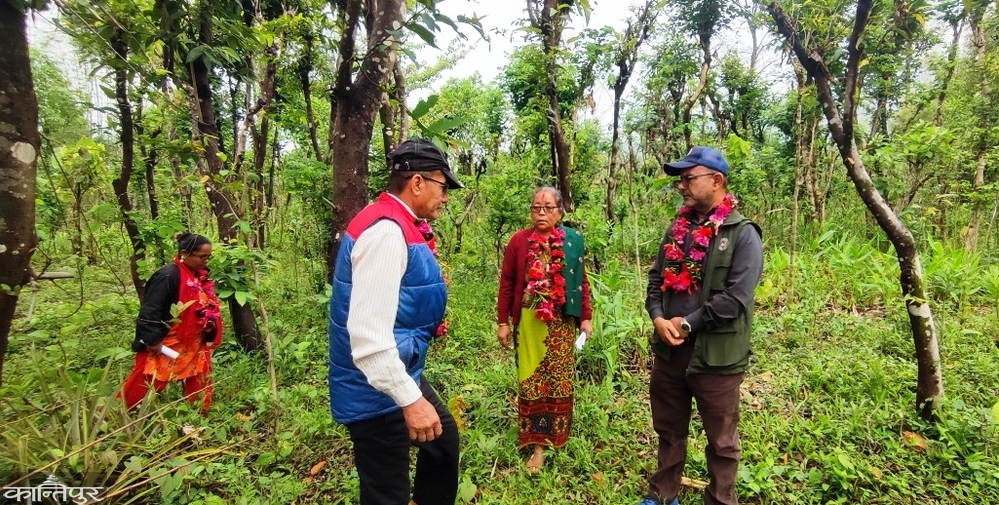
Chairman Manmaya Gurung said that after the Gauribari Ichchakamana Kabuliyati Forest Group planted grass, the practice of raising cows, goats and buffaloes has increased. ‘We have planted grass and ground grass. We have raised cows and buffaloes. Those who do not raise cows and buffaloes, but raise goats, sell ground grass. Those who raise cows and buffaloes sell planted grass,’ said Chairman Gurung.
Manmaya also raises cows and buffaloes. Sometimes she sells up to 26 liters of milk daily. A milk collection center has been opened in the village for the past three years. ‘People from all over had come and settled in the area near the river. If we had not protected it, it would have been encroached upon. There was nothing except Bhellar and Sisno. Now it is lush green. We have also received help,' said Chairperson Gurung.
The locals had been earning a living by selling seasonal fruits such as amriso, tejpat, dale grass, ground grass, bamboo and banana bhuikahar that they had planted in the forest areas they had protected. 'Now, the process of collecting fallen/dried wood and selling it in coordination with the office to earn income has also started,' said DFO Acharya. He said that this will make good use of the wood and the community will also benefit from the conservation.

