Most parents here have had to lock themselves in their homes and leave the village for their children's education.
We use Google Cloud Translation Services. Google requires we provide the following disclaimer relating to use of this service:
This service may contain translations powered by Google. Google disclaims all warranties related to the translations, expressed or implied, including any warranties of accuracy, reliability, and any implied warranties of merchantability, fitness for a particular purpose, and noninfringement.
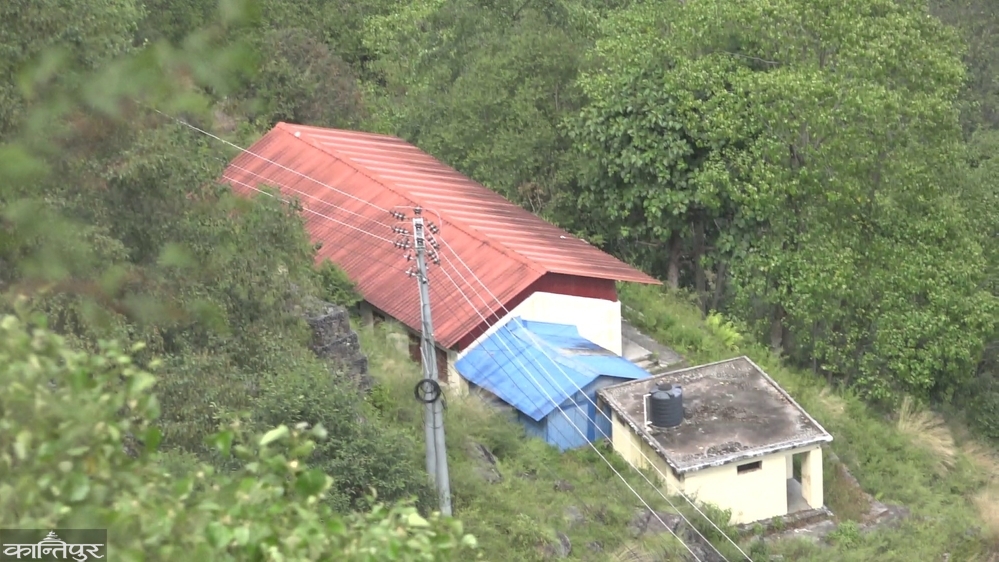
Most of the houses in remote Thongthong, Bigu Rural Municipality-1 are locked. In Thongthong, which has 43 households, only 9 doors open nowadays. The main reason for most of the houses being locked is the education of children.
The residents of Thongthong, which lacks basic infrastructure for development and is at risk of landslides, are forced to leave the village for the education of their children. The nearby Thongthong Basic School, which provides education up to grade 3, was merged with Gogar in Bigu-1 four years ago due to lack of students. The structures built in the school after the 2072 earthquake are also falling into ruins. After the village school was closed, some have locked their houses and some have moved to the city to educate their children.
From the village, one has to walk for at least 4 hours on a steep path to the school in Gogar. Local Lal Bahadur Tamang said that since young children in Thongthong could not go to school, their parents were forced to lock themselves in their homes and leave the village. Tamang said that since Lamabagar is far from Thongthong, he had to find a room there and teach them. ‘I am renting a room in Lamabagar and teaching my children and working as a laborer at Hydro,’ he said. ‘The home school was closed, and my children also moved up to the higher grades.’ He said that since students studying above grade 3 started having problems, locals have been looking for alternatives and moving to the city or elsewhere since they were young.
Thongthong, where the Tamang community lives, is known as the ‘unconventional village’ of Bhirmuni. Other developmental infrastructure has not reached this settlement. Locals say that they have had to leave the village due to health and transportation problems. There is also inconvenience in transportation in the settlement. The road built by the Upper Tamakoshi Hydropower Station has made it possible for only a few houses to walk 15/20 minutes to access transportation. Tamang said that most of the parents here, despite basic facilities, have to lock themselves in their homes for their children's education. He said that more than 20 children studying up to 10th grade from Thongthong village have left their homes for their studies.
Swasti Tamang said that since the village is remote, some women are forced to leave the village even to give birth. 'Even if you have a simple illness, you have to walk up and down for 3 hours, and it is even more difficult for pregnant women,' she said. 'Two years ago, I gave birth at home because I could not go to a health facility.' She said that she used to lock herself in her home for her children's education despite suffering. "When I was young, I used to enroll my children in a nearby school. The school was merged because there were fewer children studying," she said. "Now, I have to leave home to educate my children. Those who are financially weak don't educate themselves." Like Thongthong, the mobile school opened for children from Lapchi, which borders Bigu-1 with China, is limited to paper. The residents of Lapchi descend on Lumnang in winter. When the heat sets in, they take yaks and camels to Lapchi. The school in Lumnang is closed up to grade 3. But there is no education there. 18 children from Lapchi are currently studying in Kathmandu. A local Karmawaisar Sherpa said that an organization in the village is keeping them in Kathmandu and educating them. ‘After the earthquake destroyed the school building in Lumnang, we took the children to Kathmandu to study,’ he said, ‘Even if the building is not built, we have not allowed the school to be closed. The road is being built, and we have said that the school should be operated when the border is opened in the future.’ He said that the teachers of the Lumnang school have been transferred to Lamabaga.
A school in Riku, another village in Gaurishankar Rural Municipality-9 near Bigu, which offers classes up to grade 3, was also closed due to lack of students. The school was closed due to a very low number of children due to its small population. Now, the residents of Riku are also forced to leave their homes to educate their children.
Riksang Tamang, former management committee chairman of Thongthong Basic School, said that since young children could not walk for hours due to geographical remoteness and inconvenience, they had no option but to leave the village. ‘We have to walk for hours on steep roads to reach school,’ he said, ‘Young children cannot walk, so their parents have to leave their homes.’
Bigu Rural Municipality has made arrangements for children from such remote settlements at Gaurishankar Secondary School in Ward 1 Jagat, along with a dormitory. Currently, 83 students from grades 1 to 10 live in the dormitory of this school. Hiramani Gautam, principal of Gaurishankar Secondary School, said that the municipality has been providing free dormitory with meals to students from remote areas of the municipality.
He said that since it is difficult to keep young children in the dormitory, some parents have been looking for a place to stay here. He said that if the school itself can operate buses due to the road built by the Upper Tamakoshi Hydropower Center, children from remote areas can be brought in the morning and dropped off at home in the evening. "Due to the geographical remoteness, it is very difficult to bring young children to school," he said. "It is not known when the river will rise and when the landslide will occur. There has been some relief after the municipality started operating the hostel, but children from remote areas are still deprived of education at school age."
He said that children from more than 7 villages including Thongthong, Tashinam, and Simigaun currently come to study at Gaurishankar Secondary School. He said that after studying in the village at the basic level, many children drop out of school due to the distance.

