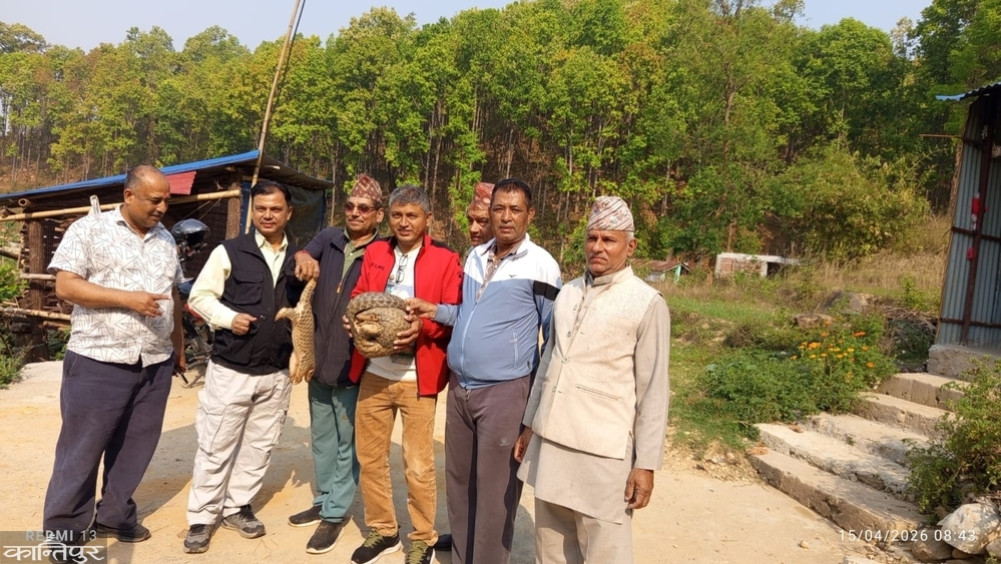
Hetauda's Community Rani Forest started salak conservation in 2062 BS. The forest has allocated about 20 hectares of its area for the rare wildlife salak.
We use Google Cloud Translation Services. Google requires we provide the following disclaimer relating to use of this service:
This service may contain translations powered by Google. Google disclaims all warranties related to the translations, expressed or implied, including any warranties of accuracy, reliability, and any implied warranties of merchantability, fitness for a particular purpose, and noninfringement.
Two salaks found in Makawanpurgadhi Rural Municipality-3 Makranchuli, which is connected to Hetauda Sub-metropolitan City, have been handed over to the Rani Community Forest Users Committee in Hetauda Sub-metropolitan City-6 Choughada for conservation. Manish Devkota of Makawanpur had found two salaks, a mother and a baby, in his shed at night.
Devkota woke up and found the salak when a dog was barking and trying to attack the salak. He saved the salak from the dog and took it under his control and handed it over to the Rani Community Forest Users Committee in the presence of Ward Chairman Bishnu Prasad Dahal for conservation. The mother salak weighed 12 kg and the baby weighed 3 kg, said Bhimsen Poudel, Office Secretary of the Rani Community Forest Users Committee.
The Rani Community Forest Users Committee in Hetauda Sub-metropolitan City-6 Choughada has been protecting salaks in Makawanpur for two decades. Rani Van started salak conservation in 2062 BS. The forest has allocated about 20 hectares of its area for the rare wildlife salak. Out of the 7 blocks of the forest area, 2 blocks have been allocated for salak conservation.
More than a thousand tour groups from home and abroad have come to the forest group to see the salaks protected in the group and study them. Block numbers 5 and 6 of the forest are being converted into salak conservation areas and the endangered and protected salaks are being protected. Local consumers have joined hands in protecting the salaks' food, ants and dhamira's shells.
Awareness hoarding boards, salak statues, salak cages have been constructed to provide information about salaks, and injured salaks are being rescued. Locals from outside districts as well as Makawanpur have been handing over salaks found in their areas to the Rani Van group.
Human activities in the area where the salamanders are found are prohibited and the salamanders are being protected. The salamanders found in various places are brought to the Rani Community Forest for conservation and released. Keshav Dhital, the chairman of the community forest, said that there are currently more than 5 dozen salamanders in the Rani Community Forest.
The Rani Community Forest has also arranged to give a certificate and cash reward to the person concerned for bringing salamanders from elsewhere. A cage has also been built in the community forest to treat sick salamanders. The salamanders, which were previously protected only by the community forest group, are now being protected by other community forest user committees in Makawanpur.
The District Forest Office is taking forward activities such as increasing knowledge of the conservation status, habitat, and ecosystem of salamanders, controlling illegal poaching, hunting, and trade of salamanders, searching for and managing habitat conservation, and increasing the responsibility of local people, said Assistant Forest Officer Basant Gautam.
Chitwan is known for its rhinoceros, Bardiya for its tigers, while Makawanpur is being made famous by its salak (pangolin). A conservation campaign has been launched to protect the salak and declare it as the pride animal of the district. The District Coordination Committee, Division Forest Office Rapti Makawanpur and District Forest Office Hetauda declared the salak as the pride animal of the district in 2079 BS.
The salak is a friend of farmers. It controls the animals that damage crops and production by eating them. An adult salamander eats 230,000 ants and wasps in a day and about 70 million in a year.
According to the National Parks and Wildlife Conservation Act, 2073, anyone who kills, buys, sells, or transports a lizard can be fined between five hundred thousand and one million rupees or imprisoned for five to 15 years, or both.