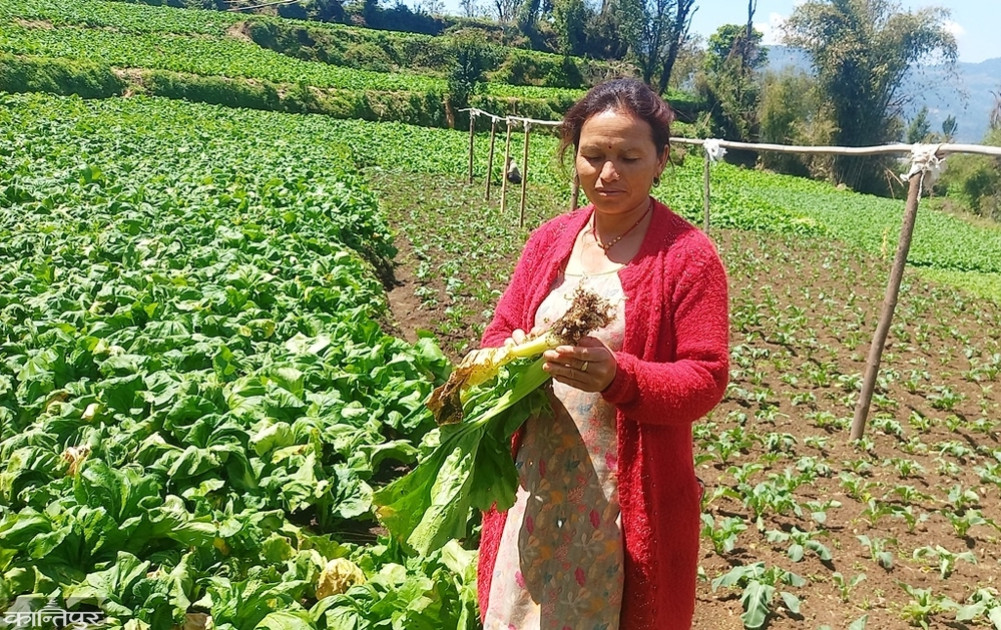
Vegetables ranging from mustard greens to cauliflower and cabbage have been facing this disease for the past 3-4 years.
We use Google Cloud Translation Services. Google requires we provide the following disclaimer relating to use of this service:
This service may contain translations powered by Google. Google disclaims all warranties related to the translations, expressed or implied, including any warranties of accuracy, reliability, and any implied warranties of merchantability, fitness for a particular purpose, and noninfringement.
Farmers in Bhimeshwor Municipality-7, a vegetable pocket area, are worried after their crops started to be destroyed by 'calve root' (knot disease).
Farmers involved in commercial vegetable farming, including mustard greens, cauliflower, and cabbage, have been facing the problem of this disease for the past 3/4 years. Due to which, they complain that they are not getting the return on their investment as the vegetables are wilting in the field. Local farmers say that they have decided to switch to alternative farming due to the disease.
More than 30 million rupees have been exported from the maize fields alone. But local Kalpana Raut said that they have to bear losses as the plants are turning yellow and wilting due to the 'calve root' disease. She said that mustard production has decreased this year due to the disease. ‘The roots of the mustard plants got knots, and when they grew and were picked, they all turned yellow and withered and died,’ she said. ‘We invest in seeds and fertilizers to generate income. Diseases cause losses when we are collecting income.’
She said that she sells mustard greens alone for around Rs 250,000 a year. Mustard greens can be harvested up to six times from the same plant at different times, and at the end, even the pods are sold. Raut said that she has been able to support herself by growing greens and vegetables and even sending her children abroad for higher education.
She said that in recent times, besides mustard, radish and carrots, knot disease has also been seen in cauliflower and other vegetables. "After the disease hit the vegetable farm, they also had the soil tested and planted rotational crops," she said. "The problem is, when we were growing vegetables, we used to take loans from cooperatives and pay them back with the produce, but the disease has caused problems, and it is difficult to raise investment."
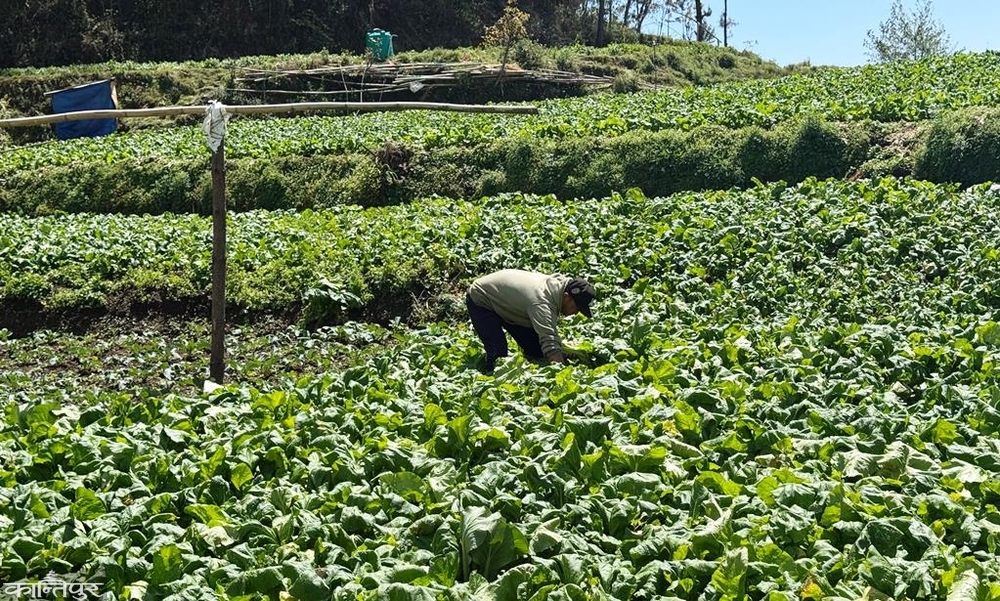
Only 200 families in the maize fields are involved in vegetable farming. The maize fields have been developed as a pocket area for vegetable farming. Vegetable farming is the main source of income for every family here. The outbreak of knot disease has been seen in the fields of all the farmers here.
This disease causes knots to grow on the roots of vegetables and causes them to turn yellow and wither, said Man Bahadur Tamang, another farmer in the maize fields. ‘Look at the fields and see that the potatoes and cauliflower that are ready to be planted are turning yellow and wilting,’ he said, ‘The disease has been causing trouble for 3/4 years, we have not been able to get the income we invested in, production is decreasing.’ He said that there has been no significant progress despite conducting soil tests to prevent the disease. He used to sell potatoes, cauliflower and potatoes worth around Rs 3 lakh annually, but his income has decreased since the disease spread.
More than 300 farmers are involved in vegetable farming in Bhimeshwor Municipality-7 alone. There are statistics that vegetable products worth Rs 130 million are exported from here annually. Out of this, the highest amount is exported from maize fields. Shanti Acharya, head of the agriculture branch of Bhimeshwor Municipality, said that the tests showed that the acidity of the soil here has deteriorated due to uncontrolled use of pesticides and chemical fertilizers.
He said that the soil of more than 100 fields was tested after problems were observed in the farmers’ fields. She said that during the test, the soil acidity was found to be 5.6 points in the soil here. She said that generally, the soil with 7.2 points in the soil is considered healthy. Due to this, she said that the soil is prone to knot disease due to the growth of fungus (calv root). 'A soil test with 5.6 percent alkalinity means it is acidic, and if the soil alkalinity is above 7.0, it is considered healthy,' she said. 'To completely prevent this disease, the use of agricultural lime and rotational crops are the best options.' She said that the acidity of the soil can be reduced in at least 10 years by planting rotational crops.
Archaya said that she has urged all farmers to use agricultural lime since the chances of becoming a commercial farmer are very low. "The disease starts with the formation of mold in the soil. To reduce it, the only way to uproot and safely destroy the affected plants is to prevent them from spreading to other areas," she said. "We have asked that cattle not be allowed to eat the plants affected by this disease. Since it is a contagious disease, we have asked that it be destroyed safely." She said that since no pesticides have been sold so far for control, farmers have been recommended to use agricultural lime when planting crops. Preparations are also being made to distribute agricultural lime to farmers under the One Ward One Commercial Farming Program in coordination with the municipality's agriculture branch, said Bhimeshwor-7 chairman Binod Tamang.