When people go down to Lumnang to escape the cold, Himalayan bears break into houses and eat food.
We use Google Cloud Translation Services. Google requires we provide the following disclaimer relating to use of this service:
This service may contain translations powered by Google. Google disclaims all warranties related to the translations, expressed or implied, including any warranties of accuracy, reliability, and any implied warranties of merchantability, fitness for a particular purpose, and noninfringement.
Locals of the remote Lapchi district bordering China are troubled by mountain bears. The bears have been eating stored food and causing trouble.
After the yak-chauri descends to Lamnang in Bigu Rural Municipality-1 to escape the cold, all houses in Lapchi are locked in winter. Kunjunorbu Sherpa said that when Lapchi residents, who buy food and other essential items from the Tibetan market Tasinghang, descend to Lumnang, the mountain bears break into their homes and eat their food. In order to protect their food from the bears, locals have recently started making barbed wire fences at the main doors of their houses.
'We go down to Lumnang from the coldest month of Mangsir, and at that time bears cause trouble by breaking into the main door of the house,' he said. 'We have placed an iron bar at the entrance to the main door to protect food from bears.'
He said that due to continuous snowfall, they have not been able to climb Lapchi. They usually go to Lapchi by chasing yaks from Lumnang in the first week of Chaitra. But this year, they have not been able to climb because of snowfall until Chaitra. He said that he is thinking of climbing Lapchi after the snow melts and the weather opens. He says that placing an iron bar at the main door of the house has reduced the trouble of bears in the past years.
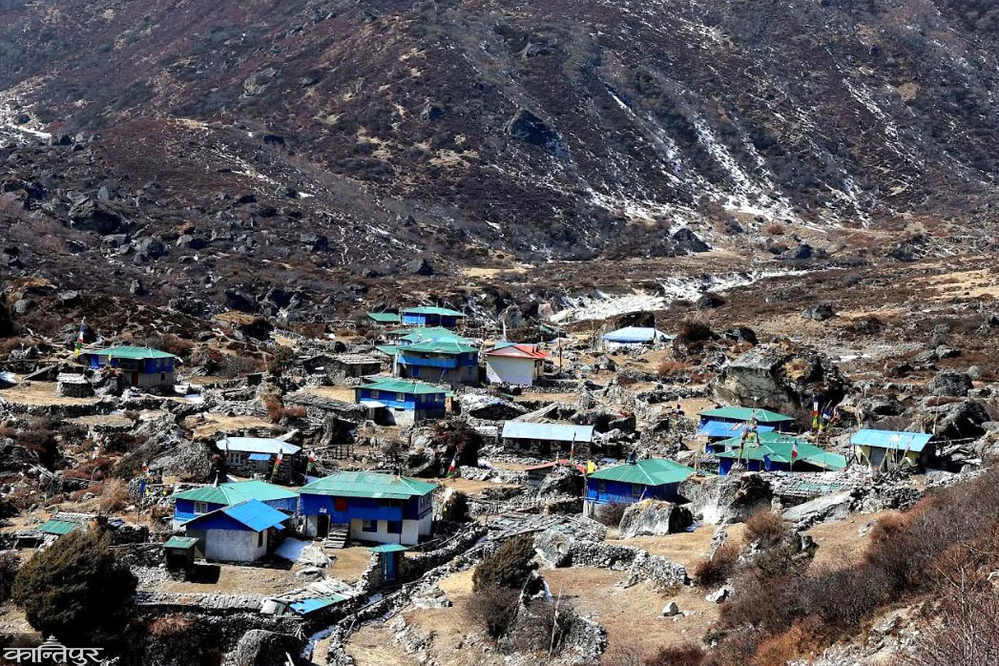
Lapchi is a mountainous village bordering Tibet, China. Since it is not possible to live in Lapchi during the cold season, the locals also have a second house in Lumnang in the same ward.
Every year from Mangsir to Chait, they descend to escape the winter. ‘Since Lapchi is covered with snowfall, when the second house falls in Lumnang, we close the windows of the Lapchi house tightly and descend,’ said the Sherpa.
There are 26 houses in Lapchi. Most of the houses built after the 2072 BS earthquake are low, making it easy for bears to enter the houses, said the local Karmawaisar Sherpa. ‘It is not possible to take all the food grains when the second house falls in Lumnang during the cold season,’ he said. ‘From Mangsir to Chait, when all the locals of Lapchi descend to Lumnang, the village is completely empty. During this season, we only go up when the food grains are very necessary.’
The main occupation of the locals of Lapchi is yak and horse rearing. They sell yak calves and horses in the Tibetan market of Tashigang. Similarly, they also sell yak ghee in the same market. The locals of Lapchi purchase food and essential items from Tashigang.
Recently, due to the problems caused by wild animals and occasional obstacles at the border, the Lapchi people are increasingly abandoning yak rearing. The locals of Lapchi, who once reared about 1,500 yak in 30/20 sheds, are now fleeing this occupation.
Locals say that there are about 400 yak in 7 to 10 sheds in Lapchi. Sherpa said that bears and leopards attack and kill many yaks and horses during migration. In search of grazing land, the Lapchi people even go to Tibetan lands to graze their yaks. He said that they pay taxes to the Chinese government for this. He said that currently, only a very few herds reach Tibetan lands.

