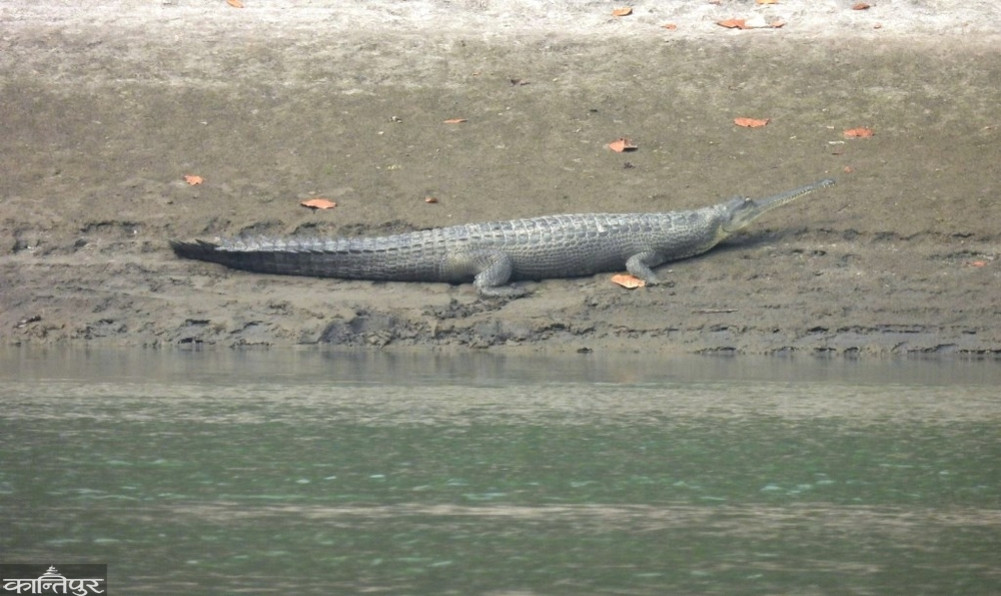
There are two species of crocodiles found in Nepal: the Gharial and the Magar. While the Gharial is somewhat calm, the Magar crocodile is more aggressive and calm.
We use Google Cloud Translation Services. Google requires we provide the following disclaimer relating to use of this service:
This service may contain translations powered by Google. Google disclaims all warranties related to the translations, expressed or implied, including any warranties of accuracy, reliability, and any implied warranties of merchantability, fitness for a particular purpose, and noninfringement.
Once upon a time, the banks of the Narayani and Kaligandaki rivers near Devghat were a good habitat for gharial crocodiles. Gradually, gharials stopped appearing in this place. After the confluence of the Trishuli and Kaligandaki rivers at Devghat, the river is called Narayani.
A gharial is currently found basking in the sun on a sand dune on the Narayani River's Gaindakot side, just below the confluence of the Kaligandaki and Trishuli rivers. 'The gharial has been seen there for 6/7 days,' said Hiralal Bote, a local from Devghat.
The gharial is a fish-eating animal that lives in clean flowing water. Due to pollution in rivers and streams and lack of fish, the gharial is disappearing. Dal Bahadur Bote, 71, who was born and raised in Devghat, says he has seen up to 20/25 gharials in Devghat and the surrounding areas of Khaireni and Chharchhare. He said he has not seen a crocodile for 30/35 years.
'Earlier, we used to drink water from this river. Now, even eating or bathing makes us itch. The fish have decreased dramatically. How can crocodiles survive in this situation,' said Dal Bahadur. The gharial is a critically endangered animal that is in danger of extinction not only in Chitwan or Nepal but also in the world. For its conservation, a Gharial Crocodile Breeding Center has been opened in Kasara of Chitwan National Park. ‘Gharials have not been seen in the upper Narayani region for a long time,’ said Sujita Shrestha, head of the Gharial Crocodile Breeding Center.
The Chitwan National Park Office has been counting Gharial crocodiles in the Rapti and Narayani rivers every year through direct observation. Sujita Shrestha, Conservation Officer of Chitwan National Park and Head of the Gharial Crocodile Breeding Center, says that gharials are counted from the Sunachuri area of the Rapti River and from Narayangadh on the Narayani River, far below, near Seti Devi Forest, to Triveni. According to the results of the census made public in Poush, a total of 366 gharial crocodiles were found, 231 in Rapti and 135 in Narayani.
There are very few males among gharial crocodiles. This time, a total of nine male gharials were found, seven in Rapti and two in Narayani. Gharial crocodiles build nests by digging holes in the mud in March and April. Locals speculate that the gharials seen in Devghat are also trying to build nests because they are moving up and down the mud. Gharials are an indicator of clean rivers and streams.
After the gharial population declined rapidly due to river pollution and lack of food, a crocodile breeding center was opened in Kasara in 2035 BS to protect them. Since they are unable to grow in their natural habitat, eggs are collected and kept in the breeding center, and the babies born there are released into rivers and streams after they grow up. According to Conservation Officer Sujita Shrestha, 2,275 gharials have been released in this way so far.
The census results show that not many gharials have survived in this way. Recently, gharial crocodiles have been injured and killed by getting caught in fishing nets. Conservationists say that indiscriminate excavation of gravel, sand, and stones in the nesting areas has also had a negative impact on gharials.
There are two species of crocodiles in Nepal, the Gharial and the Magar. Although the Gharial is somewhat calm, the Magar crocodile is more aggressive and calm. The Magar crocodile preys on fish as well as large animals. Conservation Officer Sujita Shrestha says that the Magar crocodile lives in muddy water, rivers, streams and lakes. It crawls and goes far. But the Gharial is not found going beyond rivers and streams.