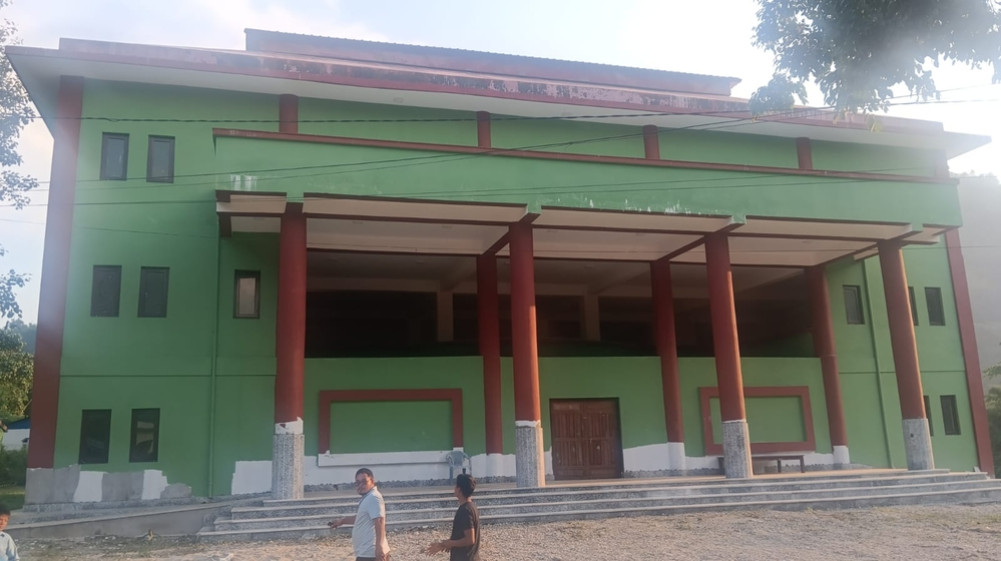
The Chepang-dominated municipality has built the Chepang Museum to display materials that have been used by the Chepang community since ancient times but are in danger of extinction.
We use Google Cloud Translation Services. Google requires we provide the following disclaimer relating to use of this service:
This service may contain translations powered by Google. Google disclaims all warranties related to the translations, expressed or implied, including any warranties of accuracy, reliability, and any implied warranties of merchantability, fitness for a particular purpose, and noninfringement.
The museum, built to house items related to the identity and culture of the Chepang community for observation and preservation, has reached the stage of being handed over. The construction work of the museum, built by the Raksirang Rural Municipality, has been completed, and now the construction company only needs to hand it over to the municipality.
The Chepang-dominated municipality has built the Chepang Museum to preserve materials that the Chepang community has been using since ancient times but are on the verge of extinction.
The municipality has built the museum with a large investment to preserve the materials that they used in the past but are now on the verge of extinction, said Rajkumar Malla, chairman of the rural municipality. The construction company has completed the construction of the museum, now only the general works are left, he said, "Now the museum will be inaugurated with the handover."
A museum building has been constructed at a cost of Rs 36.3 million in Raksirang Rural Municipality-5, Chainpur. Arrangements have been made to keep materials that the Chepang community has been using from the past to the present and that reflect their culture and identity on the ground floor of the three-story building.
The Chepang Museum was in operation in Chainpur, which is also the center of Raksirang Rural Municipality, in the past. People used to come from various places to observe and study.
The 2072 BS earthquake damaged the museum building. The repair and maintenance of the building was carried out by the Rotary Club of Makawanpur with the financial support of Dilip Baniya of Hetauda. Since the building was dilapidated and the museum could not be operated systematically due to lack of space, the rural municipality started the construction of a new building from 2078 BS to operate the museum systematically.
The Chepang Museum was established at that location in 2067 BS with the support of the then District Development Committee. The museum housed items related to their lifestyle and identity, including a single-winged dhyangro used by the Chepang community, a bat-killing spear, a bat-killing slingshot, a spade used to dig holes, a plow, weapons used to hunt wild animals, a pot for storing chiuri ghee, and other items.
After demolishing the old museum building and starting the construction of a new building, we have kept the materials kept in the museum safely in the room,' said Rural Municipality Chairman Malla, 'The Rural Municipality will make a procedure and operate the Chepang Museum in an organized manner.'
Chainpur can be reached by walking for an hour and a half from Manahari Bazaar. Currently, vehicles travel from Manahari to that place. Since the Chepang Museum is linked to the existence and identity of the Chepangs, we are confident that the Chepang Museum will be operated by the Rural Municipality in an organized manner,' said Nepal Chepang Association Chairman Govindaram Chepang.
Chepang Museum is located in the middle of Raksirang and Kailash Rural Municipality, where the Chepang community is predominant. This is the first Chepang museum in the country.
According to the 2078 BS census, there is a Chepang population of 84,364. The population of Makawanpur is 23,650, Chitwan is 35,637, Dhading is 17,160, and Gorkha is 4,268. The Chepangs are currently settled in 26 districts.