The Chepangs of the former 5 VDCs of Raksirang and Kailash rural municipalities of Makawanpur, including Kakada, Khairang, Raksirang, and Bharata, collect seeds in Shrawan/Bhadau and then grind the seeds in Asoj and Kartik to produce ghee.
We use Google Cloud Translation Services. Google requires we provide the following disclaimer relating to use of this service:
This service may contain translations powered by Google. Google disclaims all warranties related to the translations, expressed or implied, including any warranties of accuracy, reliability, and any implied warranties of merchantability, fitness for a particular purpose, and noninfringement.
The Chepangs in the western part of Makawanpur district are currently busy producing Chiuri ghee. By selling Chiuri ghee, they purchase food and other necessary items for Tihar. Since they are allowed to sell Chiuri ghee during Tihar, they do not have as much trouble covering expenses as they do when celebrating other festivals.
The Chepangs of the 5 VDCs of Makawanpur's Raksirang and Kailash rural municipalities, including Kakda, Khairang, Raksirang, and Bharata, collect seeds in Shrawan/Bhadau and produce ghee by roasting the chiuri in Asoj and Kartik. They roast the chiuri in wooden chepuas in the traditional way.
Some have even roasted the chiuri for Dashain expenses. Most of the Chepangs are now too busy roasting the chiuri to produce ghee. The chiuri plant, which is inextricably linked to the Chepang caste, is planted in the khoriyas of most Chepangs. It is customary for the relatives to give the chiuri plant to the daughter in the fourth year of her marriage as a sign that the marriage is confirmed.
The VDCs of Kakda and Bharata have a large number of chiuri plants. Due to this, the largest amount of chiuri seeds are collected there. The Chepangs here fulfill their festival needs by selling Chiuri ghee. Bishuman Chepang of Damrang in Kakda said, “Chiuri ghee is now sold in the village itself.”
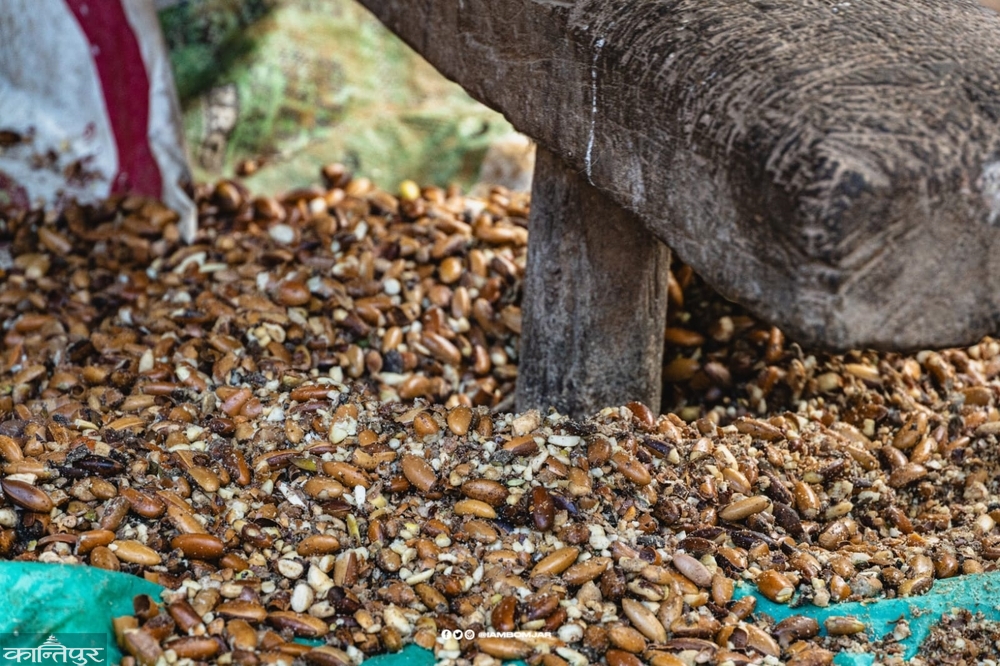
Even though oil is extracted from the chepua, it later solidifies and becomes ghee. Aitram Chepang of Kakda said, “Up to five kg of ghee can be produced from a single Chiuri plant.” Chiuri ghee is sold in the village for Rs 700 per dharni. Mana pathi and dharni are still practiced in the remote settlements of Damrang and Dhirang in the district.
The Chepangs do not have modern machines to produce Chiuri ghee. They are forced to produce ghee in the traditional way. So far, no one has provided financial and technical support to the Chepangs to produce Chiuri ghee in a modern way, which is inextricably linked to their lifestyle.
Although various government and non-governmental organizations have been doing various things for the development of the Chepang community for a long time, they are still forced to produce ghee by roasting chiuri seeds in wooden chepuas. Roasted chiuri seeds are roasted in wooden chepuas to produce hot oil. After the oil is boiled, ghee is made. Since it is also used as a health and medicine, the demand for chiuri ghee is increasing.
However, due to the lack of conservation of chiuri seeds and the lack of modern production methods, the Chepangs have not been able to meet the market demand. Although the western part of the district has a suitable climate and soil structure for chiuri production, the Chepangs have not been able to develop it commercially due to lack of awareness. The income from chiuri plants is less now than in the past.
Even though chiuri trees are large, they bear less fruit. Locals say that chiuri plants have started bearing less fruit as soon as bats die out. "When the flowers bloom on the chiuri tree, crowds of bats used to come, but now the bats have stopped coming, and the fruit has also started to fall," says Aitram Chepang.
Experts say that since bats are pollinators, the production of chiuri has also started to decrease after they were killed. They say that since the Chepangs used to kill and eat the bats in the past, this has now affected the production of chiuri. Wild animals also climb the trees and eat them when the chiuri is ripe. Mainly, the goslings climb the trees and eat the ripe chiuri.

