We use Google Cloud Translation Services. Google requires we provide the following disclaimer relating to use of this service:
This service may contain translations powered by Google. Google disclaims all warranties related to the translations, expressed or implied, including any warranties of accuracy, reliability, and any implied warranties of merchantability, fitness for a particular purpose, and noninfringement.
In Chandeni Mandan, located in Mandandeupur municipality-10, there used to be Kathar trees in every house. Kathar created the identity of Chandeni Mandan. Recently, that is not the case. In the village, trees of Kathar plants are rarely found. Now there is a problem with the Kathar trees there.
Farmers are unaware of the disease in the trees. Hira Nepal, a farmer of Jwanetar located in Mandan Deupur-10, said that the problem of rotting of the roots and the death of the plant occurred after the leaves of the Kathar tree dried up from the leaves to the branches and roots.
'Earlier in this village, there used to be tree kathar in every house,' he said, 'out of 500 households in the village, 2/3 of each house had a tree kathar plant, when a tree kathar was found, the village would sing, traders would come from the city to buy tree kathar, but now it is difficult to find tree kathar in the village, they don't even know what the disease is, the trees are dying.'
After drying, they started to burn and plant crops. Farmers complain that despite informing the agricultural knowledge center and the municipality about this problem, there is no response.
Similarly, Krishna Prasad of Chandeni Mandan says that it is difficult to make a living due to the problems seen in Nepal Kathar. He said that the 11 Kathar plants in the garden were drying up and the roots were rotting. He said that he was earning 1 to 1.5 lakh rupees annually by selling katahar.
He said, "Since 3/4 years, the problem of diseases and insects started to decrease, the leaves and branches started to dry up, and later the roots rotted and the plant itself died."
According to him, the technician came and checked everything while addressing the farmers' complaints. They said that there was no information about it. Sundar Nepal, a farmer of Mandandeupur-10, said that there is now a problem with tree cutting in the whole village. He said that out of 7 Rukhkathar plants, only one plant is left.
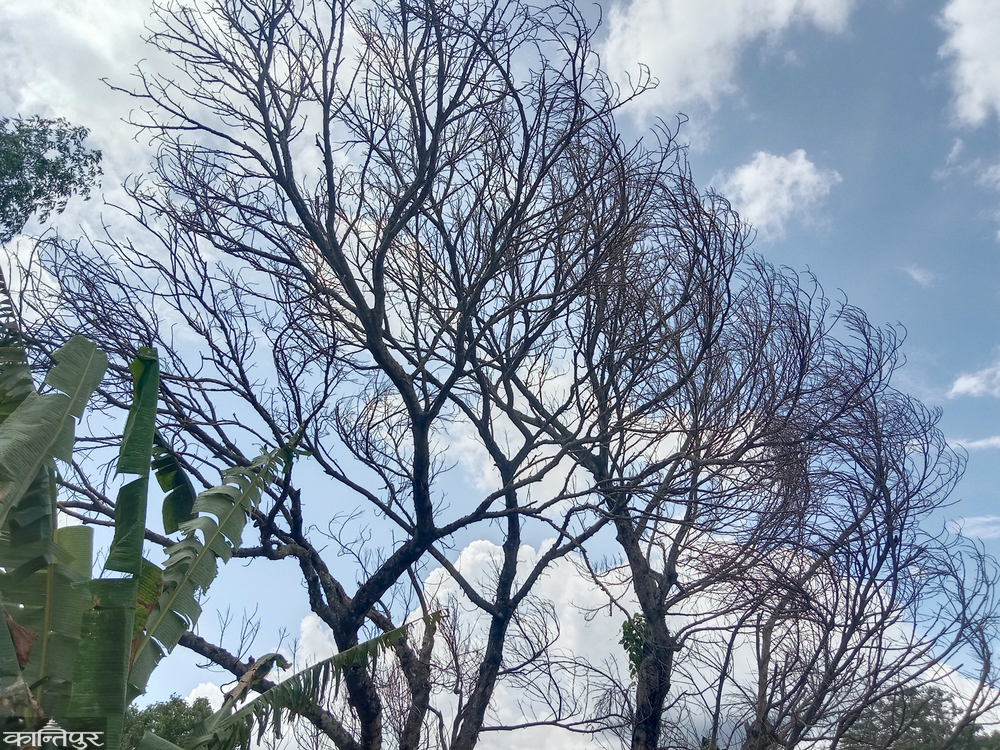
'I am not the only one who has experienced this problem,' he said, 'now the problem of all the farmers in the village is the same, the problem of rotting has been seen after the plants are drying up.' Rama Karki, the crop protection officer of the district agricultural development office, said that after the farmers reported this problem to the municipality, the technicians examined the plants.
According to him, the test was carried out in Bari last July. "To identify the disease, samples were collected and sent to NARC to investigate," she said. However, local farmers have said that they have not received any information about this matter. According to Kisan Krishna Nepal, after testing the plants and collecting samples from here, no information was given about its report and prevention. Manoj Nepal informed that the Ward Office has been requested to inform the farmers about the report from the district and the prevention measures. Although the district and municipality have asked to inform the farmers about the problem, the farmers have said that they have not received the information from any agency.

