We use Google Cloud Translation Services. Google requires we provide the following disclaimer relating to use of this service:
This service may contain translations powered by Google. Google disclaims all warranties related to the translations, expressed or implied, including any warranties of accuracy, reliability, and any implied warranties of merchantability, fitness for a particular purpose, and noninfringement.
The money to buy salt, oil and clothes has been saved by Zabi (bag). Jabi is his only source of earning Rs. 50-year-old Jhelimaya of Sachak Tol-5, remote Raksirang Rural Municipality of Makwanpur, weaves zabi of Chepang Odal cloth.
She weaves and sells at least one job a week. Only the Chepang couple lives in the remote village hut. Her husband Shyamalal has been helping her to take out the thread of Odal cloth. There are odal trees in the forest of that settlement.
'They cut the branches of those trees and take their leaves and cook them in hot water to make thread-like fibers,' said Kokil Chepang, a local resident. Not only that, when they go to the forest, they also keep sickle and khurpa in their pockets. Even when they come to the city market, most of the Chepang people leave this bag and come full of it.
'This jabi bag is connected with Chepang's identity,' said leader Chepang Govindram, 'Whether you live in a house with odhar or kare, there is a jabi bag wherever there is a chepang.' Not only Jhelimaya from Sachak in Raksirang Rural Municipality, but also 71-year-old Zhigarimaya Chepang from Silinge of the same municipality weaves and sells jabi. In the past, the Chepangs of this area used to weave jabi only for their own needs, now they also weave to sell. One job is sold for five hundred rupees. We have been selling the whole cloth-woven jabi for 700 rupees. We have been selling jabi made by mixing other materials for 500 rupees, said Zelimaya.
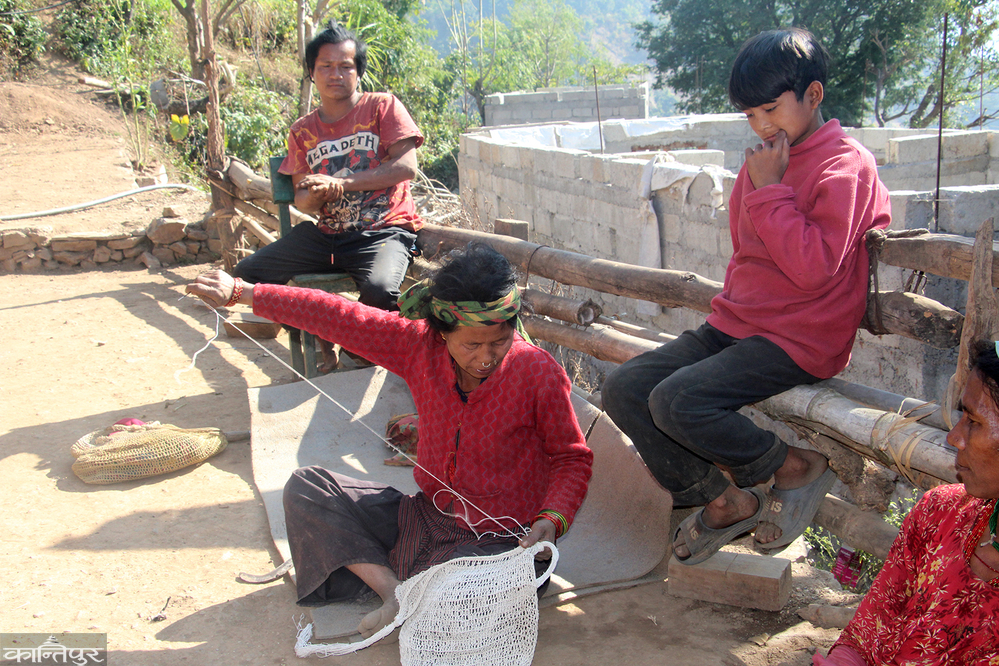 file photos
'It takes seven days to weave a bag,' she said, 'There is no other way to get money, we have to sell it by weaving it.' A Chepang handicraft shop has been set up in Lothar market for the purpose of selling the materials produced by the Chepangs. The same shop sells various products of Choya and Bamboo, Amriso Chucho, Jabi . "Last year, more than 2,500 pieces of jabi woven by Chepang were sold," said Phulmaya Chepang, manager of the shop, "now the market for jabi bags is good. Be it in the program of Chepang or in the program of other tribes, especially the jabi produced by Chepang is done.'
Whether or not it is sold or not, whether it is Odal jabi woven by Chepang or Choya and bamboo products, shops buy them, so Chepang who have skills in hand weave jabi . "Jabi bags are gradually becoming a source of income for the Chepang people, but on the other hand, the transfer of skills has also increased," said Lalimaya Chepang, head teacher of the local mawiki, "The sale of jabi bags has contributed to the Chepang community's income, as well as building skills." The shop in Lothar buys and sells not only bags produced by Chepang, but also Amriso, Nanglo, Doko, Damlo, Tokri, Ghoom, Dhakki etc. .

