We use Google Cloud Translation Services. Google requires we provide the following disclaimer relating to use of this service:
This service may contain translations powered by Google. Google disclaims all warranties related to the translations, expressed or implied, including any warranties of accuracy, reliability, and any implied warranties of merchantability, fitness for a particular purpose, and noninfringement.
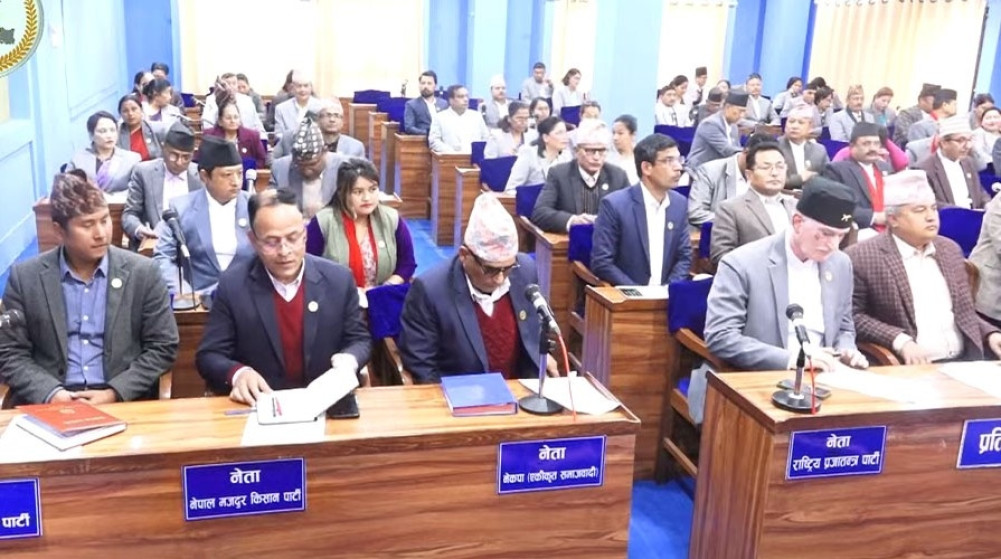
The winter session of the Wagmati State Assembly has started from Friday in Hetaunda. Due to pressure from the opposition, the Wagmati state government started the fifth session of the second term of the state assembly in a hurry due to the lack of sufficient business. The leaders of the political parties represented in the House expressed their best wishes at the first meeting of the session.
At present, the government has registered only four different amendment bills in the state assembly. Parliamentarians are saying that only four bills will not reach this session of the House. Although the government claims that other bills are being drafted, the employees are saying that it is not likely to be registered in the parliament secretariat immediately.
It was agreed that no bill would be submitted in the first meeting of the 15th session of the Provincial Assembly at the meeting of the Working Arrangement and Consultative Committee. According to which, Speaker Bhuvan Kumarama Pathak informed the House about the letters received from the provincial head office and moved the meeting forward. He adjourned the next meeting of the Provincial Assembly to 11 am on January 23, with the party leaders offering their best wishes.
Addressing the House, the leaders of the parties represented in the Provincial Assembly emphasized on the need to move forward with consensus and cooperation. Stating that the Provincial Assembly is a platform for discussing and solving civil problems, the leaders of the parties pointed out that it is necessary for all political parties to form a common opinion and move forward. At the beginning of the
meeting, Chief Minister Bahadur Singh Lama claimed that the government under his leadership is making policy decisions for the long-term development of the province. "We are not working for cheap popularity and political consumption, but keeping the long-term development of the province at the center. We are trying to resolve the problems seen in the development of the province by holding a meeting of the provincial level development problem solving committee.
Shalikram Jamkattel, the leader of the main opposition party in the state assembly, CPN-Maoist Center Parliamentary Party, has made a serious allegation that unrest has been increasing in the country since the formation of the grand coalition of UML and Congress. The government is trying to run the country through ordinances after the problem of the alliance itself. "The government is insolent towards usurping government land, hiding incidents of misappropriation of cooperative funds, and protecting those who do wrong," he said.
CPN-UML parliamentary party leader Jagannath Thapalia claimed that the current session will be oriented towards making new laws, becoming a unity session, and creating a prosperous province. Rashtriya Prajatantra Party parliamentary party leader Uddhab Thapa expressed his belief that this session will be able to work in favor of the state and the citizens of the state and accused the government of not being able to work even though the citizens had high expectations after the formation of the government of two major parties.
CPN Unified Socialist Parliamentary Party leader Krishna Prasad Sharma Khanal said that there is weakness and administrative inefficiency in the leadership and policies of the provincial government. Even though the grand alliance was not made in the name of constitutional amendment, no achievement was seen. The state government is like the rhinoceros of Chitwan, it could not pick up speed", said Surendraraj Gosai, the leader of the parliamentary party of the Nepal Labor Farmers Party.
Shailendraman Bajracharya, the leader of the Nepali Party Parliamentary Party, claimed that the tribal community got the rights due to federalism and claimed that the citizens got the language rights.