We use Google Cloud Translation Services. Google requires we provide the following disclaimer relating to use of this service:
This service may contain translations powered by Google. Google disclaims all warranties related to the translations, expressed or implied, including any warranties of accuracy, reliability, and any implied warranties of merchantability, fitness for a particular purpose, and noninfringement.
The bird called 'Common Crane' in English is called Laxman Saras in Nepali. Locals also know it as Karyangkurung or Malchari. This bird, which flies one after the other in a sequence like the Karyang Kurung makes a sound, enters Nepal after winter.
Chitwan's Divyanagar is the only place in Nepal where this stork, which comes from Siberia, a very cold region of the world, spends the entire winter. But in Divyanagar, it is becoming difficult to see common cranes like before.
75-year-old Uttam Choudhary is a resident of Sisai, a Tharu-dominated village in the Divyanagar district, one and a half kilometers away from the Narayani river. Uttam, who was born in Sisai, has been seeing herds of Karyang Kurungs coming and living in the fields of the village since he was young. He says that when the Karyangkurung flew in the sky, it used to cast a shadow just like the clouds below.
"The old people used to talk in Tharu language saying that Chitwan falls from the Karyangkurung Himal and falls in the rain". In other words, Karyangkurung came from Lau Himal to Chitwan and now it will rain well. It was seen about 30/35 years ago that large herds were coming, but now it is much less,' said Uttam .
The experience of Tikaram Pokharel, an old resident of Ghandruke Chowk in Divyanagar, about two kilometers from Uttam's house, is similar. "When I saw, there were 6 or 7 herds". If counted in one herd, there were 70/80 karyangkurung. Now one or two herds come. There are not even 24/25,' said Tikaram. Pokharel, who migrated from Kaski in 2024, is now 64 years old.
He said that until the year 2060, there will be plenty of karyangkurung in the fields of Divyanagar . After 2065 years, his experience is very less. They were not at home in the first place. The slot was empty . Now the house has grown, and the factory has also opened . Tikaram said that he was afraid to come to Karyangkurung.
Old resident Uttam Chaudhary also says that the increase in houses has affected the birds. "First we had only three houses in Sisai. Now there are 75 houses. There is a practice of putting fertilizers and chemical pesticides in the fields. It affected the bird,” said Uttam.
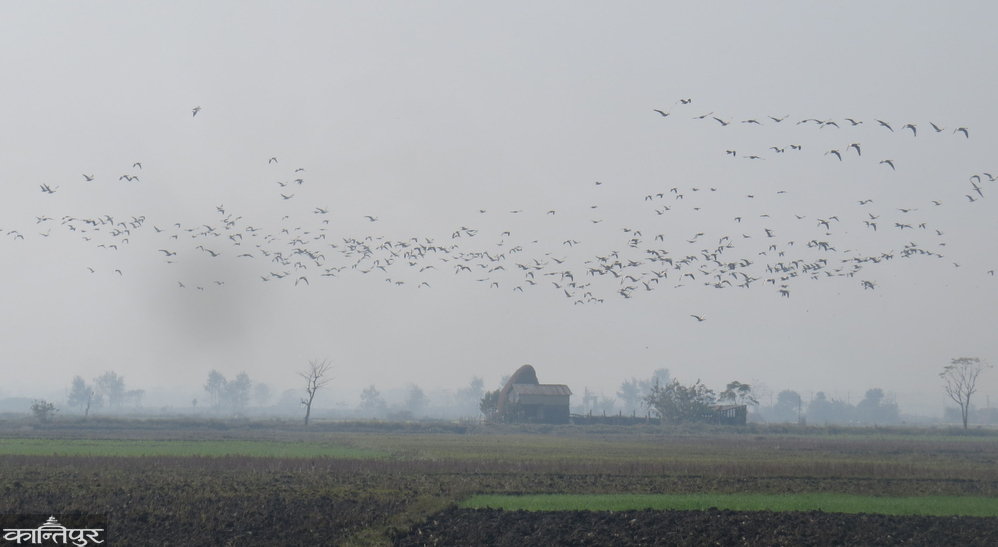
The winter water bird migration to Nepal is currently being counted. Hathan Chaudhary, a resident of Bharatpur Metropolitan City-25 near Divyanagar, is the central president of the Nepal Bird Association. Under his leadership, waterfowl counting started in Divyanagar area on Monday morning. Shortly after starting to count birds in the Divyanagar forest, Hathan heard a very familiar voice . A Karyangkurung separated from the herd was flying away .
A few moments later, three karyangkurung flew towards the southwest corner where the previous bird had gone. While Hathan's team was moving towards the Narayani river after crossing the Divyanagar branch and Sisai village, a group of birds flew north and took a rest by reaching the Bhangalo made by the Narayani river a little away from the bank. Hathan and his assistant quickly counted, there are 32 karyakurung birds in that group .
'There were 17 total last year . We found 187 in 2023. In 2020, we counted up to 242 karyangkurung. Most of all, that's what he said. Karyakurung is the second highest flying bird. Rupal's vulture is the bird that flies at the highest altitude of 13,000 meters, Hathan says. It is not found in Nepal. Karyangkurung flies at 11,000 meters and the third number is Barheaded Goose or Khoyahans at 9,000 meters.
Hathan informed that 153 species of birds migrate to Nepal in winter. Hathan says that 40 percent of the birds are water birds such as Khoyahans, Karyangkurung and Chakhewa. Among water birds, Karyangkurung is a bird that spends the entire winter in Nepal and lives only in Chitwan Divyanagar . This bird arrives around November and stays till March .
"He will not stop at Kailali's bhajan but not for the whole winter or for some time". In Nepal, it spends winter only in Divyanagar. Otherwise, its large herd goes to Bihar and Rajasthan in India to spend the winter. There is also a place called Bharatpur in Rajasthan, there is a large herd of it,' he said .
This bird, which grazes in the fields of rice fields and lives in the banks of the river, has found that environment in Divyanagar . But as the condition of the paddy field deteriorates, they are less and less coming here, not only the locals have experienced it, which has also been confirmed by the continuous monitoring of experts . Karyangkurung eats not only rice grains but small insects and frogs in the fields. Don't like the hype .
'If there is less to eat, if there is a disturbance, they stop coming . To say that there used to be a lot of visitors and now there are fewer, it means that the environmental conditions here have started to deteriorate . This is a thought-provoking topic for people too," Hathan said. There is a factory in Divyanagar. Electricity substation has started to be built. The Nepali Army also observed this bird in agony when it was conducting parajumping training in this area .
Choosing Chitwan from Siberia is a very pleasant thing for this place. But now the environmental status here seems to be deteriorating. It needs to be improved . If this happens, it will help not only in environmental protection but also in tourism. "There are many tourists who prefer to see this important bird," Hatnal said. There is an opinion that by renting 10/15 bigha land for habitat protection, the farm can be made suitable for them.

