Navratri festival is celebrated based on religious beliefs and spiritual beliefs. Navratri has 9 nights, 9 goddesses, 9 stories and worships different goddesses every day.
We use Google Cloud Translation Services. Google requires we provide the following disclaimer relating to use of this service:
This service may contain translations powered by Google. Google disclaims all warranties related to the translations, expressed or implied, including any warranties of accuracy, reliability, and any implied warranties of merchantability, fitness for a particular purpose, and noninfringement.
The glory of motherhood is important for all beings in the world. Most of the people's reverence is naturally placed at the feet of their mothers. Man first gets the good fortune of folk vision in his mother's lap.
That is why mother is considered as the progenitor of all beings. His compassion and grace are the basis of the temporal and transcendental welfare of the child, that's why it is said that - 'Matridevo Bhava: Pitridevo Bhava: Acharyadevo Bhava:
Mother's place is the first place in this commentary. Bhagwati, who is the Mahashaktiswarupini Devi and the mother of the entire world, she is the Gnanaguruswarupa who shows the path of welfare of all people.
Actually Mahashakti is known as Pambrahma, who performs many pastimes in different ways. Through his power, Brahma creates the world, Vishnu lives and Lord Shiva destroys, so he is the Adinarayani Shakti who creates - maintains - destroys the world.
This Mahashakti is reputed as nine Durga and ten Mahavidya . The intention is that - the Supreme Goddess plays everywhere in various ways - ``Shakti Krida Jagat Sarvam'' is the sport (leela) of Shakti.
That's why Navratri festival related to nine Durga is celebrated based on religious beliefs and spiritual beliefs. 9 Nights, 9 Goddesses, 9 Stories Every day a different goddess is worshiped.
First, it is important to understand that - why 9 days of Navratri? Why not 10 days, 11 days or other days, here 9 days is the single last digit .
The number 9 is considered a symbol of excellence and completeness, which is believed to represent perfection . The word Navratri is made up of two words, the first is Nava (9) and the second is Navratri, meaning the festival of nine nights. In Vedic religion, Navratri is counted in 9 nights.
According to the recognition of 9 planets in astrology The relationship of each planet is related to the 9 forms of Maa Durga . 9 points have an inseparable connection with human life and have a very deep influence, and it has the highest importance. 9 days of Navratri are considered the best days for worship and worship.
Ghatasthapana
Today is the first day of Navratri Ghatasthapana How to understand this festival? Eastern philosophy (Asian philosophy) is especially known as Bharatvarsha, even in the Vedic Sanatan philosophy that originated in South Asia, all the religions, cultures, rituals, civilizations, and traditions are all within Omkar and considering Om as the root religion, chanting, meditation, and worship. -Reciting, performing rituals falls under Vedic Sanatan Dharma.
Durga Shakti is invoked by worship, meditation, fasting, upasana, awakening to invoke Goddess Shakti. The first day starts with Ghatasthapana .
From the day of Shukla Paksha Pratipada in the month of Asoj to Navami (Naurtha), Sailputri is worshiped and worshiped in the first form of the eight-armed goddess.
Navratri: Worship of the first Goddess Shailputri
In Navratri, nine forms of Durga are worshiped with more rituals. The religious knowledge of the elemental concept behind this goddess form is essential for cultural, spiritual and social development. Maa Durga is first worshiped as Shailaputri.
Octagonal Goddess Shailputri - She was named Shailputri because she was born as the daughter of Parvatraj Himalaya. Her vehicle is the bull, hence this goddess is also known as Vrisharudha. Trishul in right hand and lotus flower in left hand. According to the story, once when Daksha Prajapati invited all the deities while performing a yagna, Lord Shankar was not invited.
But Lord Shankar allowed him to go to the Sati Yajna, seeing his desire and strong urge. In that Yagya, Sati could not bear the insult of her husband by the insulting words of Daksha, who had contempt for Lord Shankar and was burnt by the fire of Yoga. Devoted by this terrible grief, Lord Shankar destroyed that sacrifice. This Sati became Shailputri in her previous birth as Shailraj Himalaya Putri. Shailaputri became the consort of Lord Shankar. The importance and power of yin is eternal . Shailaputri, riding on Taurus, wears the moon . Durga Shakti Shailaputri is considered as a symbol of good luck, prosperity and strength. She is also famous as another mother nature.
Kalash is installed on Ghatasthapana Pratipada date and Kalash is believed to bring happiness, wealth, wealth and auspiciousness. The mouth of the Kalash is believed to be the abode of Lord Vishnu, Gala Rudra, Moola Brahma and the central goddess Shakti. At the time of Navratri, the power present in the universe is called Ghatasthapana. Kalash is installed to destroy all harmful waves and to create peace and prosperity in the house. Maa Shailputri is worshiped on the same day or night. As Maa Shailputri is related to the moon, the worship of Yin There is a classical belief that Chand dosh is eliminated in a person's horoscope.
Goddess Brahmacharini worship on the second day
Goddess Brahmacharini is worshiped, worshiped and worshiped on the second day of Navratri. There is a classical belief that worshiping Maa Brahmacharini leads to knowledge and dispassion. Brahmacharini means - Tapa (means), Charini is the Goddess of conduct. In the scriptures, the importance of every form of worship and story is told.
Maa Brahmacharini This form of the goddess who practices penance is very magnificent in full Jyotirmaya, Maa is holding a japa mala in her right hand and a kamandalu in her left hand. In her previous birth, this goddess was born as a daughter in a house in the Himalayas, according to the teachings of Naradji, the goddess who did severe penance to get Lord Shankar as her husband, because of this difficult penance, she was called a penitent. Addressed as Brahmacharini, another name is Arpana, known as Usha.
Devi Brahmacharini is understood as the skill of spiritual knowledge to separate from external things and objects to protect against negative disorders. Brahmacharini is considered to be the goddess of chanting, penance, knowledge, wisdom and discernment. She is the goddess who controls Mars to bring good fortune.
In the difficult struggle of life, the mind is to remain stable and undisturbed. Additionally, the white saree on the goddess's body represents purity, the lotus symbolizes wisdom. It is considered a symbol of simple, calm and gentle.
Worship of Chandraghanta on the third day
Goddess Chandraghanta is worshiped on the third day of Navratri. The worship and worship of Shakti Chandraghanta, the third form of Durga, is of utmost importance. On this day, idols of the goddess are worshipped.
Devi's form is supremely peaceful and benevolent. The face of the goddess is radiant like gold, calm and gentle. On the head of the goddess there is a half moon in the shape of an hour, hence the goddess was addressed as Chandraghanta. Seated on a lion in maa yudh mudra holding trishul, bow, mace and sword. Ardhachandra is the married form of Goddess Chandraghanta Parvati.
Goddess Chandraghanta is the goddess who controls ``Manipur'' chakra in Tantra Sadhana, while in astrology, Yin is associated with Mars. Weapons The resplendent Chandraghanta Devi who awakens knowledge can also be known as the Goddess of Tantra Sadhana. Goddess Chandraghanta is known as Goddess Chandraghanta, who killed Mahishasura in the war and got all the gods from Asuras. There is a scriptural statement that man is freed from all worldly troubles by worshiping Chandraghanta .
Fourth day: Worship of Durga Kushmanda
On the fourth day of Navratri, Goddess Kushmanda is worshipped. Maa Kushmandevi is considered to be the fourth incarnation of Durga. On this day, the mind of the sadhaka is located in the 'Anahat' chakra to achieve sadhana, while the relationship of the goddess is with the planet Mercury in astrology, she is considered as the goddess of knowledge and learning. According to legend When creation did not exist, there was darkness all around, then this goddess created the universe . Therefore, this Goddess is considered as the Adi-Swarupa, Adi Shakti of creation. This is the reason Maa Kushmanda was addressed by the name Also known as the eight-armed goddess. Suryamandal is the abode of Goddess Maa Kushmanda seated on a lion. The light and radiance of Yin's body shines like the sun in the ten directions with bright light. This eight-armed goddess holds kamandalu, bow, arrow, lotus-flower, amritpurna kalash, chakra and mace respectively in her hands .
Fifth day: Worship of Durga Skandamata
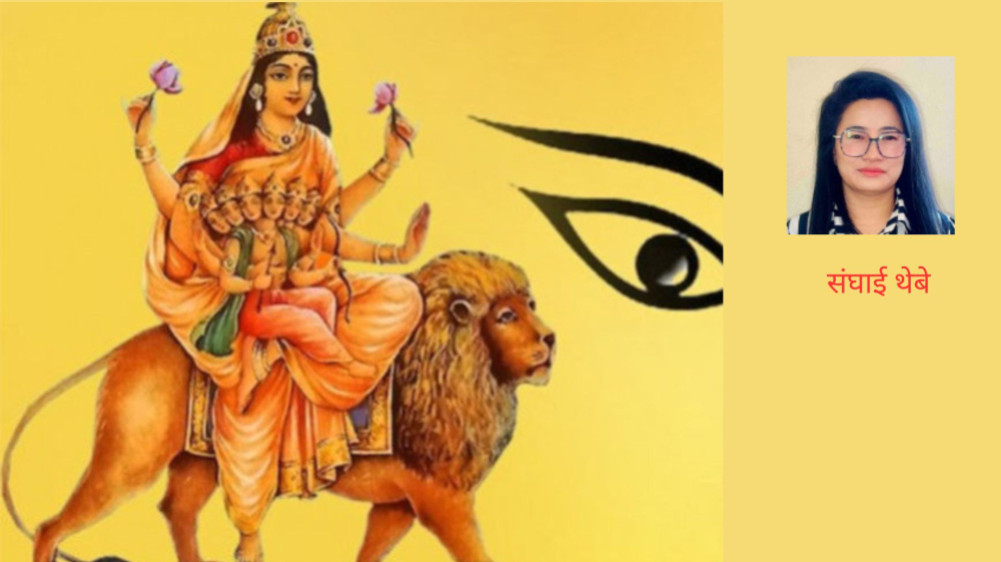
On the fifth day of Navratri, Goddess Skandamata is worshipped. Maa Skandamata is Parvati, the daughter of the Himalayas. According to mythology, the goddess seated on the throne with her son Skanda Lord Kartikeya in her four-armed lap represents motherly love, as well as being considered a symbol of motherhood.
Skanda means mother (goddess) of Lord Kartikeya. Vatsalya's idol is Sankadmata, hence the meaning of Yin's name is Skandamata. According to mythology, she was the mother of Lord Skanda, the commander of the gods in the Devasura War, Skandamata appeared as the fifth incarnation of Durga to protect Kumar Kartikeya. If Skanda's vehicle is a lion, the goddess always seated on a lotus flower can be known as Padmasana Devi. Skandamata was the power to create new consciousness in worldly life. There is a religious belief that worshiping Skanda Mata will make it easier to have children.
Sixth day: Worship of Katyayani
On the sixth day of Navratri, Katyayani, the sixth form of Navadurga, is worshiped. Katyayani was born in the house of Maharishi Katyayana as the daughter of sage Katyayana. This is why the sixth incarnation of Durga is called Katyayani.
On the four arms of the goddess, the upper right hand is in Abhayamudra and the lower hand is in Varamudra, the upper hand of the left hand is adorned with a sword and the lower hand is adorned with a lotus flower. According to the scriptures, the power of Katyayani is included in the form of Bhadrakali, Chandika, Kali. Katyayani Devi is considered special for Yoga Sadhana, Tantra Sadhana
Seventh day: Kalratri worship
Shakti Kalratri, the seventh form of Durga, is worshiped on the seventh day of Navratri. It is also known by the name Shubhankari of Kalratri. Yin's name is made up of two words . Kala means death and night means darkness. Kaal also has two meanings, time, another death, which Kalratri merges its gap, which merges its gap between time and death in the form of motherhood, creative and compassionate nature of the dark night, Ashim night.
Kalratri is considered as a very terrible form of destroying evil forces like demons, monsters, and demons. It is found in the stories that Durga took Kalratri avatar to slay the demon Chanda-Munda.
Eighth day: Worship of Mahagauri
Ashtami Tithi and Navami Tithi are of special importance in Navratri. On Ashtami Tithi, Goddess Siddhidatri is worshipped. On the eighth day of Navratri, Mahagauri, the eighth form of Durga, is worshipped.
There is a religious legend saying that Mahagauri's meditation, memorization, worship will bring the greatest welfare to all the devotees.
Ninth day: Worship of Siddhidatri
The last date of Maharatri All goddesses are worshiped on Mahanavami date for the completion of Navratri. On this day, there is a religious belief that all the wishes and accomplishments of the seeker will be achieved by practicing Sadhana according to the classical laws and with complete sincerity.
The ninth day of Mahanavaratri is more important. Navami Tithi itself is considered to be a goddess. On the ninth day, Durga's form Siddhidatri is worshiped. On this day, complete with classical laws and regulations There is a mythological story, spiritual and religious belief that worshipers, devotees and seekers will achieve success with sincerity.
The form of Siddhidatri Devi contains all the forms of goddesses. Durga's nine Shakti name Siddhi who is considered as the goddess who bestows all kinds of siddhi.
(The author is a Dharmasanskriti scholar)