In Kanchanpur, more than half a dozen rivers flowing from Chure are carrying large quantities of wood. Division Forest Office Kanchanpur has been saying that there is a problem of lack of budget for collection.
We use Google Cloud Translation Services. Google requires we provide the following disclaimer relating to use of this service:
This service may contain translations powered by Google. Google disclaims all warranties related to the translations, expressed or implied, including any warranties of accuracy, reliability, and any implied warranties of merchantability, fitness for a particular purpose, and noninfringement.
Every year hundreds of trees are washed away along with floods in the river flowing from Chure. Some slopes are dry and some green trees are flowing. As the fallen trees cannot be collected in time, they flow into the river and mix with the river. Valuable timber including sal, sisau, vijaysal and khair from Chure and Bhawar areas is carried away by monsoon floods and brought to India.
In Kanchanpur, more than half a dozen rivers flowing from Chure are carrying a large amount of wood. During the monitoring of the Machheli River by the Division Forest Office last week, more than 80 trees of sal and sisau were found. In Barkha, hundreds of trees are flowing in the same river . In which even large ones from pole size to Sal and Sisou seem to have flowed.
'If we can collect it now, we can prevent it from being washed away to India, otherwise it will be washed away when there is a big flood,' said Subas Kunwar, senior forest officer of the Division Forest Office Kanchanpur, 'but now we don't have the budget to collect it.'
Now the trees brought by the flood from Chure and Bhawar areas are in the river . Along with the Mahakali, when there is a flood in Sunwara, Vanhara, Machheli, Chaudhar, etc., wood also gets washed away . "Some will be washed away, some will be buried in the river," said Rabindra Kunwar, president of Chure Conservation Network Kanchanpur.
It is estimated that at least 20/30 thousand cubic feet of wood will be washed away in one season. A budget of 3 million more is required for the collection of wood. The government has set a budget of 135 rupees for the collection of one cubic foot of wood. The argument of the Forest Office is that there is a problem in collection because the budget is not released immediately after the end of the financial year. The budget office provided by the government spends on labor wages and transportation. Senior forest officer Kunwar said that the provincial government is providing an annual budget of 5 lakh Harakari for this. The management of such wood is done by the district supply committee. There is a provision to auction the rest by giving 30 percent of the collected wood to the supply committee. Kunwar, a senior forest officer, said that there is a provision to provide the timber received by the supply committee at a cheap rate to those affected by disasters and other affected areas. He said that due to the low budget, trees of high value are washed away from various forests in the district.
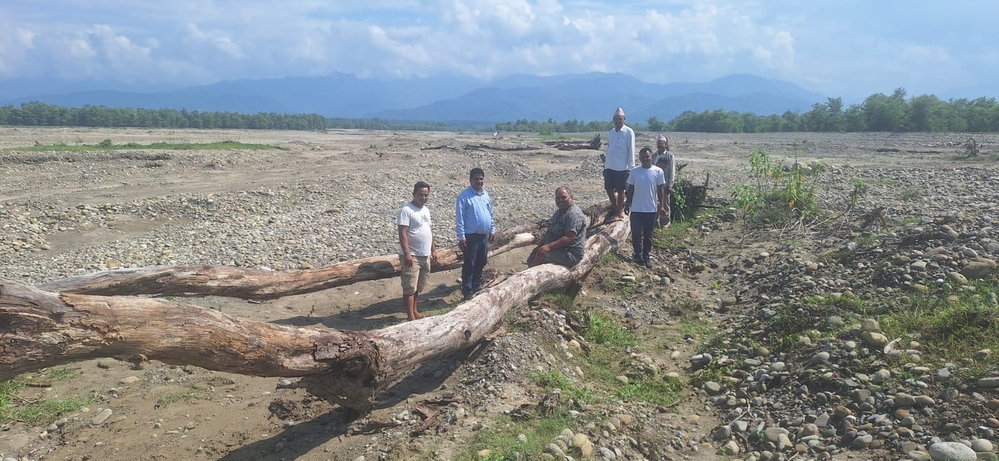
In the Brahmadev region, Khare river flows and the amount of wood flows and goes to Mahakali . In addition, the Doda river has carried away a lot of wood. If collected from time to time, expensive wood can be prevented from being wasted.
Till 2079, till June 15th, Dhalapada wood used to be collected from community and national forests. It would reduce the amount of wood flowing into the river channel to some extent . Dinesh Yadav, Head of Sub Division Forest Office, Kunda, said that due to the provision of collecting wood only from two years to Chait 15th, there is a problem in collecting the work thereafter. Yadav said, "During the dry season, permission should be given at the lower level for the collection of wood drifting in the river, it will facilitate immediate collection," Yadav said.
Except for Mahakali, most of the rivers flow through community forests. If the fallen trees near the community forest can be collected by the community forest, the amount of driftwood can be reduced. There is a provision that the consumer committee of the community forest area and the division forest office of the Chure area can collect it. Therefore, there is a problem in the collection of wood flowing from Chure area. The wood that flows in the river is mostly in the national forest area . Kunwar says that the wood can be collected by the division forest office or local level forest branch. "We don't have a budget, there is a situation of confusion because there is no mechanism at the local level," said Kunwar, "again, collection is not that easy during the dry season." The risk is high.'
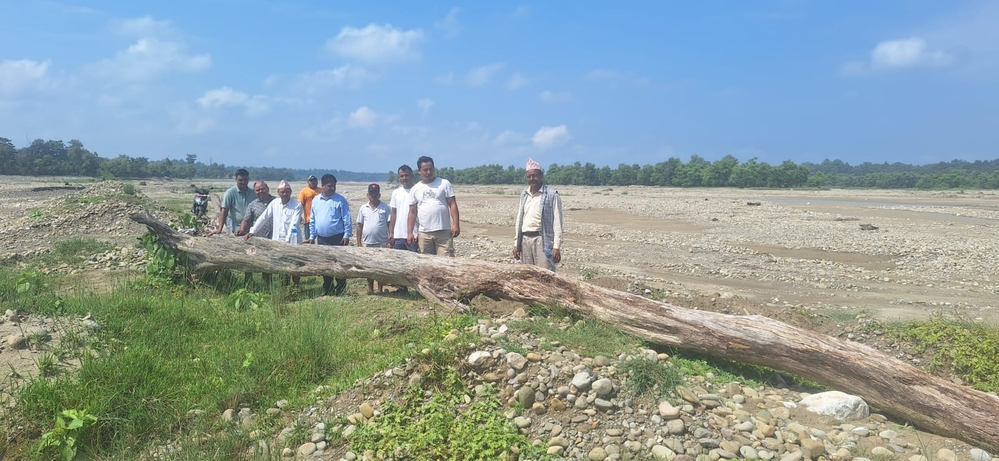
Division Forest Office has completed the collection of fallen trees within February/April. Community forest also has to work accordingly. It is not allowed to enter the forest during summer. It seems that the amount of driftwood can be reduced to a certain extent to be collected even at the end of May before the rains.
"It is not possible to do this by just one party, if all the stakeholders from the forest office, community forest, local level can work together, we can get benefits by collecting driftwood," Kunwar said, "It is not possible without the cooperation of all agencies and levels."
Shivdutt Pant, President of Community Forest Consumer Federation Kanchanpur, says that the state government needs to make a procedure for the collection of endangered wood. "It would be easier if the right to collect and use wood at risk is given to the community forest, if it is given to the division, it will be delayed again." Pant's argument is that collection will be easier because community forest can employ local people even on loan.
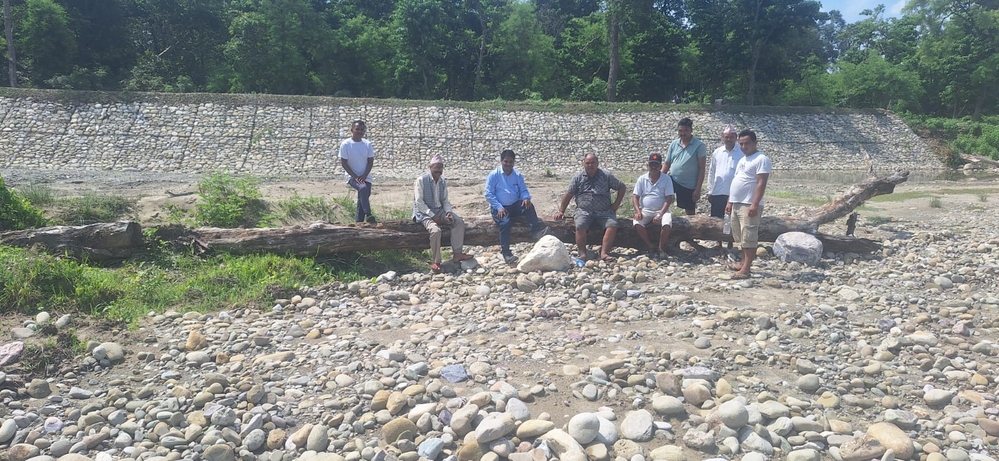
Landslides and erosion are increasing in Chure area due to uncontrolled exploitation of river channels. Because of this, the forest trees in Chure and Bhavar are at risk. Those same trees are brought by the river during the dry season.
The flood of Mahakali also destroys the park
The flood of Mahakali river is also destroying the forest area of Shuklaphanta National Park. The western part of the park has been regularly eroded by the Mahakali River for a decade . "Last year, the flood of Mahakali has done more damage," said Purushottam Bagle, conservation officer of the park.
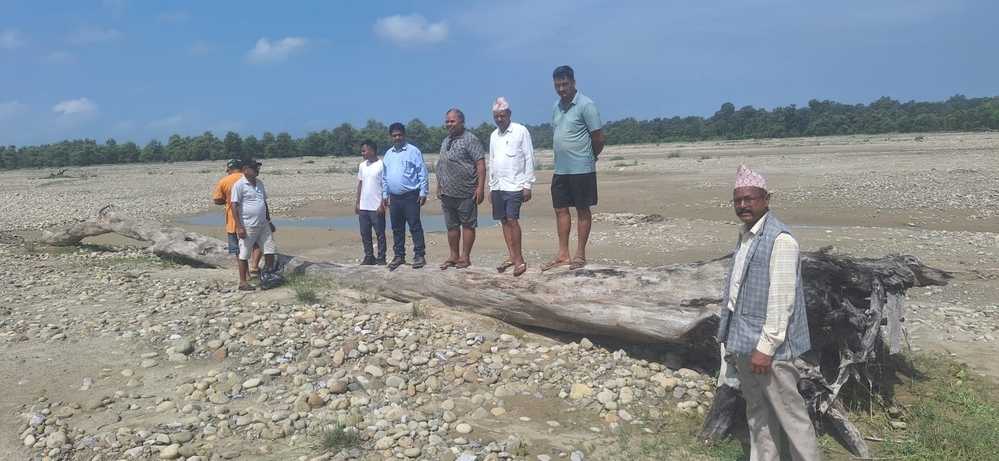
It seems that even the Shuklaphanta grassland of the park is at risk due to the annual erosion. The Shuklaphanta grassland is the prime habitat of the bivalve. According to the last count, there are more than 23 hundred twelve horns. Although the park administration has taken initiatives to control the erosion, the work has not been done so far.
The Mahakali is regularly cutting across a length of about one kilometer . About 50 to 100 meters are being cut every year. Conservationists say that there is a risk that the flood of Mahakali may enter the grassland if it is not prevented in time.

