The Nepal Pediatric Society has said that the 'Swarnavindu Prashan' program, which has no scientific certification, will only waste the state's investment and there is a risk of negative impact on a large number of children if the ministry runs it as a program, so this campaign should be stopped immediately.
We use Google Cloud Translation Services. Google requires we provide the following disclaimer relating to use of this service:
This service may contain translations powered by Google. Google disclaims all warranties related to the translations, expressed or implied, including any warranties of accuracy, reliability, and any implied warranties of merchantability, fitness for a particular purpose, and noninfringement.
The Swarnabindu Prashan program started by the Ministry of Health and Population to feed children without any solid scientific basis has become controversial.
The Nepal Pediatric Society has demanded that the 'Swarnavindu Prashan' program be postponed immediately, saying that there is no scientific evidence available so far about 'Swarnabhasma' feeding children as an 'immune booster'. Parents are also in a dilemma whether to feed their children or not after the Society of Pediatric Specialists issued a statement and objected.
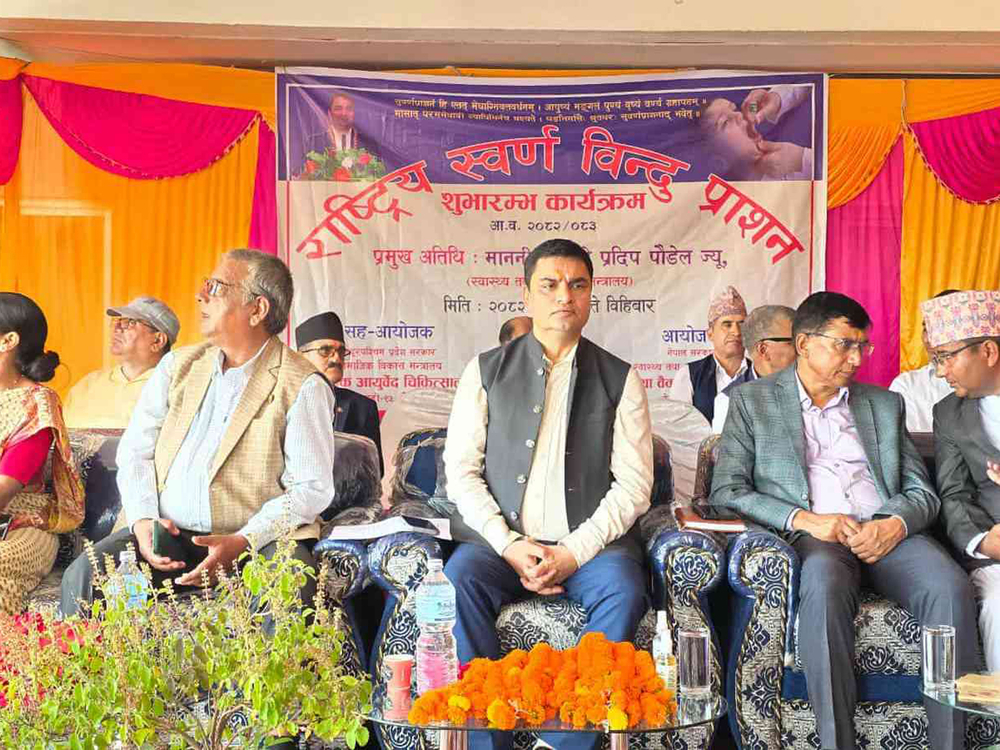
Health and Population Minister Pradip Paudel recently approved the 'Swarnavindu Prashan Program Operation Guide for Children, 2082' and formally started the 'Swarnavindu Prashan' program by feeding a child of Dhangadhi with gold ash. The ministry has also allocated a budget of 80 lakh rupees in this financial year to run the campaign across the country.
'Swarnavindu Prashan' is a semi-liquid mixture prepared by mixing Swarna Bhasma, Madhu (Honey) and Brahmi Ghrit using the classical method . Brahmi Ghrit is cow's ghee prepared with a mixture of herbs like Ghodtapre . Swarnabhasma is a modified product prepared by burning high carat gold using traditional method in Ayurveda medicine industry . In the
directory, it is mentioned that Swarnabindu Prashan should be fed to children from 6 months to 5 years old once every month. However, the Nepal Pediatric Society has asked parents and doctors not to feed 'honey' to babies under one year of age and to be careful until high-quality evidence is available about the 'immune boost' claim of Swarnabhasma. The society has requested the parents and doctors to feed Swarnabhasma only if it is proven safe after research.
The Nepal Pediatric Society has said in a statement issued recently - 'Official disagreement with the government campaign to feed Swarnabhasma (Swarnakalp) to children, as an 'Immune Booster'. As the scientific evidence, child safety, quality and risk and regulatory clarity available so far are insufficient, the lack of basis for 'boosting the immune system' from Swarnakalpa in infants, the registration/batch test of the Department of Heavy Metal (Gold) related to heavy metal (gold) and the registration/batch test of the Department of Drug Administration (DDA) have not been made public.' All pediatricians are of the opinion that lead, mercury, etc. have been found and cases of child-lead poisoning have also been registered and until the DDA's registration certificate number, validity and indications are published, Swarnabindu should not be given.
Nepal Pediatric Society Secretary Dr. Ramhari Chapagain said that the 'Swarnavindu Prashan' program, which has no scientific verification, will only waste the state's investment, and since the ministry runs it as a program, there is a risk of negative impact on a large number of children, so this campaign should be stopped immediately . "Various studies and researches have not found the fact that Swarnabindu Prashan increases children's intelligence, memory and speech," he said.
Society has asked to invest in breastfeeding, timely vaccination, vitamin-A, zinc for diarrhea, proper nutrition and timely treatment system rather than Swarnabindu Prashan to strengthen child health.
Nepal Ayurveda Doctors Association has claimed that the protest of Nepal Pediatric Society is meaningless. The association issued a statement on Wednesday saying that Swarnavindu Prashan is mentioned in the ancient book of Ayurveda (about 4 thousand years old) 'Kashyapa Samhita' and that Swarna Bindu Prashan contributes significantly to the development of children's physical, mental and disease resistance . In the
statement, it is said - 'In Eastern civilization, there is also a practice of sprinkling incense and honey in the auspicious ceremony of a newborn baby. Swarnavindu Prashan, an ancient practice of Ayurveda, strengthens the immune system of children. It also appears to be a good safe effective practice in the available evidence base.
President of Nepal Ayurvedic Physicians Association and Director General of Ayurveda and Alternative Medicine Department Dr. Shyambabu Yadav asserted that pediatricians cannot ignore research, traditions, values and culture in the field of Ayurveda by unilaterally protesting. Various studies have said that Swarnbhasma plays a positive role in the immune system of children. It is also the responsibility of modern medicine to build up the original medicine,' he said, 'We are aware of the effect of Swarnabindu Prashan.' "It has been found that the morbidity rate of the child has decreased, the memory has increased, and so far no side effects have been observed," he said.
Ministry of Health spokesperson Dr. Prakash Budhathoki said that the Provincial Ayurveda Hospital Dang has been running Swarnavindu Prashan program since 2079. "Until now, we have given Swarna Bindu to nearly 50,000 people," he said.
is a semi-liquid mixture prepared by mixing Swarna Bhasma, Madhu (Honey) and Brahmi Ghrit using the classical method . Brahmi Ghrit is cow's ghee prepared with a mixture of herbs like Ghodtapre . Swarnabhasma is a modified product prepared by burning high carat gold using traditional method in Ayurveda medicine industry .
How is Swarnabindu Prashan prepared?
3 mg of Swarnabhasma, 1 mg of honey and 2 mg of Brahmi Ghrit are used to prepare Swarnavindu Prashan. After that, by placing Swarna Bhasma in the Khalva Yantra, add honey to it and gently stir it for three minutes and then add Brahmi Ghrit and the mixture is prepared . The medicine thus prepared is kept in an airtight glass bottle . And it is best to use within 24 hours of preparation.
Swarnabindu Prashan should be fed to which age group and how often? And what are the precautions to be taken?
Children from 6 months to 5 years are fed once a month and 12 times a year. This is free distribution . It is prohibited to feed children with fever, diarrhea, cough, cold, and cold. It is considered appropriate to eat it on an empty stomach. It is recommended not to give food to children for 30 minutes after consumption and to report immediately if any adverse effects such as nausea, vomiting, or allergy occur. Parents of children with allergies or weak immunity are asked to use it only after consulting a doctor .
What are the benefits of feeding Swarnabindu Prashan?
According to the books and scriptures of Ayurveda, it helps in the physical, intellectual and mental development of children as well as increasing immunity. It also helps to increase memory, make speech clear .
How much the government is investing in this . How much does it cost the government to feed one child with gold?
The Ministry of Health and Population has allocated a budget of 80 lakh rupees for the current financial year to run the Swarnavindu Prashan campaign. 10 lakh drops are prepared for 80 lakh rupees . 1 drop equals 0.05 mg . 1 drop for 6 months to 1 year, 2 drops for 1 to 2 years, 4 drops for 2 to 5 years . One drop is worth 8 rupees. Location of
program
Provincial Ayurveda Hospitals of Dang, Dhangadhi and Jhapa, University Ayurveda Teaching Hospital Kirtipur, Ayurveda Hospital Naradevi, National Ayurveda Panchakarma and Yoga Service Center Budhanilkanth, District Ayurveda Health Center Morang, Gandaki Ayurveda Hospital Pokhara, Dhaulagiri Ayurveda Hospital Baglung, Regional Ayurveda and Alternative Hospital Tanahu, Lumbini Ayurveda Medical Center Butwal, Raptilaya Ayurveda Hospital Dang, Bardia Ayurveda Gulriya Health Center, Provincial Ayurveda Hospital and Research Center are in Surkhet .
Similarly, Ayurveda health centers in Dailekh and Jumla, Ayurveda and alternative hospitals in Parsa, Dhanusha, Sarlahi, Kathmandu, Lalitpur, Bhaktapur, Chitwan, Nuwakot, Makwanpur are feeding.

