According to the data of the Ministry of Agriculture and Livestock Development, in July last year, 52 lakh 43 thousand kg of apples worth Rs 72 crore 99 lakh were imported from China and 40 lakh 50 thousand kg of apples from India worth Rs 32 crore 44 lakh.
We use Google Cloud Translation Services. Google requires we provide the following disclaimer relating to use of this service:
This service may contain translations powered by Google. Google disclaims all warranties related to the translations, expressed or implied, including any warranties of accuracy, reliability, and any implied warranties of merchantability, fitness for a particular purpose, and noninfringement.
Although apples are produced in the Himalayan districts of all the 6 provinces except Madhesh, the import is increasing every year. In the first month of 2082/2083, only in July, 92 lakh 94 thousand kilos of apples worth 1.5 billion 44 lakh rupees have been imported. Nepal mainly imports apples from China and India.
According to the data of the Ministry of Agriculture and Livestock Development, 52 lakh 43 thousand kg of apples worth Rs 72 crore 99 lakh were imported from China and 40 lakh 50 thousand kg of apples from India worth Rs 32 crore 44 lakh in July last year.
In 2081/82, 92 million 253 thousand 125 kg of apples worth 10 billion 55 million 75 million rupees were imported. 7 crore 98 lakh 65 thousand kg of apples worth 9 billion 74 crore 16 lakh rupees were imported from China. According to the data of the ministry, 1 crore 3 lakh 87 thousand kg worth Rs 81 crore 59 lakh were imported from India. In 2080/81, 821 million 45 thousand kilos of apples worth 8 billion 44 million 89 million rupees were imported. 7 crore 11 lakh 81 thousand kg worth 7 billion 57 crore 46 lakh rupees were imported from China and 1 crore 8 lakh 81 thousand kg worth 85 crore 89 lakh rupees from India. This year, 20,000 kg of apples worth 4.4 million rupees were imported from New Zealand. Karnali in
production, Gandaki in productivity
Although there are around 12 thousand 494 hectares of apple cultivation in the country, the production area is 6 thousand 285 hectares. In 2080/81, 54 thousand 506 tons of apples were produced. Apple productivity is 8.67 tons per hectare. Although Karnali province is ahead in terms of production, Gandaki is first in terms of productivity. Apple cultivation is mostly in Karnali province. Production is also done in Karnali. But productivity is in Gandaki province, the ministry said. In Karnali, 8 thousand 928 hectares are cultivated, but the production area is 3 thousand 651 hectares. In 2080/81, 32 thousand 952 tons were produced in Karnali. Productivity is 9.03 tons per hectare. During this period, 9,644 tons of apples were produced in Gandaki. Gandaki has 851 hectares of land suitable for apple production. According to the ministry, the productivity is 11.33 tons per hectare. According to the ministry data, 5 thousand 115 tons were produced in Lumbini. Apples are produced on 695 hectares of cultivable land in Lumbini. The productivity is 7.36 tons per hectare, the ministry said. 4,07 tons of apples have been produced on 574 hectares of land in Far West, 1,933 tons of apples have been produced on 333 hectares in Koshi. According to the ministry, 885 tons of apples were produced on 851 hectares of productive land in Bagmati.
The import of apples will not stop for another 10 years, says the official of the ministry. Although there is a possibility of producing fruits such as pears, groundnuts, tree nuts, apples are more preferred," said Ramakrishna Regmi, senior statistics officer of the ministry, "recently, it is no longer believed that the road network has failed to reach the market. After the road network was connected everywhere, the wasted apples have come to the market. To increase apple production, seed production has also been started in Mustang.
In the absence of a cold store, fresh apples in the market
Bhim Bahadur Rokaya of Simkot rural municipality-7 of Humla has planted about 300 apple seedlings in about 9 nurseries. Out of that, about 50 quintals of apples were grown from 200 plants that produced last year. He is preparing to send apples to Nepalgunj and Surkhet by road this year and is in the process of picking apples. "It is not possible to send it out by paying 120 rupees per kg on the ship," he said, "Now that the road has been connected to the village, it is not difficult to earn 3/4 lakh a year by selling apples." Dan Bahadur Budha of Simkot-6 has also prepared to send apples out this year. About 250 apple trees are planted in 7 plantations and 100 trees are producing in his garden. He is ready to export at least 40 quintals of apples this year.
After Humla headquarters was connected to the national road network on June 22, the apples of Humla have started going to big cities by car. Apples have been cultivated on an area of about 518 hectares in all 7 rural villages including Simkot. According to the District Agricultural Development Office, apple production is about 4,000 metric tons this year. There was a problem of rotting of apples produced in Humla due to road inconvenience. About 25 large apple farms are operating in Simkot alone. Namgyal Tamang, the former president of Humla Industry and Commerce Association, said that even if only 80 percent of the apples produced get the market, within two years Humla will become independent from apples.
The apples of Dolpa, where apples are grown on nearly 800 hectares of land, have also started going out of the road since last year. But since the Jajarkot-Dolpa road is not paved and the bridges over the various rivers have not yet been built, out of the 7,000 metric tons of apples produced last year, only 4,000 tons of apples were produced, said Govinda Bahadur Malla, Agriculture Development Officer on behalf of the National Agricultural Modernization Project Apple Zone. According to him, apple production has increased this year. He estimated that about 8 thousand tons of apples were produced this year.
Along with Dolpa and Humla, the Himalayan districts of Karnali, Jumla, Mugu and Kalikot, apple grows in all the local levels. In Karnali, about 12,500 metric tons of apples are produced in Jumla in an area of about 3,100 hectares. Now there is a wave of apple cultivation in the villages of Jumla. Meen Bahadur Bhandari of Guthi Chaur Rural Municipality-5 of Jumla said that Fuji, Gala, Kinrad and Golden varieties of apples are being produced the most in Karnali. He has established an apple orchard for four years with an investment of around 22 million rupees. Last year, 80 metric tons of apples grew in his garden where he planted about 48,000 saplings. He said that the traders used to go to the garden to buy apples. The farm aims to produce two hundred tons of apples this year.
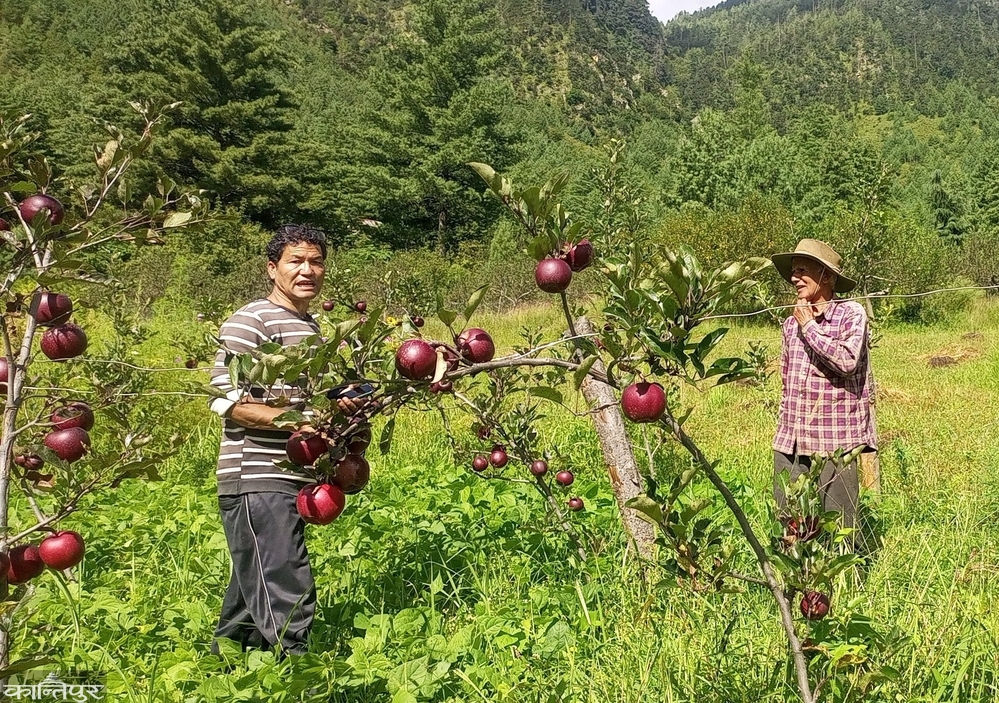
Now the demand for Jumli apples has reached the international market, said Tank Giri of Guthi Chaur-3. He has established an apple orchard by planting 14,000 saplings on 22 hectares of land with an investment of around 7.5 crores. "Earlier there was no road, when apples could not be delivered to the market, it was feed for cattle," he said, "now the demand is coming from all over Nepal, it has become difficult to meet the demand." The 14th District Council of Savik District Development Committee declared Jumla as an organic district in 2057 and put forward the concept of 'one house, one apple garden'. According to the data of District Agriculture Development Office, about 16 thousand out of 19 thousand families are involved in apple cultivation in Jumla. Farmer Manprasad Neupane said that now apples are being sold at 50 rupees per kg in Jumla. He complains that the importance of Jumla apple is decreasing due to lack of proper storage and management.
Businessman Lalit Budha saved the Karnali highway when it was blocked many times and it was killing the apple farmers. "The road closure is our destiny for years," said Karna Bahadur Budthapa, a businessman from Jumla, "even if the vehicle is stopped for 1 day, millions of apples rot." Now he is buying apples from farmers at Rs 50 per kg. Delivery to Surkhet and Nepalgunj along with purchase of cartons and vehicle transportation will cost an additional 20 rupees per kg. He complained that he is now having to sell apples for 100 rupees despite keeping them on rent in a cold store in Nepalgunj. He says that Indian apples are also being sold at Rs 120 per kg, so there is a problem in sales. According to him, except for those kept in cold storage, the season for getting Jumli apples ends after Dasain-Tihar.
Another businessman Manoj Bohra said that apples costing Rs 50 per kg in Jumla are sold up to Rs 250 in Kathmandu. "There is a difference of 200 rupees per kilo between the consumer and the farmer, and transportation, packaging and grading costs a maximum of 50 to 70 rupees," he said, "The biggest benefit is the traders and middlemen in Kathmandu."
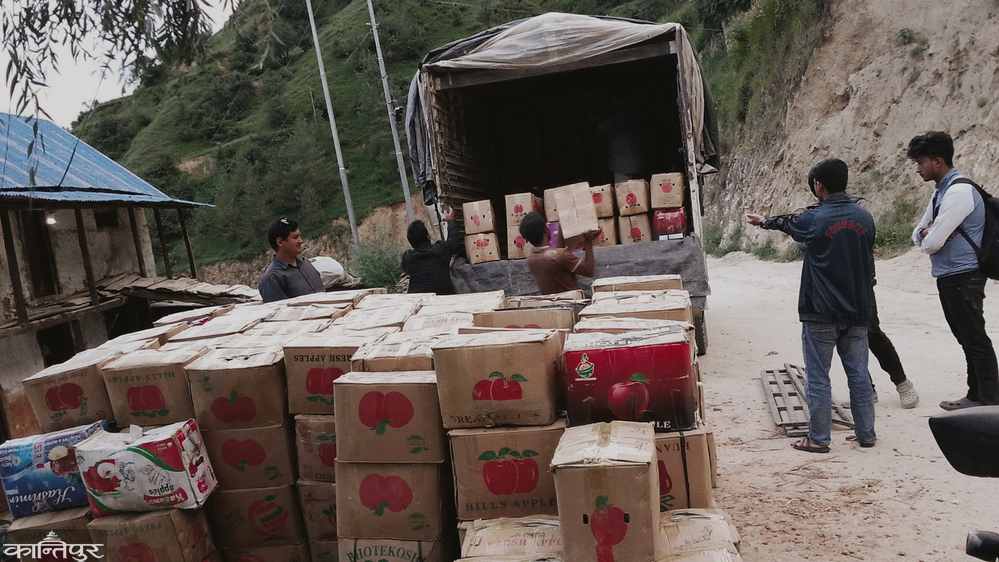
According to the data of the Ministry of Land Management, Agriculture and Cooperatives of Karnali Province, apples are being cultivated on an area of 3,419 hectares in Karnali. According to the ministry, 31 thousand 1 hundred 2 metric tons of apples were produced last year. Acting Secretary of the Ministry Parashuram Rawat said that it is estimated that apples will be produced in the same area this year. According to him, due to storage problems, lack of grading, road inconvenience, problems in packaging, there is a problem in getting Karnali apples to the market and getting a good price. "Farmers have not been able to get the market and price as they said. Farmers sell apples at 50 rupees per kg, the price is 125 rupees in Surkhet and 250 rupees in Kathmandu," he said.
Trucks carrying food and construction materials from Surkhet and Nepalgunj now return loaded with apples from Jumla, Mugu and Kalikot. Some farmers of Mugu are sending raw apples to the market fearing that they will not be sold after the last week of July. Karna Bahadur Mahtara, a farmer of the local Mugu Talch, said that even though juicy and sweet apples will be produced after August 15, they are forced to pick and send some of them in August due to the fear that the apples will not be sold when they go to the cities. "Half of the apples were sent to the market raw," he said, "Even now, selling at 50 rupees per kg is hardly a problem. We have not been able to make as much profit from farming as we expected. If the wholesalers came directly and bought from us, we would have got some concessions." Acting Secretary Rawat said that the apples produced in Karnali are selling an average of 47 percent in the market from August to October. According to him, Karnali apples are now reaching all over the country. He said that Karnali apples are organic because no chemical fertilizers, pesticides or any other chemicals are used. He says that if attention is paid to quality production, grading, leveling and packaging, the demand will increase in the international market as well. He informed that there was a problem in the production due to the infection of Lykira, Zhusilkira and the disease caused by the powdery mildew in apples.

