The families of Jhaljaliya, who have been hit by floods since 2006, have been forced to work as laborers in India for their livelihood.
We use Google Cloud Translation Services. Google requires we provide the following disclaimer relating to use of this service:
This service may contain translations powered by Google. Google disclaims all warranties related to the translations, expressed or implied, including any warranties of accuracy, reliability, and any implied warranties of merchantability, fitness for a particular purpose, and noninfringement.
Bhajani Municipality-4 of Kailali, Jhaljlia's district was Pahenlpur due to paddy fields. Farmers were busy harvesting paddy. Last year, on October 5, the flood in the Kandra river swept away about five hundred bighas of paddy fields in Jhaljaliya in a moment. The Bhimaladevi Lwar family bought 10 kattha of agricultural land. In the second year after buying the land, when the crops were being brought in, all the land including the wet rice was destroyed by the flood. Devar Chandra's family left the village and went to Bangalore, India after the land was destroyed. Bhimaladevi's husband, Jasya Luar, is ill and cannot walk. Bhimaladevi of old age is now like dying or living.
In Jhaljaliya, like Bhimaladevi, about 50 bighas of 42 families were destroyed by last year's floods. The river flowed in the ripening crops . Every family had paddy cultivation from 10 kattha to one bigha . 15 families including Rang Bahadur Dhami, Rang Bahadur Shahi, Chartubhuj Bam and others became homeless and moved to Jhaljaliya camp to seek shelter.
'No one had less than 10 kathas . When we were about to harvest paddy, the flood suddenly hit us so that we could not cultivate it," said Tek Bahadur Rawal, a local. Now the river is flowing next to our land.' After Kandra named the farm belonging to 42 families of Jhaljaliya, they have also migrated a little further. "Every time, the rice grains hanging on the land that is made of that soil keep moving around in the eyes," said the local Nirmala Devi Deuba.
The story of the suffering of the residents of Jhaljaliya due to the flood of Kandra is long . The flood that occurred for the first time in the year 2006 displaced more than 200 families. On the land where they are farming, the bank of Kandra has now formed. "Hundreds of bighas of arable land have now become barren," local Dil Bahadur Budha said, "Our everything is gone." Many other families were devastated.'
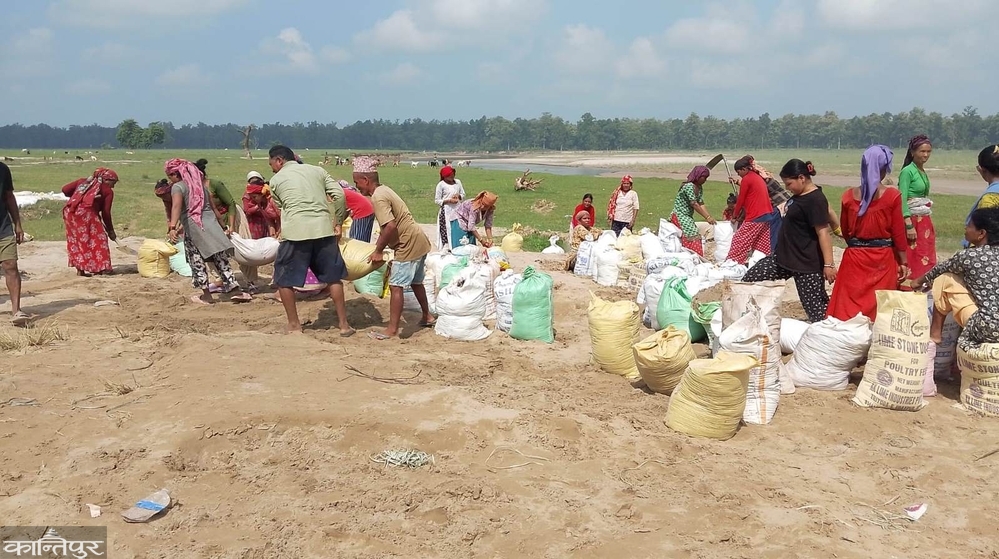
After Kandra built a farm, now there is no family in Jhaljaliya who has not gone abroad for livelihood. According to the members of the village development organization formed by the municipality, there are about 380 families living in Jhalzhilia. Some other families have been displaced forever. After the land was washed away, they were forced to leave the village in search of a way to feed themselves,'' said Bhalmansa Bharat Choulagai of Jhaljhlia.
Ganesh Kathayat left the village and went to Bangalore after his family's one bigha farm was completely covered with sand. Locals said that 20 families including Tej Bahadur Bhul, Siddha Vik and others have also left Thatathal . After the land is washed away, the families living in the village have no other means of income . Therefore, the son in some house, the father in another has entered India to work. I also just returned from working in Nainital, India for five months. I earned 50,000 baht in five months," says Tek Bahadur Budha, secretary of Devithan Toll Development Organization, "my son is preparing for public service in Kathmandu. He has to pay for his expenses.'
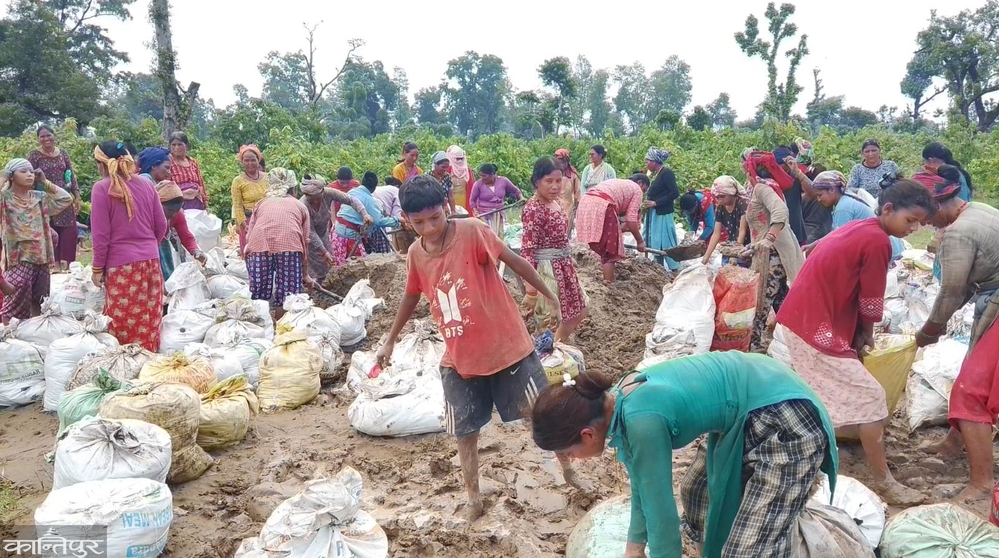
With the aim of advancing the development of his village, tol, and society, a tol development organization has been formed from village to village in Bhajani in collaboration with colleagues. Those organizations are now doing community development activities. Locals complain that no government agency has done anything to prevent river erosion.
'Last year, after the flood caused damage, an allocation of 11 lakh rupees was made by the municipality. Ward 4 President Janataram Choudhary said, "The residents of Jhaljaliya are always under the threat of erosion." The budget was frozen because the consumer committee could not work in the last financial year. ``The consumer committee did not have cash to collect construction materials like saria and cement, nor did they get loans. "The budget was frozen because it could not be done on time," he said.
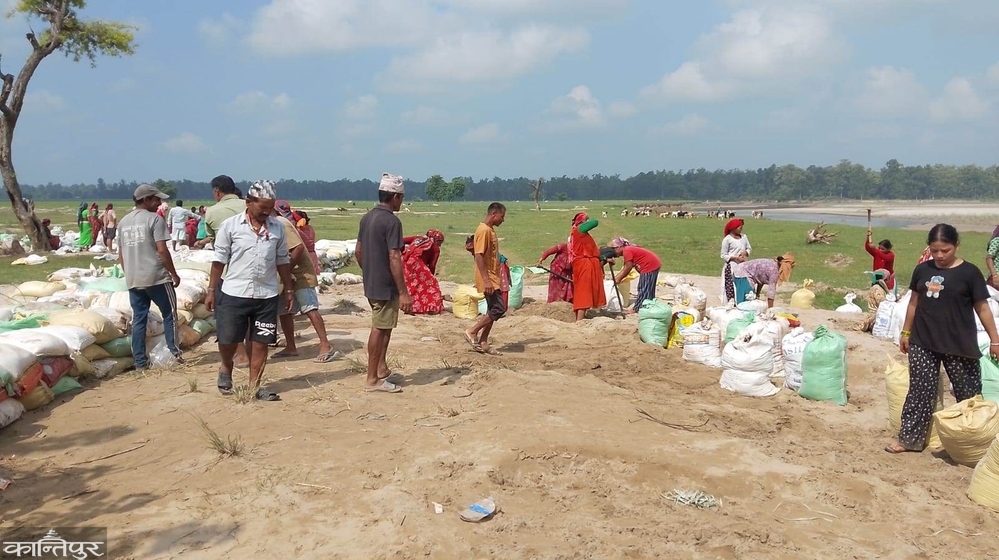
The residents of Jhaljlia, who lost their farms due to the lack of support from government agencies, are now trying to build biological embankments to prevent river erosion through Toll Development Organization. According to Ram Air, working in the cooperative society, five toll development organizations have been formed in Jhaljaliya.
380 families including 60 households belonging to Pratikshalaya toll development organization, 150 belonging to Chetansheel, 41 belonging to Kalika, 80 families from Badimalika and 52 families from Devithan toll development organization are involved in biological embankment . They recently collected 1/100 rupees from every house and bought bamboo, bags and other necessary materials. Deciding that one person from every family must be present, they volunteered to make biological embankment to prevent river erosion.
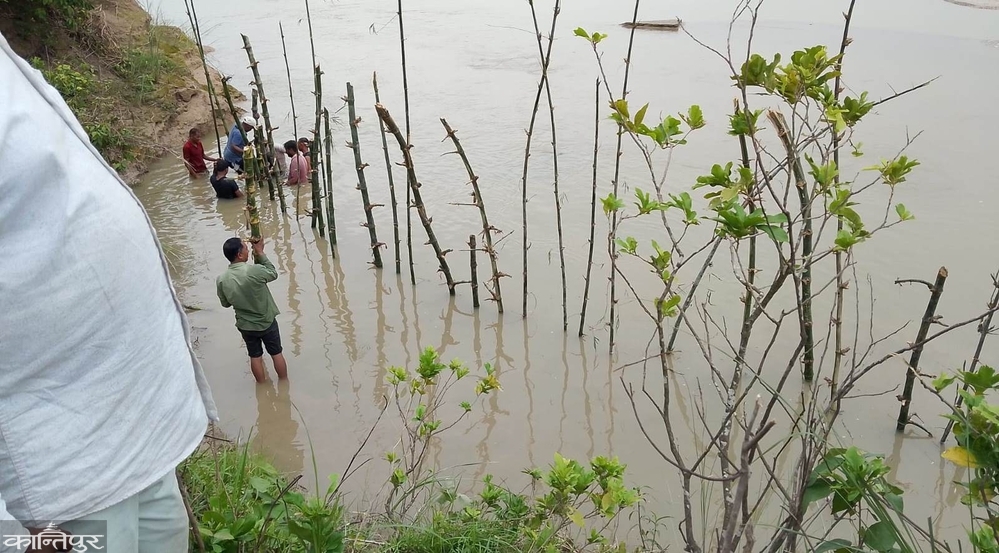
Tek Bahadur Rawal, Secretary of Devisthan Toll Development Organization, says, "We collected money from every house and donated labor for 12 days". Even if there is no big flood this year, even the biological dam has not been able to stop the flood and rise above it. According to Rawal, 52 families are at high risk of flood. He said that they are filling sacks with soil by burying them at the cutting site.

