We use Google Cloud Translation Services. Google requires we provide the following disclaimer relating to use of this service:
This service may contain translations powered by Google. Google disclaims all warranties related to the translations, expressed or implied, including any warranties of accuracy, reliability, and any implied warranties of merchantability, fitness for a particular purpose, and noninfringement.
Jaiprakash Pandey of Yashodhara Rural Municipality-2 Bhavpur used to spend about 45/46 thousand for plowing and weeding 8/10 years ago to prepare for planting in 75 Kattha fields. It used to take up to 10 days to work in the fields. On top of that, it was equally difficult to find farmers. Now he is not worried about farming or preparing the plough. Now he has started farming using modern agricultural equipment and he is not only happy but also amazed at the savings in cost, labor and time.
"After starting planting with cultivator and rotavator, both cost and time have been saved," he said, "now it costs 23/24 thousand to plant in the field". Ramdas Kebat of Bhavpur is also surprised to be able to cultivate using agricultural equipment.
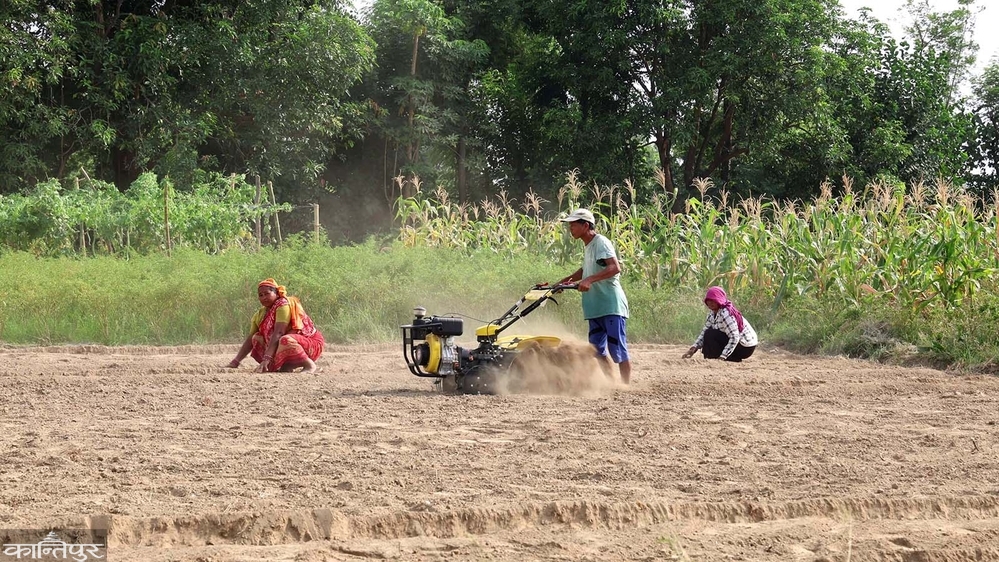
In this village where 60 families live, Kebat has only one hall bull . He does not use oxen to plow the field and plant the crops more than 80 katha. He now plows all his fields with cultivators and rotavators and cultivates them with combine harvesters . The use of bullock carts has also decreased in his house . "There is no wood to make ploughs, to drive oxen, let alone plow," he said. He said that bullock carts are only being used to throw manure in the fields and to carry grain.
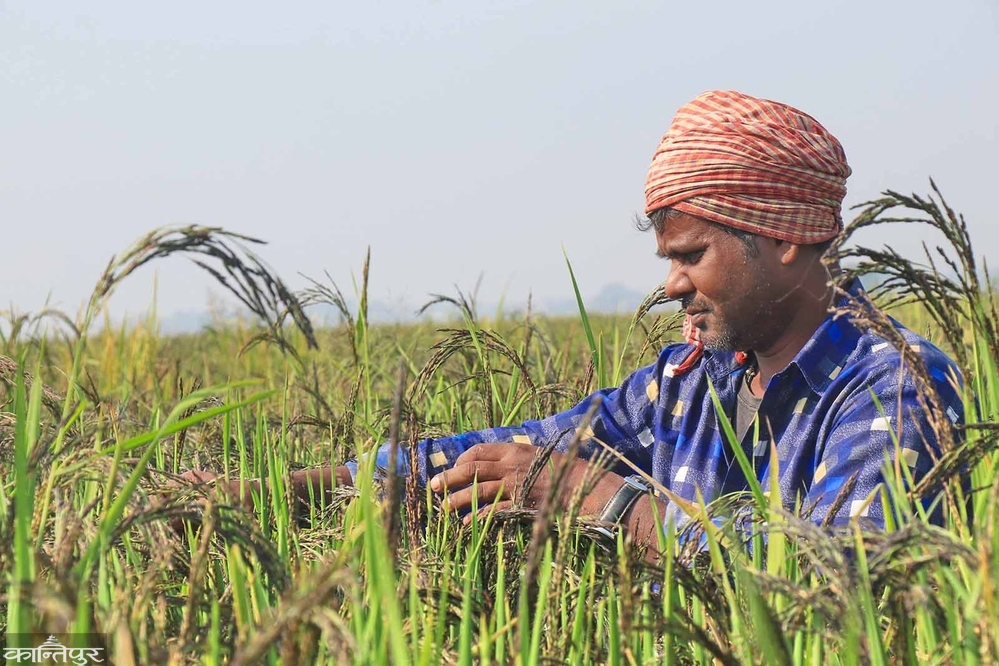
The use of modern equipment is increasing among the farmers who have been making a living through traditional and subsistence farming. The agricultural equipment that is being developed over time has made the farmers and the agricultural sector easier. That is why the farmers here are using mechanical tools to sow mano and bring in muri . Farmers' interest in mechanization has increased as the government subsidies and production costs are reduced for the purchase of tools.
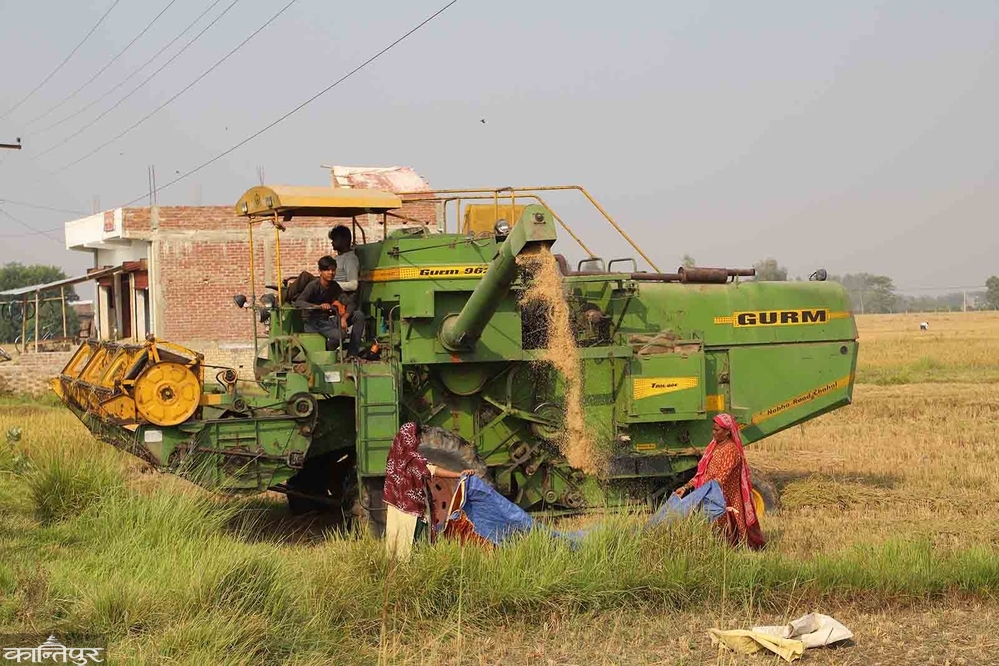
According to the head of Krishi Gyan Kendra, Bhaskar Paudel, the farmers are going to use modern agricultural equipment as the cost of production will almost double due to high wages and lack of skilled workers in traditional technology. He said that the stress of not getting a farm has been relieved now that the machine has started working. He said that 90 percent of the farmers in the district are using tools to cultivate and grow crops. Easy, low cost and increased income. If the development and use of equipment continues at this pace, the attractiveness of those looking for a future in agriculture will increase," he said.
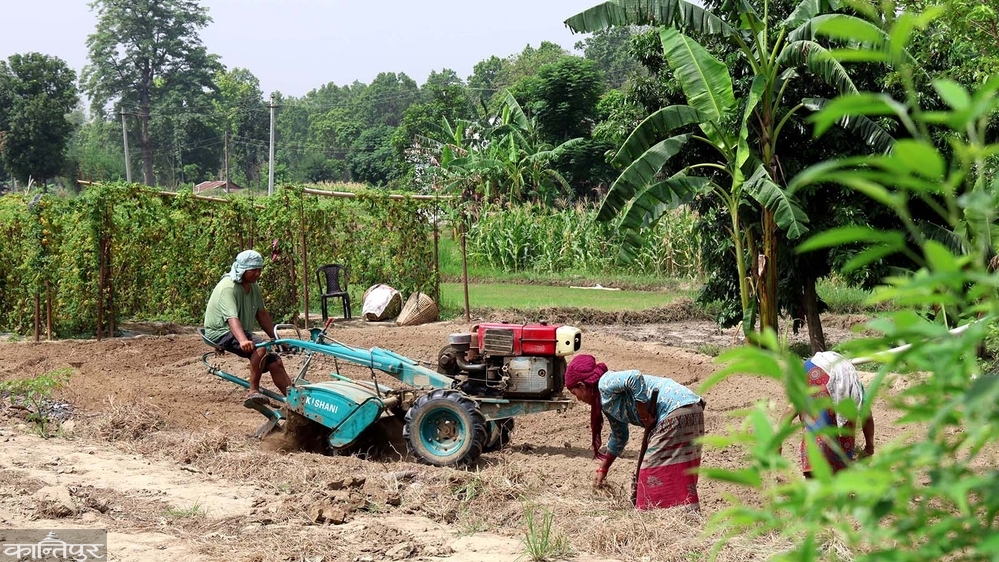
Now most of the local levels have started distributing small to large agricultural equipment to the farmers with subsidy and cost participation, and the enthusiasm among the farmers has increased . In the district, mini tillers are used to prepare the land for sowing seeds by plowing fields, power tillers are used to prepare the land before planting crops and cultivators are used to cultivate the fields . Similarly, cultivators, combine harvesters, threshers, tractors, chaff cutters, spares and reapers are used to make the soil fine.
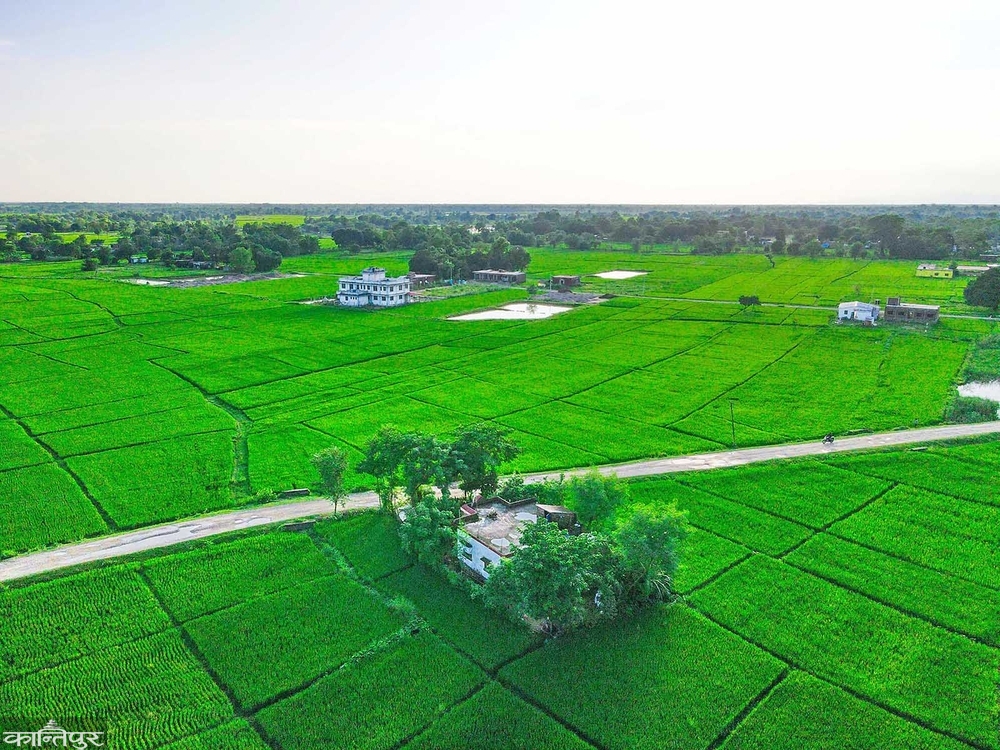
Similarly, boring, pumpset and motor are used for irrigation . Sowing and planting machines are used less here . For the seeds used for planting, the farmers find it difficult when they have to put the seeds in the bed differently at the beginning. There is no paddy planting machine in the district. Plowing is done here up to three times before planting paddy. Some people plant rice for the second time . It costs about 20,000 to plow 30 paddy fields once using a plow. Ramsurat Pal, Information Officer, Senior Agricultural Extension Officer of Krishi Gyan Kendra, said that plowing a field with a rotavator once would cost 9,000 rupees. It takes 1,800 human resources to harvest three paddy fields.
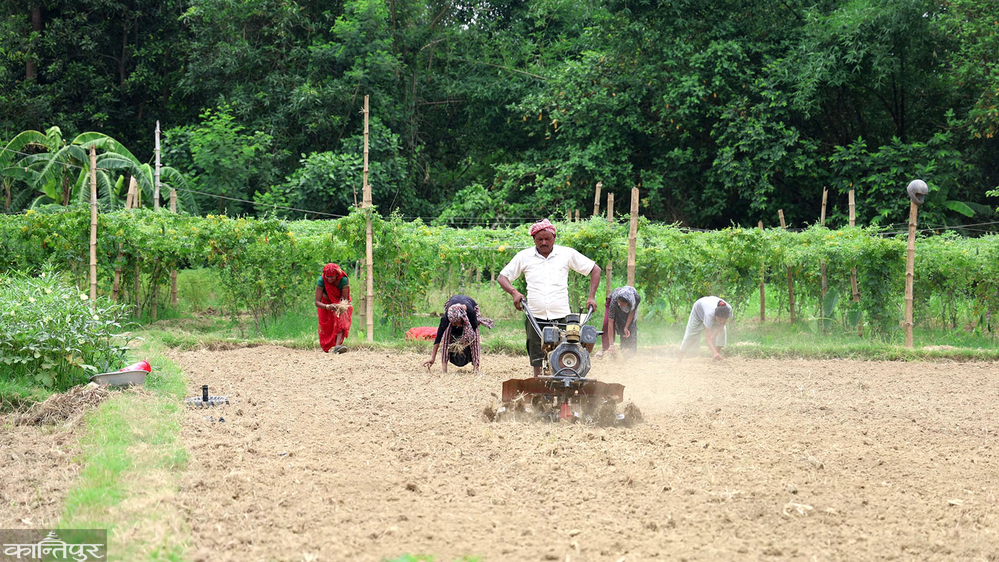
"The combine harvester cuts about 4 tons of paddy fields at 1,200 and puts them in the fields," he said, "The laborers plant all day long." A combine harvester cuts and cares in a snap. It is expensive if you have to pay extra money to carry the rice harvested by people as a burden.' According to him, if the seeds are placed and planted by machine, it reduces the cost of production by 25 percent and increases the production by 20 to 30 percent. He said that the use of technology has greatly facilitated the farmers who could not farm due to the fear of not getting agricultural workers and high production costs.
Lately, the use of machines to plant paddy is also increasing in Terai . Along with the saving of wages and time, the farmer's interest in the machine is increasing as less water is needed. A medium-sized paddy planting machine costs about 15 lakh rupees. The head of Krishi Gyan Kendra, Bhaskar Paudel, said that 10 fields can be planted with the machine in an hour. He said that it will cost about 3,500. It takes about 6,000 wages from the laborer to plant 10 katta fields . If 9 people plant all day long, 10 paddy can be planted. To be planted by the machine, the seeds must be placed separately . The seeds should be picked differently and placed in the machine and planted. When people plant seeds, they need a lot of water. Planting by machine does not require much water, he said.
In 079/80, the Ministry of Agriculture and Land Management of the Lumbini State Government conducted a study in Kapilvastu and Banke in the hilly districts of Palpa, Gulmi and Terai and showed that 72 percent of the food crops and the rest of the vegetables, other and oilseed crops were mechanized. Similarly, it was found that the cost of plowing the fields in the hills in the traditional way was 2 thousand 590 rupees per plant, while it was found that 1 thousand 282 rupees were spent using the hand tractor. Similarly, it was found that the cost of cutting/threshing paddy in Terai is about 15,000 per hectare and 8,115 per hectare when using modern equipment.
The main inputs of agricultural production are land, labor, capital and management. Khursed Ahmed Khan, an agricultural expert, said that although other production materials are stable, the problem of labor in agriculture is becoming complicated in recent times. He said that the demand for mechanization has increased due to less manpower, time saving, production increase and relatively low cost. Due to the migration of young people abroad and the use of traditional labor in agriculture, the cost of agriculture has increased and the use of agricultural tools has started to increase slowly. "Agricultural equipment has not been women-friendly," he said, "If it is improved, it will have more impact." Having made agriculture his ancestral profession, he is growing gold in the soil today. Tired of farming in the traditional way, he has now become the owner of millions. He started farming with one katta 14 dhur and now he has added land and land to 120 katta . Vegetables are cultivated in about 60 kathas and rice, wheat, mustard and mustard are grown in the rest . "I use modern equipment and technology in all crops," he said, "I earn good income." There were a lot of problems when farming with people.' After the cost was high, the production was low and there was a problem with marketing, he bought a power tiller to plow the fields. Later, they got a mini tiller by spending 32,000 with 50% subsidy. He has studied the demand and price of vegetables according to the season in the market and planted them. He said that the annual income from agricultural work is more than 1 million. By farming with modern mechanization, skill and technology, they have built big houses in two places in the headquarters Taulihwa. Has a good understanding of how modern equipment is used.
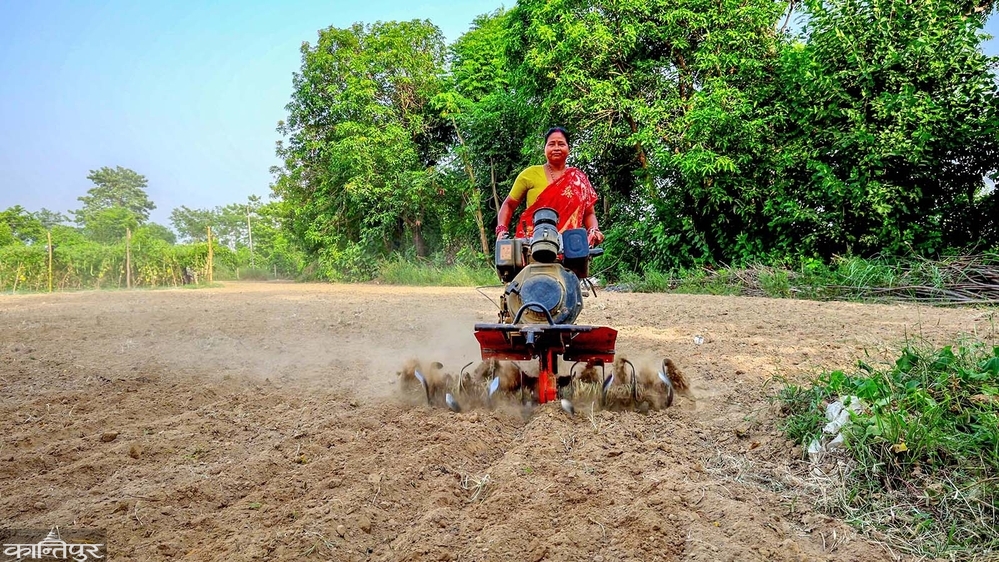
Recently, he has also won the first prize in Agrivastu Krishi Tara-2082 held in the district with the aim of honoring the farmers while promoting the agricultural sector. Received a certificate with one lakh cash for the award. "I am happy to win such a big prize for the first time," he said, "Now I will inspire the youth to find a future in agriculture". Budhisagar Shukla, the farmer leader of Maharajganj Municipality, said that mechanization in agriculture is indispensable to meet the manpower who is fleeing from the agricultural sector and to add youth attraction to agriculture. He said that agricultural mechanization will not only increase the productivity of agricultural products, reduce costs, but also help maintain the quality of produced agricultural products.
A study conducted in 067/68 showed that the main labor force in Nepal's agricultural sector is animals (bulls, snakes), followed by human labor and third by equipment. Now the situation has changed and mechanization has become the first. After the government introduced agricultural mechanization promotion policy in 2071 to increase agricultural productivity, to make it sustainable and competitive, now its impact has reached the people's level. In the agricultural development strategy, the aim was to increase access to tools and equipment among the farmers . Similarly, the implementation of the Prime Minister's Agriculture Modernization Program and the implementation of the Vegetable, Fish, Rice Zone Program seems to have increased farmers' access to mechanization. Ramakant Choudhary, a farmer of Krishnanagar municipality, said that the belief that farming is done only by humans and bulls/rangas has changed with the technology introduced in a short period of time. Although there are 83 thousand hectares of agricultural land in the
district, 81 thousand 576 hectares are being cultivated. Rice has been cultivated in 65 thousand 852 hectares. The productivity of rice is 4.2 metric tons per hectare. Wheat has been cultivated in 31 thousand 735 hectares. The productivity of wheat is 3.5 metric tons per hectare. Similarly, dal has been cultivated on 7,466 hectares, mustard on 4,361 hectares and corn on 1,390 hectares.

