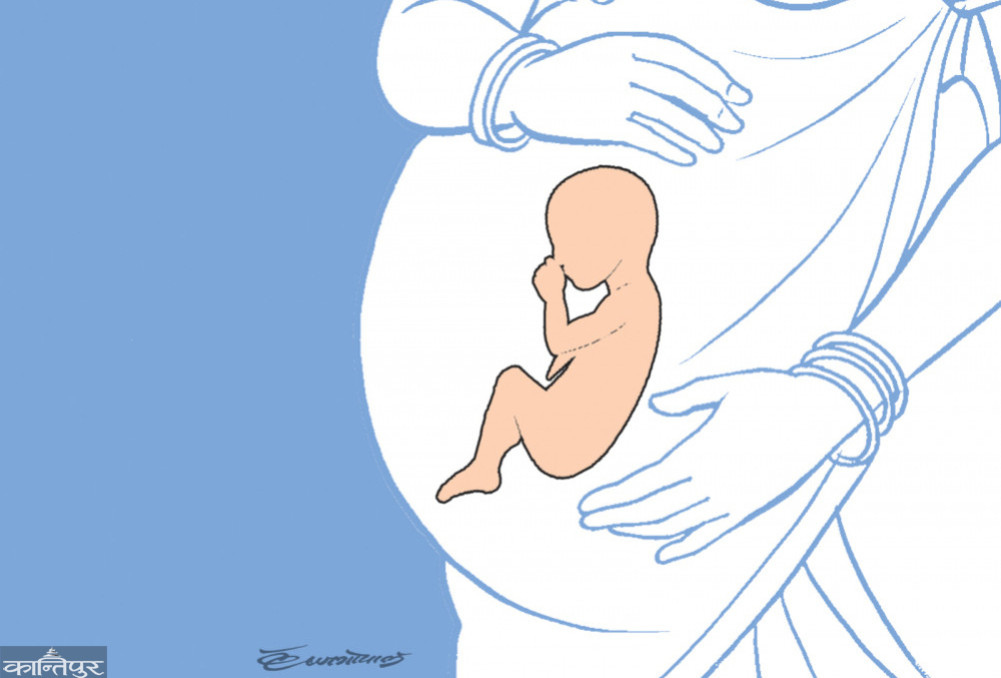
While safe abortion is being established as a reproductive right of women all over the world, in Nepal, the social stigma imposed on women due to abortion has not decreased.
We use Google Cloud Translation Services. Google requires we provide the following disclaimer relating to use of this service:
This service may contain translations powered by Google. Google disclaims all warranties related to the translations, expressed or implied, including any warranties of accuracy, reliability, and any implied warranties of merchantability, fitness for a particular purpose, and noninfringement.
An 18-year-old girl from Dailekh and a 17-year-old boy from Dolpa, who were studying at Birendranagar in Surkhet, were in a relationship for about one and a half years. Taking precautions, the girl suddenly became pregnant last May.
Struggling to live in Surkhet with the dream of doing something after studying, they decided not to marry immediately, and had an abortion. But after the society came to know about the abortion, the incident was criminalized. The society itself called the police and condemned them for committing immoral acts.
The young woman was arrested and taken into custody by the police when she had to eat nutritious food and rest after having an abortion. After the investigation by the police, a case was filed against the young woman, the young man and the drug store owner for causing illegal abortions. But after a month and a half they were all acquitted. Although acquitted by the court, the young woman had to face mental stress and social ostracism due to having an unwanted abortion during that period.
000
A 25-year-old man from Kanchanpur and a local single woman approached . The young man used to work in house construction, and they were in a relationship for about 3 years after they got to know each other. Due to not taking precautions during pregnancy, the woman got pregnant . This issue created chaos in their lives . It was not easy for them to have an abortion, they managed to reach the hospital - becoming husband and wife.
They didn't plan until they got married and got an 8-week abortion at the hospital with the same names as husband and wife. But due to excessive bleeding, the woman's family came to know . Then the matter reached the court through the police.
Not only the physical relationship, but also the abortion was done with the consent of both of them . But due to the fear of social stigma among women and the law regarding abortion, the woman accused the young man of rape and abortion, and the police prosecuted the case accordingly. The court did not believe that the young man committed forced labor, but imposed 1 year imprisonment and a fine of Rs 7,000 for the crime of abortion. The young man has been serving his sentence in the district jail since last February.
000
In Nepal, at one time abortion was considered a sin from a religious point of view, a socially immoral act and a crime from a legal point of view. But now it has been 23 years since it got legal recognition . While safe abortion is being established as a reproductive right of women all over the world, in Nepal, the social stigma imposed on women due to abortion has not decreased. The above are just a few examples of what kind of legal practice
is taking. The current law reflecting the patriarchal social thinking and its influence is also becoming an obstacle to women's rights over their own wombs.
Abortion against the will or by force of a pregnant woman is a crime. But if the same abortion happens with the woman's consent or naturally, in that case, the law should provide necessary support, facilities and treatment. But according to the current law, the government is also criminalizing the abortion performed by a pregnant woman with her consent.
Not only that, the law has also criminalized women by declaring abortion as a crime in the case of spontaneous abortion and premature stillbirth. Senior advocate Meera Dhungana says that although abortion is legally recognized, patriarchal thinking and society have not accepted it as a right of women. The womb belongs to a woman, a woman will carry it. The woman should have the right to decide whether to give birth or not,' she says, 'but here, even if the woman gets pregnant on her own whether she wants to or not, the woman is being jailed.' Senior advocate Dhungana says that due to the double, vague and insufficient provisions in the law, abortion is being criminalized.
The constitution has ensured the right to reproductive health as a fundamental right . The 'Safe Motherhood and Reproductive Health Rights Act', which came into effect from October 2075, provides that a woman can have an abortion up to 12 weeks with her consent. Similarly, there is a provision to terminate the pregnancy up to 28 weeks if the woman's life is in danger if she does not have an abortion, the child may be born with a disability, the pregnancy is the result of rape or incest, HIV or similar incurable diseases, and if the fetus cannot survive after birth or the fetus is disabled due to genetic defects . However, there is a provision that abortion is considered a crime even in the case of receiving such services from health institutions and trained registered health workers other than those designated by the government or even in the case of self-abortion, which does not seem practical.
'Abortion is a woman's reproductive health right . It's about her body . The crime related to this cannot be classified as a crime related to life," says senior advocate Dhungana, "because the state criminal code has classified abortion as a crime related to life, as soon as the police hear about the abortion, they first arrest the woman and take her to custody. There is an influence of patriarchal thinking . So many social insults are imposed that how will that woman survive in the society?'
Also, in the writ filed by Lakshmidevi of Ajaimeru-8 of Dadeldhura against the government in the Supreme Court, the bench of Justices Kalyan Shrestha and Rajendra Prasad Koirala explained on June 6, 2066 that abortion should not be made a 'part of the castle of life' in the law. But till now the government has not complied with it, nor has the existing law been amended.
The World Health Organization recommended in 2022 that abortion should not be criminalized and it should be completely decriminalized. Similarly, it was recommended that abortion should not be limited on the basis of pregnancy period or similar conditions and that the permission of a third person should not be required for abortion.
Likewise, the Convention on the Elimination of All Forms of Discrimination against Women (CED) monitoring committee also suggested to Nepal in 2018 to ensure that women should not be criminalized for abortion under any circumstances. But the government has not yet decriminalized abortion.
According to the Ministry of Health, currently only 19.2 percent of Nepal's health institutions have safe abortion services. Abortion services for 12 weeks or more are available in only 37 hospitals across the country . On top of that, only 42 percent of women know about abortion laws.
Currently, it is estimated that 53 percent of pregnancies in Nepal are unintended, and it is estimated that about 60 percent of unintended pregnancies are aborted. According to a study conducted by the Family Welfare Division and IPAS, the rate of unsafe abortion in Nepal is 52 percent.
This fact shows that high unintended pregnancies also have high abortion rates . On the one hand, access to safe abortion services is poor and on the other hand, the rate of unsafe abortion is high . In such a situation, while reducing unsafe abortions, the government should emphasize the expansion and awareness of confidential and reliable safe abortion services, but on the contrary, the government is criminalizing abortion.
Senior advocate Dhungana says, "On the one hand, patriarchy and the practice of social stigmatization of women continue". On the other hand, there are very few health institutions that provide safe abortion. Even when a woman has a safe abortion, there is no privacy. In this case, it is not appropriate to criminalize abortion as soon as it is done.
Dr. Head of Maternal and Neonatal Division under the Family Welfare Department has also alarmed health workers and doctors who provide abortion services. Gauri Pradhan Shrestha says. "Though the constitution ensures safe motherhood and reproductive rights, the law has not become practical," she says, "that's why in the report submitted by Nepal to the United Nations, France commented that 'you are still giving the death penalty to women.'" According to the current law, it is not easy for health workers to provide abortion services.'
According to him, the current law says that abortions above 28 weeks cannot be performed. While 5 percent of maternal deaths occur due to the poor condition of the fetus, the infant mortality rate is also high . In such complex situations, there should be a legal system to abort any period of pregnancy with the woman's consent. Shrestha says .
'A woman's life is the first, the mother's life is safe, the birth of a child has meaning, therefore, it is necessary to make a law to put the health and life of the mother as the first priority,' she says, 'If the pregnancy is over 28 weeks and the mother is dying, what is the meaning of that birth ? If there is a condition of disabled birth or a condition where the fetus does not survive even after birth, then what is the meaning of that birth?'
law has created a situation where abortions cannot be performed after 28 weeks and then if there is any problem in the pregnancy, the woman has to be left to die, she said. If a woman's life is likely to die because of her pregnancy, she should be allowed to have an abortion. If the child is born with dismemberment or dies after birth, there should be a provision for abortion,' she says. "The law has made it a condition that not only the service recipient, but also the service provider should look at the condition of the pregnant woman, but look at the law," said Dr. Shrestha says, "Because of providing abortion services, many health workers have to go around the police and courts". It is sad for us. Because of this, there are complaints that doctors refuse to provide services in many places.
According to him, the provision that health workers must undergo training and be registered is not practical. "Doctors who are gynecologists themselves, it is not practical for them to be retrained and get permission to provide abortion services, even though they are expert doctors, some health institutions have not been able to provide such services," said Dr. Shrestha says, 'Due to this, the customer has been inconvenienced.'
The police claim that in accordance with the provisions of the law, they arrest and prosecute cases in which abortion is a crime. Central spokesperson of Nepal Police DIG Ramesh Thapa claims that they are working sensitively in the case of pregnant women in the case of abortion. "The law has put abortion in the palace of life". The police will register a case as soon as they receive information about any incident, they will not arrest people without any inquiry or without investigation, we will arrest and investigate after conducting a phase of investigation, said DIG Thapa.
According to the ministry, currently safe abortion services have been extended to all 77 districts and such services are free in government hospitals. But due to social stigma and fear of violation of privacy, pregnant women are denied access to safe abortion services .
'People in the village still consider abortion as a means of family planning . In fact, this is a sensitive issue,' said the director general of the health service department. Tank Barakoti says, 'We have made many efforts to prevent unsafe abortion. We are also taking initiatives for legal reforms in consultation with everyone.'
At present, abortions are being performed all over the world to save the life and health of women, rape cases and fetal disabilities. 21 countries, including the US, have restrictive abortion laws. But apart from that, in 77 countries, abortion is legal if a woman wants it.
In other 47 countries, there is a law on abortion only in cases where continuing the pregnancy would adversely affect the health of the pregnant woman . Likewise, 44 countries have provided for the approval of abortion only in cases where there is a risk of death of the pregnant woman. Nepal has provided legal recognition to abortion since 2002.
149 cases in five years
According to Nepal Police, 149 cases related to abortion have been filed in the last 5 years. According to the police head office, 149 cases have been filed for crimes against pregnancy protection and reproductive rights during the 5-year period from 2076/077 to 2080/081.
of which there are 29 cases in 2076/077, 27 in 077/078, 37 in 078/079, 32 in 2079/080 and 24 in 2080/081 . During this period, 58 cases were registered in Madhesh province, 25 in Koshi, 20 in Lumbini, 12 in Kathmandu Valley, 11/11 in Sudurpaschim and Gandaki, 8 in Karnali and 4 in Bagmati. Only 12 cases have been registered till the end of March 2081.
Similarly, in 2080/081, 4 cases are yet to be resolved in the Attorney General's Office, while 23 out of 46 cases were decided in the High Public Prosecutor's Office . Likewise, 37 out of 81 cases filed in the District Public Prosecutor's Office have been decided. Among them, 18 cases were decided and 18 cases were acquitted.
Some of these cases are cases of heinous crimes. But in some cases, the police, without understanding the nature of the incident, first arrest and detain the pregnant woman and then start the interrogation, this is unnatural,' says Advocate Naveen Kumar Shrestha, 'The police should also be sensitive in such cases.' Likewise, abortion cannot be done even after identifying the sex.
In this way, there is a provision that it is a crime to forcefully and identify the sex or to cause an unsafe abortion and also in the case of breach of privacy. Those who commit such an offense will be imprisoned for up to five years and fined up to 50,000 rupees.
Annually 1 lakh 5 thousand take abortion services
Currently, 223 health institutions in Nepal provide free safe abortion services. Which is less than a third of the total health institutions . Moreover, only 37 of those hospitals have abortion services beyond 12 weeks.
According to the Family Health Division, in 2080/081, 1 lakh 5 thousand 98 people took safe abortion services across the country. About 7 percent of the service takers were under the age of 20, while 93 percent were pregnant over the age of 20.
In that year, 73 thousand 971 people had abortions by medicine and 28 thousand 385 people had abortions by tools. Similarly, 2,077 people took medication-assisted (MI) services, while 735 people took instrumental D&E services.
52 percent unsafe abortion
In recent years in Nepal, a study has shown that 52 percent of pregnancies are aborted unsafely. In 2023, a study conducted by Ipass Nepal and other organizations showed that two out of every five pregnancies end in miscarriage. According to the study, there were 8 lakh 62 thousand 199 pregnancies that year. 52 percent of them had an unsafe abortion .
Apart from that, 38.9 percent of pregnancies were planned and 9 percent of pregnancies were unplanned. Apart from that, 38.7 percent of the pregnancies were induced abortions and 7.8 percent of the pregnancies were aborted due to intentional pregnancy. Similarly, 5.7 pregnancies were aborted due to unwanted pregnancies, the study concluded.