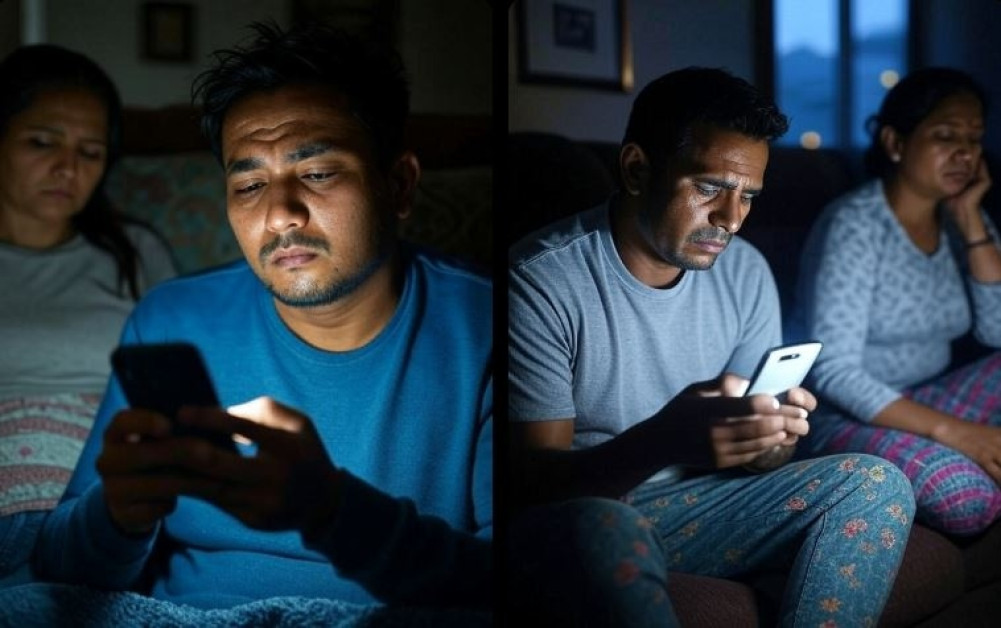
The 'blue light' that comes from the screen of a phone or laptop, that light inhibits the production of the hormone melatonin in our body, the hormone that helps us sleep.
We use Google Cloud Translation Services. Google requires we provide the following disclaimer relating to use of this service:
This service may contain translations powered by Google. Google disclaims all warranties related to the translations, expressed or implied, including any warranties of accuracy, reliability, and any implied warranties of merchantability, fitness for a particular purpose, and noninfringement.
24-year-old CD (name changed) lives far from home in Kathmandu. He came to Kathmandu for studies and is studying a 2-year course. But it took 4 years to reach, his said course is still not finished.
As it happens, CD who lives alone spends a lot of time on the screen at night . Even though he knows he should sleep, now he is spending time on the screen.
Every night he regrets not sleeping or not doing something useful. Since he couldn't go to class without getting enough sleep in the morning, he kept on promising himself - I will sleep on time today. But the next day, the same problem repeats again . Later, to remove this habit, he went to psychiatrist Dr. Dr. Yuzalman Singh arrived. According to Singh, now many people come with such problems.
28-year-old Abby is busy with office work all day . She reaches home tired from the office in the evening. Being busy with office work all day long, she always feels that she doesn't have enough time for herself . I regret not being able to live for myself every day.
That's why she stays up late at night without sleeping in order to give time for herself. She uses devices . Saying the last episode, she can watch the season of the series. The whole day's work is also stressful. Can't even sleep . And I like to use the phone to forget the mind', she says, 'I feel good until I use the phone . When I can't get up in the morning again, I feel 'regret' that I have used it in vain.'
These are just some examples . In fact, it is a common problem, says psychiatrist Singh .
He says that there are two types of sleep related problems. One, not being able to fall asleep even if you want to because of a 'disorder' related to sleep. Knowing that you need another sleep and not falling asleep when you feel sleepy. 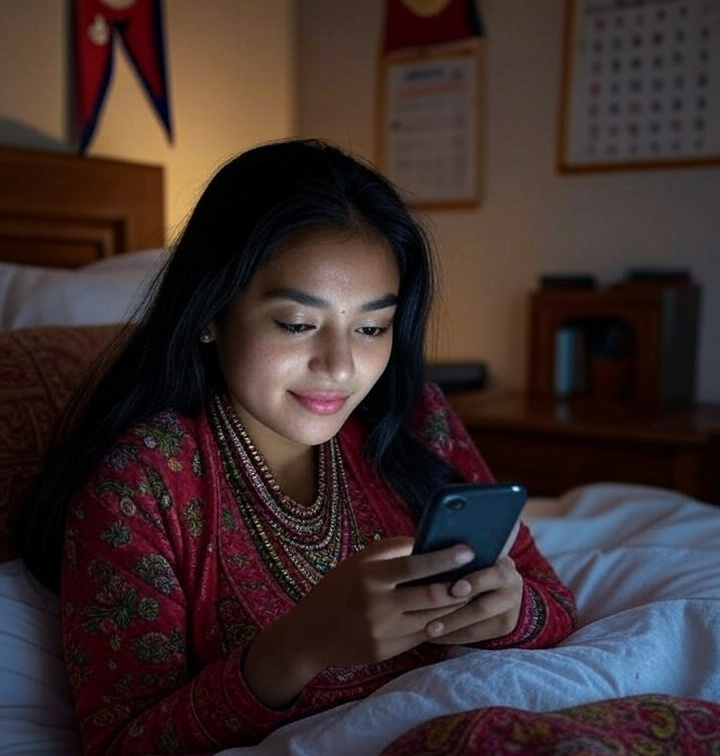
Experts say that the number of people pushing bedtime is increasing alarmingly. According to a study published in 2021 in "Frontier in Psychology", the reason why people deliberately delay sleeping has been studied. Studies have shown that most of the youth spend time scrolling on their mobile phones, using social media or watching online videos till late at night, despite the fact that it is known to have a negative impact on health. A participant in the
study said, "Even though I know I have a class tomorrow morning, I stay up until two o'clock scrolling Tiktok and Instagram. Why do people spend time on the screen late at night?" According to various studies, there are various reasons for this. Which has psychological, biological and technical reasons .
000
Social networking platforms are designed to activate our brain's pleasure system, i.e. 'dopamine'. Every 'like', 'comment' or 'scroll' activates dopamine and makes us feel happy . That's why we are constantly pushed to find that happiness . This process makes us addicted .
Similarly, as mentioned in an article in Stanford Medicine, we get novelty after scrolling. Our brain produces dopamine during discovery and exploration. Who says - "Pay attention, something new has come" . AI algorithm is also added to this . Which learns what we've liked in the past and suggests new content of a similar nature . Then we start scrolling continuously . We fall into one content after another,' the article mentions.
Psychosocial consultant Aditya Dangol also explains more about the cycle of addiction . "Once you are addicted to something, you have to rely on it for whatever you do." As soon as you get the slightest negative feeling, instead of dealing with it, you get into the habit of using something you're addicted to. Even when feeling sad, angry, happy, device usage increases . It also increases anxiety,' he says, 'because the phone can also be used in the same way, the usage increases .'
Similarly, 'Fomo' i.e. 'Fear of Missing Out' is another reason for this . Did you miss somewhere? The fear of missing something is foam. People don't want to miss anything fun or important. That's why they scroll through social media with anxiety.
Brian N. Chin, professor of psychology at Trinity College, says, "People with high FOMO tend to use social media more at night." Their sleep quality is poor. Anticipation of new messages, posts or updates can create social pressure to stay online and increase the habit of delaying sleep.' 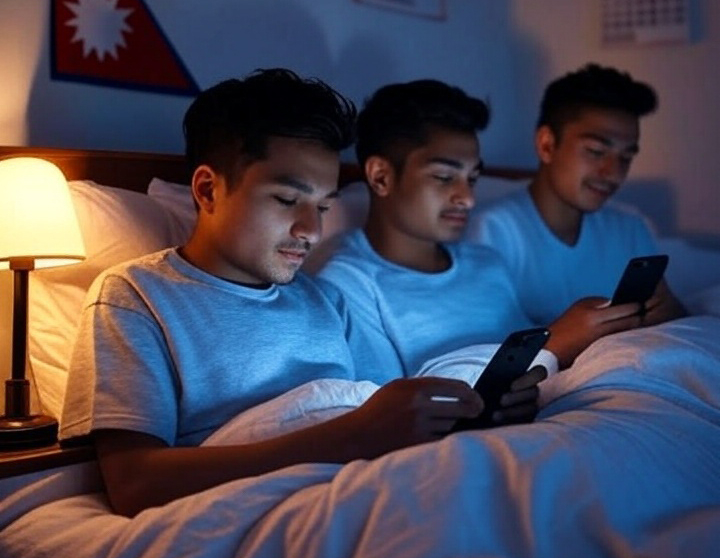
According to a study published in 'Current Psychology', people with stress, anxiety or many responsibilities use the screen to stay away from those problems at night. Spends time on social networks . In order to get even a little bit of relief from stress or negative emotions, they delay their bedtime . But such temporary relief can disrupt deep sleep .
Among these psychological reasons, the problem seen in most of them is 'revenge bedtime procrastination'. It is also known as 'RBP'. In a study published in the 'Journal of Health Psychology', about 2500 young people from the Netherlands have been studied about revenge bedtime procrastination. According to the study, 74 percent of young people sleep late at least once a week for no good reason . ie revenge bedtime procrastination .
Spending the time you don't have due to your daily responsibilities, sitting alone until late at night or enjoying solitude and delaying bedtime is 'revenge bedtime procrastination'. According to psychologist Khushbu Agarwal, instead of sleeping, staying up late and engaging in recreational activities is 'revenge' against our busy daily schedule.
That is why such practices are called 'revenge', she said. She says, ``This practice helps people with very busy routines to take some time off and give themselves time . However, it causes profound sleep problems.
is very different from RBP and other insomnia disorders. Similarly, some people may find it effective to work at night. There is also a difference between that person and someone who deliberately pushes sleep. According to Aggarwal, procrastination is staying awake even though you know it's time to sleep. Due to which morning fatigue and sleep problems may appear. Those with insomnia are unable to sleep even if they want to sleep.
Lack of personal time, stressful schedules, lack of self-control and digital distractions such as phones and social media can also cause RBP.
000
'Blue light' means blue light comes from phone, laptop screen . The same light prevents the production of a hormone called melatonin in our body . Melatonin is a hormone that helps us sleep . When melatonin is low, we automatically have difficulty falling asleep.
Similarly, our brain goes into an active state when watching a serious news, video game or any video at night. It wakes up the mind making it difficult to sleep peacefully .
Similarly, there are other technical reasons for staying on the phone late at night . As mentioned above, most social media platforms can be scrolled continuously . New posts automatically load as you scroll. It doesn't signal our brain to shut down . Instead, the curiosity of what else is in the brain. So you don't know how the time passed.

How does it harm during sleep? Fatigue at night also reduces the ability to make decisions . Since there is no point to stop scrolling, we are busy with the screen for a long time .
Similarly, the notifications that come to our other devices are made to draw our attention . Each 'vibration' forces us to turn on the device again and again.
According to a study published in 2021 in "Frontier in Psychology" mentioned above, people who feel more tired throughout the day are more likely to sleep late at night. Similarly, due to the habit of sleeping late, their fatigue is increasing . In this way, the 'cycle' of fatigue and sleep is formed.
According to psychiatrist Singh, people fall into the cycle of insomnia and the effects of insomnia. "We start using the device because we don't feel sleepy". The device does not allow you to fall asleep . The mind has a positive distortion . That is, we lie about rewarding the brain. The mind cannot catch a lie . Once this cycle starts, it is hard to get rid of it.'
Similarly, gestalt therapist and psychologist Ashish Kafle says that our habit of watching the screen gradually turns into an addiction. "Be it stress, anxiety, loneliness, laziness, free time or any other reason, if we are digitally active every day, it becomes addictive. It doesn't let us sleep," he says. "Many people don't know that there are many habits that disrupt the sleep cycle. Unknowingly, they spoil the sleep cycle.'
000
Kafle says that ``sleep hygiene'' should be made to reduce the habit of intentionally pushing sleep time. He says, "The most important thing to maintain hygiene is not to be 'digitally active' at night". Other habits such as eating less in the evening, reducing the use of caffeine in the evening, and using the bed only for sleeping are also part of hygiene.
If you have a long-term sleep problem or if you have trouble sleeping throughout the day, psychiatrist Agarwal suggests that you consult a health professional, sleep specialist or mental health specialist.
"If such a problem has been seen for a long time and it is affecting work, studies, social, family relationships, then you should go for counseling," she says, "People stay up late but have to get up early in the morning because of work." Which causes lack of sleep . Lack of sleep has both temporary and long-term negative effects mentally, physically and emotionally. It needs to be understood .'