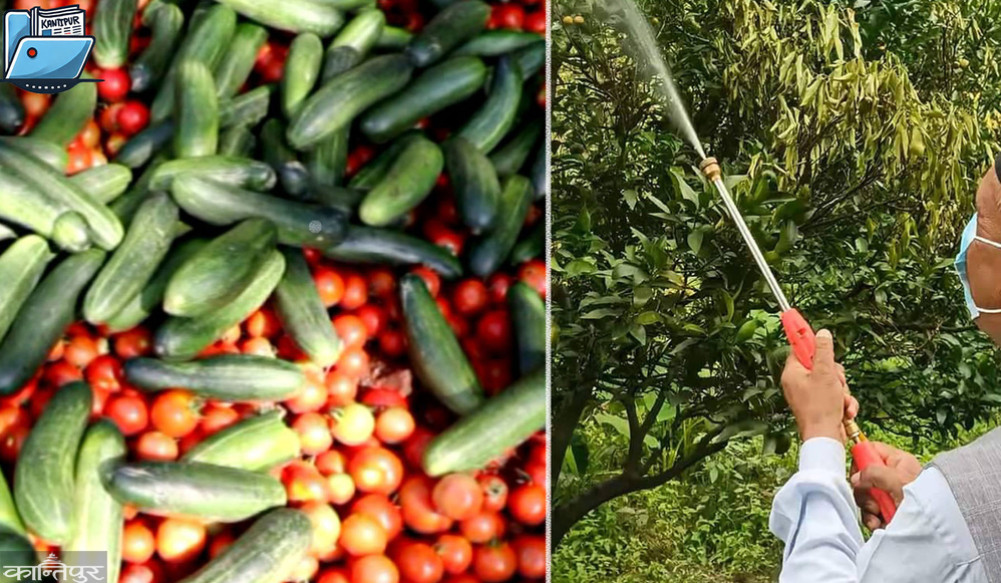
Uninterrupted importation of large quantities of pesticide-laden Indian vegetables poses a challenge in the implementation of the organic state campaign
We use Google Cloud Translation Services. Google requires we provide the following disclaimer relating to use of this service:
This service may contain translations powered by Google. Google disclaims all warranties related to the translations, expressed or implied, including any warranties of accuracy, reliability, and any implied warranties of merchantability, fitness for a particular purpose, and noninfringement.
After the formation of the provincial government, the first cabinet meeting on February 6, 2074 announced that Karnali will be made an organic province. Almost two years after that, it was decided to make Karnali an organic province in the second meeting of the Karnali Province Coordinating Council on December 9, 2076.
In order to implement the said announcement and decision, the Bill-075 was also passed in the first term of the State Assembly to make provisions related to agriculture. But due to lack of preparation, lack of staff, preference for piecemeal budget, lack of investment-friendly environment, lack of alternatives to chemical fertilizers and pesticides, the campaign has stalled . When local production does not meet the demand, a large amount of pesticide-laden Indian vegetables are being imported, which has added a challenge to the implementation of the organic province campaign.
After the state government started the campaign, chemical fertilizers and pesticides have been banned in the Himalayan district of Karnali for 6 years. But when local traders secretly import chemical fertilizers and pesticides, the farmers are forced to bear more expensive costs, according to Harihar Khanal, an agriculturist. "Goth's manure is never enough for the farmers, if you don't use artificial fertilizers, it is difficult for the seeds to grow, if there is an outbreak of diseases, there is no alternative to use pesticides," he said. There is a big black market.' He claimed that at least 250 million worth of various pesticides come to Karnali in a year.
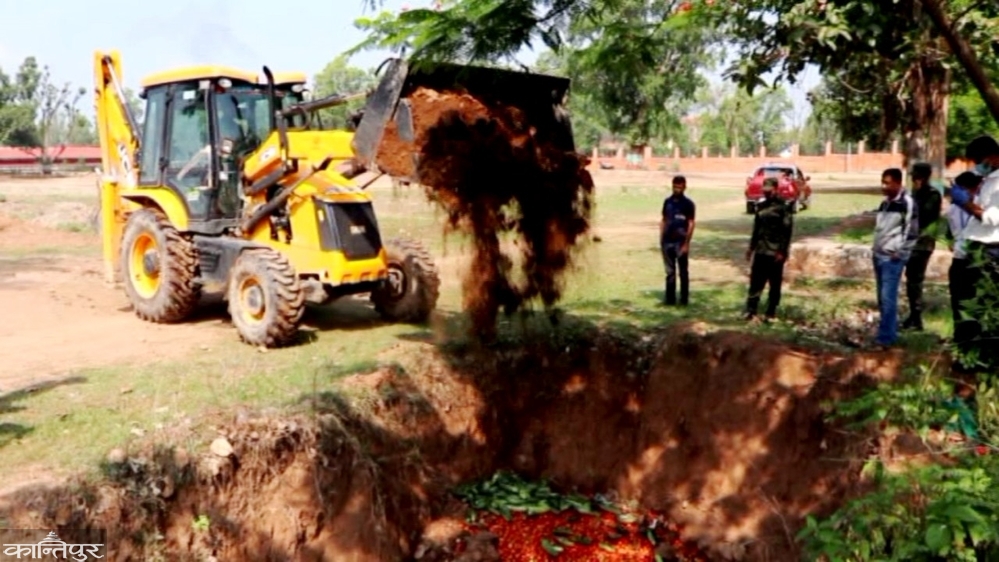
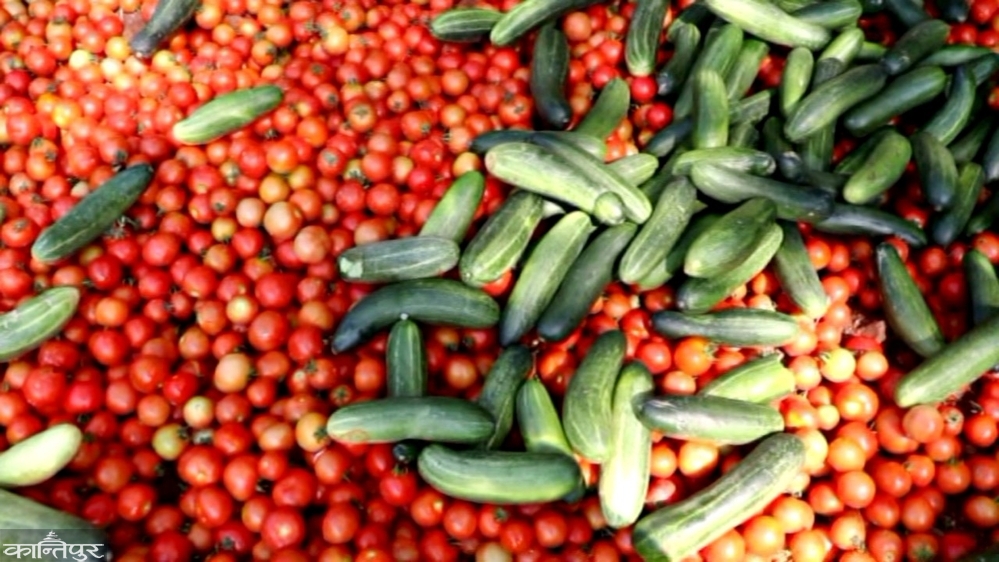
Just last Saturday, the vegetables that were heavily used in pesticides were destroyed in Bubblee Agricultural Wholesale Market located in Birendranagar Municipality-6. 870 kg of cauliflower brought from Salyan, 176 kg of Golambeda brought from Dang, 90 kg of cucumber brought from Jupra in Surkhet and 18 kg of farsi brought from Dailekh were destroyed. Carbamate and organophosphate pesticides were used excessively in those vegetables . Both of these are fungicides and insecticides.
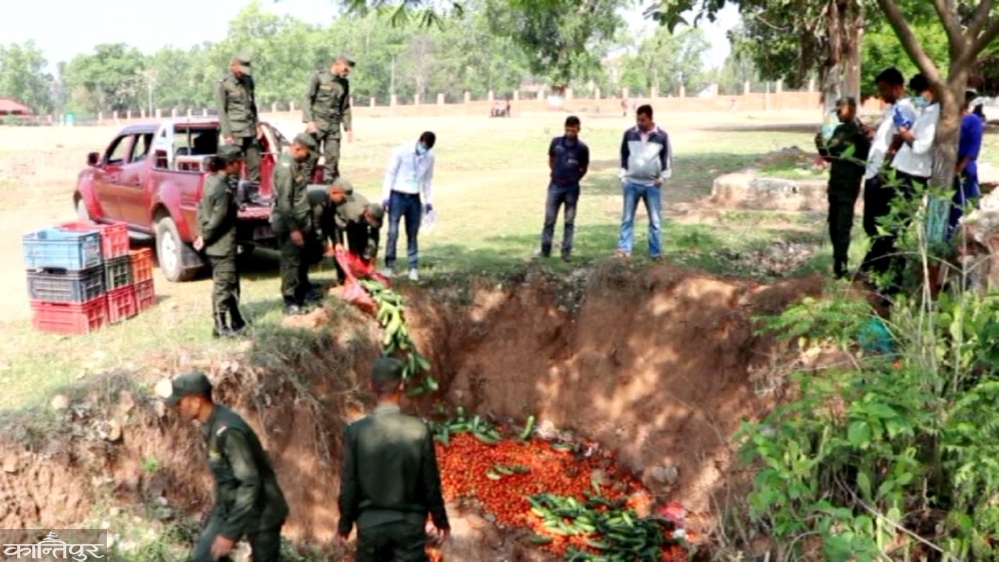
The Rapid Pesticide Analysis Laboratory under the federal government destroys vegetables and fruits brought from various districts of Karnali on a daily basis for finding pesticides. In Karnali, a large amount of vegetables are also imported from India. But as the test was done at the border crossing, the test was not done in Birendranagar. Dhansingh Thami, technician of the laboratory, said, "The testing, technology and manpower in Rupaydia are the same as here. Therefore, only vegetables from various districts of Karnali and other provinces are tested."
On Saturday, the pesticide inhibition rate was found to be 61 percent higher when tested on the destroyed vegetables . "We gave instructions to destroy the wholesale market when we found the amount of pesticides that seriously affect health when consuming those vegetables," he said.
According to Hemraj KC, head of the agriculture branch of Birendranagar municipality, about 50 metric tons of fresh vegetables are brought into the bubble agricultural wholesale market every day. Nearly 154 metric tons of highly toxic vegetables have been destroyed in a year.
According to the Ministry of Land Management, Agriculture and Cooperatives, 169,000 metric tons of vegetables are produced in Karnali, while 2,374 metric tons of vegetables are insufficient. Last year, 1 lakh 12 thousand metric tons came from Karnali. Ministry spokesperson Bakhat Bahadur Khadka informed that almost 80 percent of vegetables are imported from India.
Organic agriculture campaigner Dal Bahadur Khadka says that since there is no mechanism to check how much pesticide is used in the province or how much pesticide is in the imported vegetables, the people of Karnali have to rely on pesticide-laden vegetables and fruits. "Government's policies and programs are only propaganda oriented," he said, "The government does not even have the technology to determine how much pesticide has been used on imported vegetables and fruits."
Pesticide sellers claim that the use of pesticides has not decreased in Karnali. Himal Oli, the proprietor of Panchkoshi Agrovet and Trading Center in Surkhet, said that he trades various pesticides worth around 5 million rupees a year. He is sending pesticides to all the districts of Karnali based on the demand of the farmers. "In commercial farming, there is no alternative to using pesticides," he said, "a farm must be sprayed with some kind of pesticide at least every 15/15 days, there is always an outbreak of some kind of disease, there is no other way to control it."
Chandra Bahadur KC, the owner of KC Agrovet located in Sallibazar, Salyan, also said that he sells pesticides worth around 4 million a year. According to him, in Karnali, insecticides such as abamectin, eficet, alphamethrin, carbosulfan, herbicides such as atrazine, butachlor, glyphosate and sulfur, thiophanate methyl, thiram, and genev are being used in large quantities.
The director of Karnali Provincial Hospital in Surkhet, where the pesticide used in vegetables is acting as a weak poison. Keshar Bahadar Dhakal says. According to him, if you eat vegetables and fruits that have been used in pesticides, you will immediately experience tremors, diarrhea, fainting, and long-term problems such as blindness, cancer, tumors, impotence, and infertility.
Challenges in the implementation of the Organic Karnali campaign
An integrated agricultural laboratory under the provincial government is now in operation in Birendranagar. But due to the lack of sufficient manpower and equipment, the work of the laboratory could not be effective, said Parshuram Rawat, the commercial secretary of the ministry. The Karnali government allocated 1.1 million rupees in the financial year 2076/77 to set up laboratories for pesticide testing in Salyan and Surkhet. Since then, the budget has been allocated . But due to the annual budget freeze, both works are now at a standstill. The laboratory under the federal government is testing pesticides only in Birendranagar.
Another ambitious plan of the organic campaign was the establishment of an organic fertilizer and organic pesticide factory. For which 5.5 million rupees were allocated in the financial years 2076/77 and 2077/78. But since the work could not be done, the budget has been left to be allocated . "We wanted to establish a factory with a 50/50 percent investment by partnering with the private sector," said Kamu Secretary Rawat, "but since we did not find investors and organizations, we have stopped allocating the budget."
President of National Consumer Forum Karnali Province Akashtara Bayak said that only if quarantine can be established at the main border crossing of Karnali, the pesticide material coming from India and other provinces can be stopped. "One thing is that it is difficult to deliver food to all the people of Karnali throughout the year," he said.
In order to implement the organic province campaign, the provincial government conducted the organic agriculture model program at 13 local levels in the fiscal year 2076/77. For which a budget of 50/50 lakh rupees was also sent to all municipalities. Those programs are also now suspended. Budget has not been allocated for those programs since 2 years.
Agriculture expert Deepak Sharma says that there is a big challenge in the implementation of the Organic Karnali Campaign as Karnali is highly dependent on food along with vegetables. "Only 2 percent of nitrogen is found in one kilogram of cattle manure, while the result is 46 percent in urea," he said, "will the production increase or decrease by banning chemical fertilizers in non-productive fields?" According to the National Census 2078, Karnali, which has a population of 1.6 million 89 thousand 4 hundred 12, has an annual shortage of 25 thousand metric tons of food grains. 3 lakh 52 metric tons of food grains are required in Karnali province and 3 lakh 26 thousand metric tons are produced.
Ministry's Kamu Secretary Rawat said that Raithane crop protection and development has been given the first priority for the implementation of the decision of the organic province. "Agricultural subsidies have been organized to make the people of Karnali self-reliant from the Raithane crop of Karnali, we have implemented the Raithane crop promotion program in all districts," he said. And the work is being done to facilitate the purchase of necessary raw materials. According to him, about 3 dozen companies and cooperatives are producing organic fertilizers and pesticides from the private level.
According to the data of the ministry, 28 percent of the cultivated land in Karnali province is barren. According to the ministry, 3 lakh 99 thousand 339 hectares of arable land produces 3 lakh 26 thousand metric tons of food grains. In a study conducted by the Nepal Agricultural Research Council in Karnali in 2078, it was shown that 100 to 200 metric tons of pesticides are used annually. According to the report, 114 metric tons of pesticides were used in 2078.
Agronomist Sharma said that pesticides are being used the most in vegetable farming. "Even though there is no government data, pesticides are being used every year with the same result," he said, "During our investigation, it was found that farmers have used 24 types of pesticides banned by the government in their fields. Farmers are forced to use pesticides indiscriminately to reduce the incidence of disease."