Because of the open border, there is no testing of the seeds imported from India
We use Google Cloud Translation Services. Google requires we provide the following disclaimer relating to use of this service:
This service may contain translations powered by Google. Google disclaims all warranties related to the translations, expressed or implied, including any warranties of accuracy, reliability, and any implied warranties of merchantability, fitness for a particular purpose, and noninfringement.
Dharmadevi Dhakal of Mechinagar-1 is suffering from problems such as wilting of maize plants, yellowing of leaves, and failure to grow corn in about one bigha of land. But, what disease did the corn crop get? Why doesn't corn grow like before? He doesn't care.
87-year-old Dhakal has cultivated rice seeds at home. He has the experience of growing mangge by taking corn seeds from the house. The same Dhakal who did not have to wait for the market for Raithane seeds until the 50s. For Raithane production, seeds were separated at home, the same seeds were planted. The crop grown from that seed was eaten.
But, times have changed . With the age of Dhakal, the custom of keeping Raithane seeds at home also disappeared. Today, the seed corn kept at home in his garden does not grow . The city has to wait for rice seeds. The lentil seeds reach the villages from the city, and for other crops such as cucumbers, radishes, and parsley, they are also spread throughout the city.
In the beginning of the 20s, his family came to Bahundangi in Jhapa from Rong in southern Elam in the course of migration. His family, who came to Jhapa with the aim of earning income from farming as well as raising cattle, cultivated up to 10 bighas of land . It was not customary for him to buy seeds from the market like this. They used to choose rice, corn and pulses grown at home and put the seeds,' recalls Dhakal, 'After about 2045/046, the custom of keeping seeds in this way disappeared . Now the name is gone.'
Dhakal remembers - he used to go to the field carrying a stick while planting rice seeds. Good, yellow and blooming rice pods were selected. After cutting the paddy, it was brought home, it was weeded, only the paddy that fell during the two seasons was separated for seeds . It was dried and the seed paddy was kept separately from other paddies. When the seed was sown, it was blown and only the seed was sown. The same seed was planted, and rice grew.
Dhakal remembers - the ears of corn with good and big grains were separated from the corn that was broken while keeping the corn seeds. It was customary to wear thangra or necklace while keeping corn. Seed corn was kept separately from other corn. At the time of corn planting, seed corn was extracted . The corn was dropped and reaped in the plowed ears. There was no disease like now, nor the use of pesticides. Crows and parrots used to eat them, and they would be surprised.
Dhakal also remembers this - paddy was planted in the fields. Alima Bhatmas and Dal . After the dal ripened, the seeds were set aside for the next year. Cooking oil and turmeric were used. In this way, cooking oil and turmeric would not be affected by insects and would not spoil . At the time of planting, edible oil and turmeric seeds were planted. Mangge Falthi Dal .
Cucumber, parsley, radish, bitter gourd, beans, rye, mustard seeds were also available at home. Otherwise, it would have been exchanged in the neighborhood. "If it wasn't for him, the lower house would have been in the upper house." We used to give the seeds we had, we brought the seeds of our neighbours,' she says, recalling the days of her late 50s. People started bringing seeds from there.'
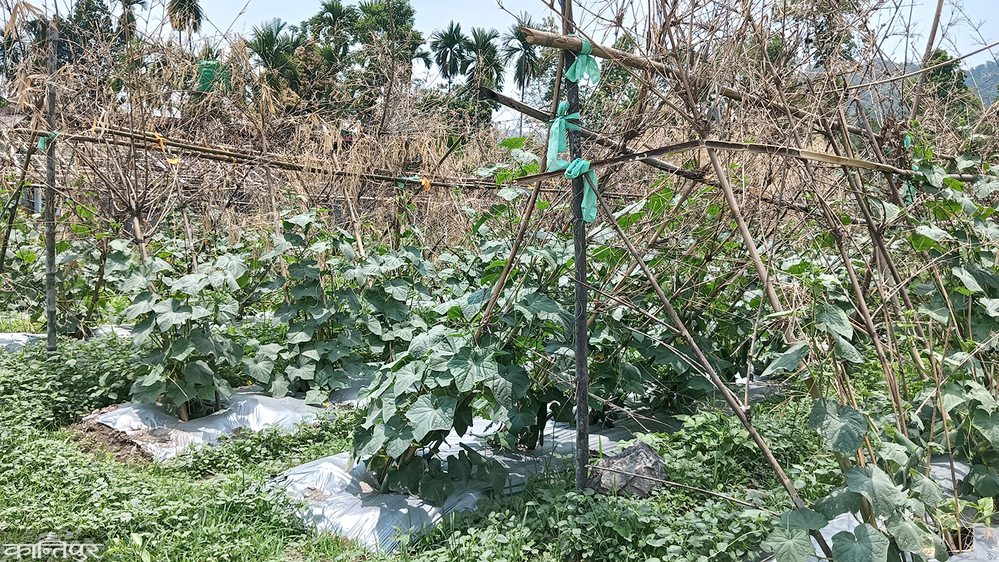 Hybrid cucumber cultivation in Mechinagar-1. Photo: Navraj Subedi/Kantipur
Dhakal saw Uriya Mall for the first time in 46 years. Some said it was like sugar, some said it was like salt. Even if some eat it to see how it is! Until 2050/51, it is known that only this urea was applied in the fields . After that, what's next,' she adds . Why has the practice of keeping seeds at home like before been lost? We asked . She says that the practice of keeping seeds at home has disappeared because of rumors that the seeds brought from the market are good and will bear more fruits.
'Bazarko biu ayo hai said, one brought it and kept it, another brought it and kept it . There was a wave of bringing seeds from the market. People are lazy to keep seeds at home . In this way, the practice of keeping seeds has disappeared,' is his experience.
...
Bhimla Subedi (53)'s house is reached after going east for about 6 kilometers from the brick kiln located in Mechinagar-7. Corn is growing in the fields, cucumbers and bitter gourds are holding the thongs, parsley is growing in the cornfields. However, none of these crop seeds were produced in his home. It was bought from the seed center in the brick kiln market and planted in the garden.
'The seeds kept at home stopped growing well . The seed brought from the common grows . At that time, only dung manure was used and the seeds kept at home grew well,'' she says. The soil is spoiled . The seeds of the house do not grow.' According to him, the seeds of millet, papar, etc. are available at home, but for the seeds of other crops, we have to wait for the city.
...
Purna Bahadur Khadka, a farmer of Mechinagar-2 Buddhmode, is a commercial farmer. In his experience, after the year 2051/52, the seed sales center started expanding . And the village started waiting for the city for seeds. Imported seeds have attractive labels and packaging. It looks good from the outside, the farmers bring it when they see it,' he says, 'started to look for local seeds, started to take care of the hybrid seeds coming from outside . This also sent the message that local seeds will not grow . The practice of keeping seeds at home has disappeared.' According to him, the time has come when the seeds brought from the market such as corn, radish, and cucumber are made to grow by making dangs and taking care of them. Anyone has the experience of having to concentrate in villages and towns for Raithane production seeds.
Rice varieties like Jirasari, Lalbachchi, Dhukurbachchi, Champasiri, Big Mushuli, Small Mushuli, Bhotange, Harintol are the rice of the Raithane variety of the East . ``Jirasari is a very old rice variety . The rice of this paddy was like cumin, he says. Similarly, in maize, seti maize and yellow maize are the former rathana varieties.
Since there is an open border between Nepal and India, farmers are buying seeds from India recently. The quality of the seed is neither tested nor the soil suitable. As it is cheaper in the border Indian market, when going to Naxalbari, Panitanki and other markets, farmers will hear the Khadka bringing cucumbers, radishes, coriander and other seeds. Some of them bring the seeds of grains like rice and corn from India. But what is that seed? Is the soil suitable, not suitable ? Who will do the testing? Such actions are also spoiling the soil,' says Khadka.
The information officer of Krishi Gyan Kendra Jhapa, Chetraj Bhandari, says that the problem of importing seeds from foreign countries is the problem of the entire nation. He says that seeds are being imported because of the open border. However, he says that it is not true that the seeds of Raithane production have disappeared. The government of Nepal is in the process of producing seeds of advanced varieties so that crops of advanced varieties should be planted. On the other hand, farmers' interest in local seed production is decreasing,'' he says, 'Farmers are attracted towards hybrid seeds because they are more productive. Even though local seeds are planted somewhere, most of the farmers are attracted to hybrid seeds.
Even though rice, corn, millet and other vegetable seeds are being imported from India, the customs office does not have the data of what kind and how many have come, said Ishwar Kumar Humagai, information officer of the Mechi customs office.

