Conservationists estimate that there are more than two dozen Raithane elephants in the Jhapa forest, many of them injured
We use Google Cloud Translation Services. Google requires we provide the following disclaimer relating to use of this service:
This service may contain translations powered by Google. Google disclaims all warranties related to the translations, expressed or implied, including any warranties of accuracy, reliability, and any implied warranties of merchantability, fitness for a particular purpose, and noninfringement.
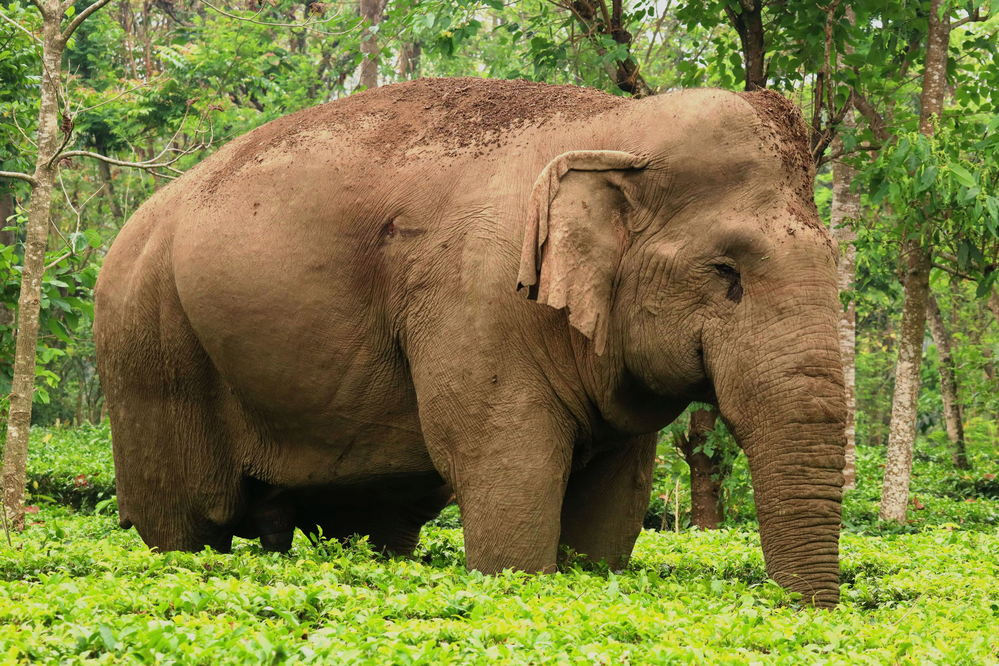
Bahuvan Community Forest located in Mechinagar-3 of Jhapa. An injured elephant has been wandering around the lower and lower edges of the forest for several days with injuries to its legs and back. The National Nature Conservation Fund is treating the elephant in collaboration with the Division Forest Office, Jhapa. But relative improvement is not coming.
According to conservationist Shankar Luintel, who is directly involved in the treatment, the treatment is not being effective due to the declining age of the elephants. This is not the first time that an elephant has been found in such an injured state in the forest of Jhapa. Raithane elephants, which have been roaming in the local forest for years, are often found injured. Some have been treated, while most of them are still injured.
Elephant conservationist Luintel saw an injured elephant in Mechinagar-4 last February 28. The elephant was injured on its left leg, back and right leg, and it looked like it had been hit by bullets. The injured elephant was wandering from village to village looking for food.
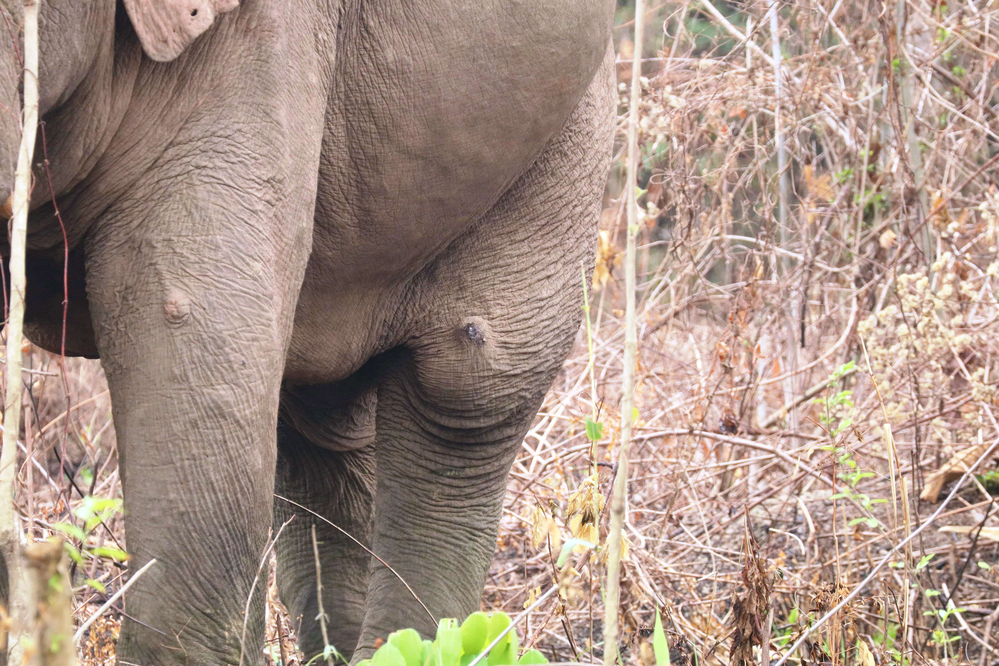
On March 26, an elephant came to the private forest near the village in an injured condition in Mechinagar-1. The elephant's thigh was swollen and paralyzed. The swollen part looked like it had a wound inside and the elephant was walking in a sluggish manner.
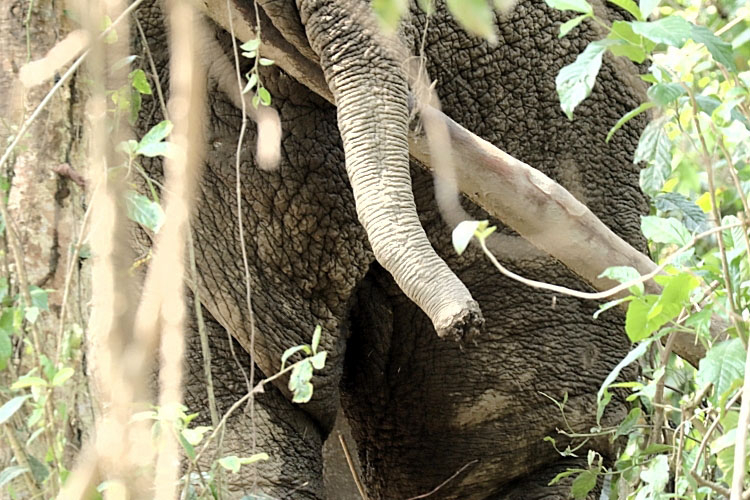
A few days after this incident, another adult elephant was found in the Pragati Community Forest at Mechinagar-13 Charali in a condition that it could not move without sight. When it came near the East-West Highway, the Division Forest Office had even mobilized security personnel to drive the elephant into the forest because it would be crushed by the rush of hundreds of vehicles.
In this way, injured elephants are seen one after the other in different places of the district . Such elephants come to the villages and appear frequently in Mechinagar, Buddhashanti, Arjundhara, Bhadrapur, Kachankawal and other areas. Conservationists believe that this is an elephant. But, why elephants who have been wandering in the local forest for years are often found injured? Who is injuring the elephant ?
conservationists have an opinion on this . Whether the elephants are getting injured by fighting each other or being attacked by humans. Devendra Kharel, a wildlife conservationist, believes that elephants are continuously found injured as a result of human attacks. "When people tried to dominate the earth by saying that it is only mine, then the number of elephants being killed and injured is increasing," says Kharel, "Man tried to take control of everything, the result of which is being suffered by wild elephants lately."
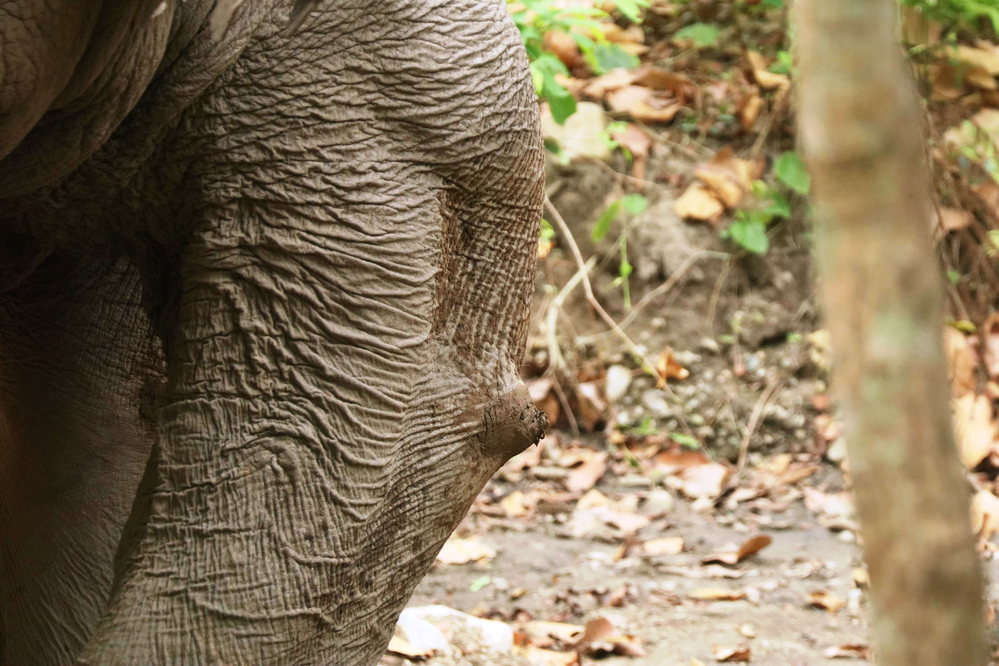
He says that there are more than two dozen elephants in Jhapa forest and many of them are injured. He says that most of the elephants' bodies are not found intact and have some kind of injury. Elephants walking in groups are led by a female. Elephant groups have their own discipline . In this way, Kharel's experience is that elephants that are separated from the group and walk alone (raithane) are attacked more than others.
Some elephants are disciplined and some go along with others. He says that elephants get injured when they fight with each other. When the elephants walking alone come to the settlement in search of food, people attack them with various tools (stones, ropes, spears, sticks, metal objects) while chasing them. He believes that this is another reason for elephant injuries. It is difficult to meet an elephant in its full state. Whether it is in the case of pierced ears, eyes, trunk, skin, or legs, injuries are found somewhere," says Kharel, "most of these injuries are found to be caused by human blows."
The Division Forest Office investigates the cause of wildlife death and coordinates the treatment of the injured. Bharatbabu Shrestha, head of Division Forest Office, Jhapa, also says that elephants get injured due to conflicts or human attacks. One of the reasons elephants are seriously injured is natural causes. Especially male elephants fight with each other for reproduction, food etc. . We have found that elephants are seriously injured in this fight,' he says. Apart from this, he says that elephants are also injured when people hit them with various tools.
The forest office has been treating seriously injured elephants in coordination with the National Nature Conservation Fund. But, it is not easy to treat elephants, huge animals. Carrying a stick for treatment is a very risky operation," he says, "If the darting is not done or the elephant's posture is not matched, it may not be able to get up . In some cases, it is death.' He says that only seriously injured elephants will be treated by taking the risk. Elephants that are injured naturally are not treated much. It is left with the hope that it will be treated naturally. Recently, he has experienced an increase in the number of elephants injured by human attacks. The conflict between humans and elephants is old. Both elephants and humans are important to each other,' he says.
The smugglers are not found
In the middle of the Kalika community forest located in Jhapa's Mechinagar-13, a 45-year-old elephant was found dead with both beards cut off at the beginning of 2081. The elephant was killed with a loaded gun and its parts, including its beard, tail, and nails, were taken away by a gang of smugglers. Such organs are considered valuable and conservationists say that illegal international trade is taking place.
According to conservationist Kharel, the elephant was found smelling very badly at that time. Even after killing such a big animal and cutting off its beard, no one got the trick. When the concerned team reached, it was not possible to get close to the elephant due to the smell . We have pressed many times to find the beard gang by doing a proper investigation,' Kharel remembers, 'but so far neither the gang has been found nor do we know where the investigation has reached.'
Three months after that, a wild elephant was found dead in the Bahuvan area of Mechinagar-3 in June 2081. An elephant found dead near the local Dharadhare River was found with deep injuries on its neck. A post-mortem by a team of doctors from the Koshitappu Wildlife Sanctuary confirmed that the elephant had been killed with a shotgun.
It was found that elephants were killed this time in the same manner as the elephants were killed in the previous Mechinagar-13 incident. An elephant was found dead in Panchpokhari Community Forest located in Buddhashanti Rural Municipality-5 in the district in October 2077, with its beard cut off. It is not known where the research has reached.
Who and why is killing elephants? The concerned body seems to be unaware of this . Why is the research not completed? Chief of Forest Division Shrestha argues that due to the open borders and the investigation of wild animals, it is not possible to reach the gangs of smugglers. Big smugglers are involved in this kind of smuggling, as it is a wildlife issue, not enough information can be found. There is an open border, these various issues make it confusing to reach the conclusion of the investigation,' he says, 'We will investigate with the help of Nepal Police, CIB and other agencies. However, the smuggling gang cannot be reached.'
In the past two decades, 21 wild elephants have been killed in Jhapa alone. Officials say that most of the elephants were killed by electrocution. But why are elephants killed? It is not found that the investigating agency is taking this seriously.
(All photos of wounded elephants: Shankar Luintel)

