The number of landless squatters in Fungling is 71 households. Apart from these, there are only 36 houses of Dalit families.
We use Google Cloud Translation Services. Google requires we provide the following disclaimer relating to use of this service:
This service may contain translations powered by Google. Google disclaims all warranties related to the translations, expressed or implied, including any warranties of accuracy, reliability, and any implied warranties of merchantability, fitness for a particular purpose, and noninfringement.
53-year-old Lalimaya Ghatani, who has been living in Fungling Municipality-3 Agedim since 2068, lost her 56-year-old husband Santaman Ghatani two years ago. Born in 2028, she was married off by Santaman in 2052. Santaman said, "I have a two-story house, parents, one brother and one sister, I will not let you live in misery, there is plenty of room to eat."
He was taken to Michiring in Hangpang District across the Tamor River, near the headquarters of Fungling Bazar. At that time, every government work like citizenship, marriage, death registration was done from the headquarter, fairs and haat bazaars were held at the headquarter. Since there was no highway, he had to walk from the village to come to Fungling. The area around the headquarters was considered accessible and the village beyond the Tamor river was considered inaccessible. "The words spoken by Santaman when he cheated are all true," Lalimaya says, recalling three decades ago, "After six months of marriage, I found out that the land and house belonged to someone else."
According to Lalimaya, they have been sitting on bond money. The bond money is given by the daughter (Lalimaya's mother). "My daughter's money, after four or five years, I sold it and paid for it. They have migrated there from Thukima village,' Lalimaya added, 'But even in Thukima, there is no ancestral property, they are eating by eating.'
As time passed, the mother-in-law passed away. After the death of his parents, the eldest son migrated to Fawakhola, Fungling Municipality-11. Lalimaya, who has given birth to three children, also moved to Maiti village, Fungling Municipality-3 Simle with her husband.
Maiti asked for Tej Bahadur Limbu's land near the house on the condition of earning blindly. She asked for bamboo in the village. She cut thatch from Agadim and built a house with a thatched roof. At this time, Santaman was living by the river and had started working as a woodworker. After moving here, two children were added and there were five. The foundation of the house built in 069 is still there.
'In our caste, it was a custom to get married a little early. Even now it is . We married the eldest son and daughter. Gold, jewelry, wedding feasts were also spent there. Jaundice afflicted the old man . We took him from Jhapa to Dharan for treatment. Many lakhs were also spent there. It was spent on the funeral and funeral of the old man. I had to teach them to send their children to school,' Lalimaya added while narrating the long story of being a squatter.
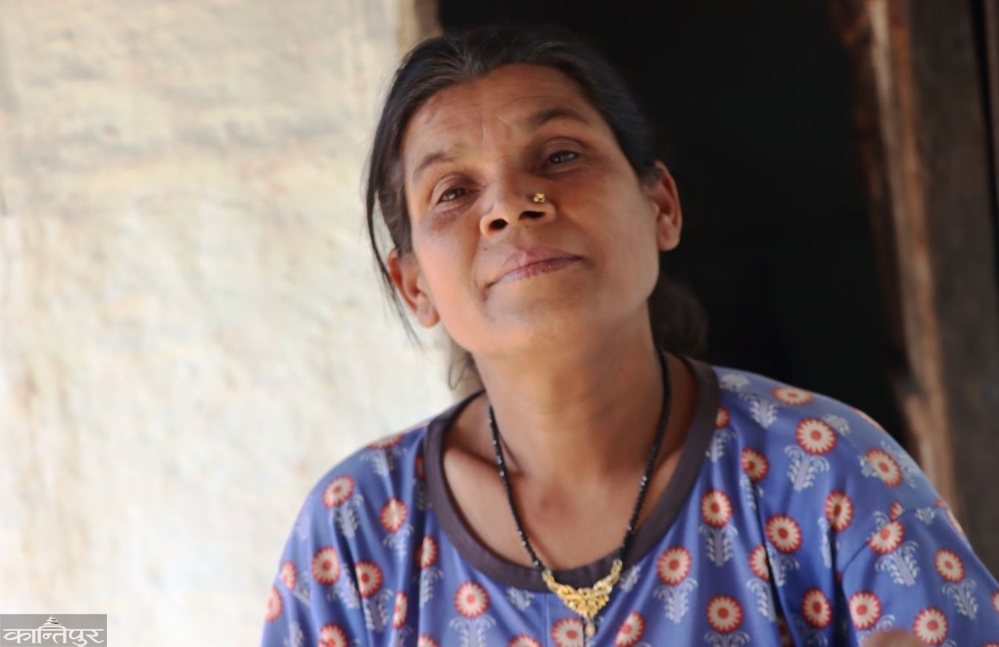
The eldest daughter is married to a land owner . He is hoping that now his son will earn and join and the tag of squatters since his father will be erased . "The mother-in-law also passed on to someone else, the same thing happened to her husband," she added. So now they will earn and make it their own?'
Rather than being freed from the squatter, he was worried that the moneylender would tell him that 'your old man owes money'. When her husband died, she took a loan from her neighbor Bhagirath Giri. She is proud to get rid of it.
Bhagwan Sunuwar of Fungling Municipality-8 Dokhu Bahanande Ghumti is 62 years old. Now he is living a single life in a family with two sons, daughter-in-law and grandson. His two wives passed away. He came from Pathibhara Yangwarak-1 Nangkholyang in 2018 to dokhu excuse and was born here as his second child. His older brother is a disabled person who cannot speak. The sister also became the same . He lost his father when he was 12 years old, the only one of three children in the family. Bhagwan's father, who had gone to sell bamboo choyapat, came back with a cart. At that time, there was no umbrella that could be poured into the water. It was made from bamboo sticks and used to fly with leaves. It was a narrow road. After hitting the guard, he fell down on the side of Tamor river and was seriously injured. According to Bhagiman's cousin Ghanshyam Sunuwar, then there was no hospital like now. He brought the injured father-in-law and kept him at home. Did home remedies including herbs . But, after reaching three months, he passed away.
Taking care of brothers, sisters and mothers with different abilities became a responsibility for God from a young age. At the time when there was no alternative income, the family had to be supported by farming and handicrafts. From 018 to 071 years, Krishna Prasad lived in the land of Ghimire . After leaving there, Ghimire gave 70 thousand rupees according to the decision made by the village community. Bhagwan used to load and unload trucks and tractors. When four people unloaded the goods of a truck, it was reduced from one to three hundred rupees a day . But it was not regular. That money was enough to support the family. "I was going through the situation of what I eat today, what will I eat tomorrow, I never got the money to join the household," God explained the reason for being a Sukum resident.
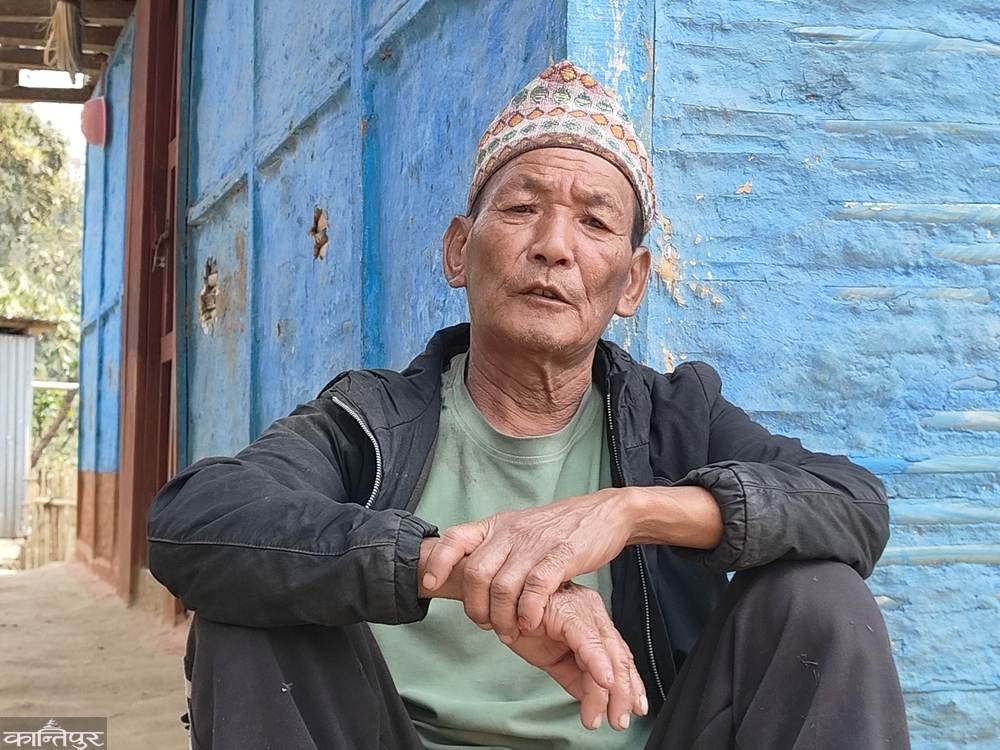
Genten saved 260 thousand rupees and gave it to his cousin Ghanshyam. Binaju has given 6 anat land to build a house . The condition is that God will pay four lakhs and Ghanshyam will register four annas of land . Now God's family is living in that house, built by himself with zinc leaf and bamboo kiln. God has not been able to collect the 1 lakh 40 thousand rupees to be given to the brother. The two or four pennies earned by carrying goods are paying off the loan incurred while building a house. The two sons have now started driving taxis. There is some hope in God. His plan is to register the land after paying the remaining amount. Ghanshyam thinks that some amount should be increased as the land and conditions are connected with Mechi highway for many years. Due to price increase and Ghanshyam's change of mind, it is not decided whether Bhagwan will have an opportunity to become squatter free.
The life of Thakur Prasad Ghimire living in Fungling-3 Kenim is like Lalimaya and Bhagwan. Until last year, his main occupation was offering bedspreads to the families of the deceased in the Brahmin community . He has been alienated from it for a year. His family living in the loft of Bhagirath Bhattarai of Fungling-3 Kenim came here from Pathibhara Yangwarak-1 Nangkholyang in 048. They were living on the land of Gautam Thar and were displaced by the landslide.
"After the landslide swept away the place where they were sitting, the elder and Milo went to the plains, Sailo Daju and I went to this side (Fungling)," said Ghimire . He told that now he is supporting himself by doing daily wages and doing business. With the help of Mavali and relatives, the elder son and younger daughter have studied up to 12 . The younger son has gone to India with his mother to study Sanskrit. The husband and wife earn up to 800 rupees a day when they get a job . But since Hattakatta does not have a physical body and cannot speed up the work, it is difficult for him to get a job as a wage earner. "I earn 500 rupees and my wife 300 rupees daily for work like cutting firewood, cutting straw, picking cardamom, and spitting amriso," added Ghimire, "so we have a family of two." Getting a bed would cost rice, utensils, bedding, and 500 to 2,000 rupees. If you have to buy rice, salt, bread, soap, marmalade, there is a problem of expenses. This couple, who have no wealth in their name since their fathers, have not seen the possibility and dream that they could earn and build a house with their own abilities . "It is believed that when three generations pass, one generation will eat its own food," added Ghimire, "then God will look after the children."
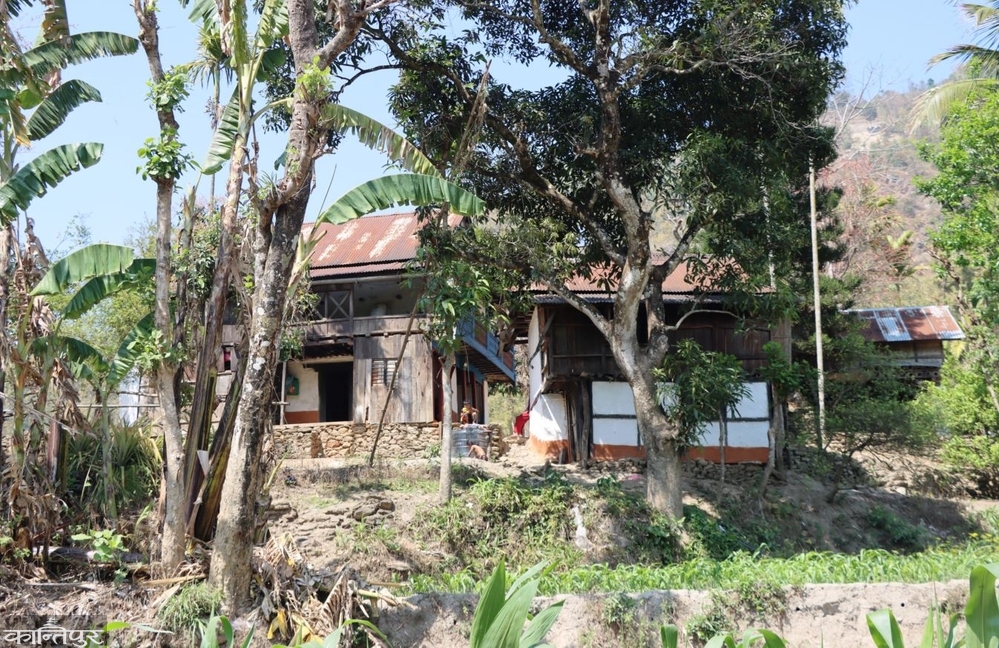
From the outside, no one calls the house where Tikamaya Sarki (Purkoti) lives as a squatter. There are structures such as three-storey house, two-storey matan, cow shed. Pigeons, goats, cows have been reared . There is a fruit garden around the house, including bananas, litchis. Husband Harak Bahadur Sarki Vaidesik is in Malaysia for employment . Tikamaya lives with her two children by farming. He has four children .
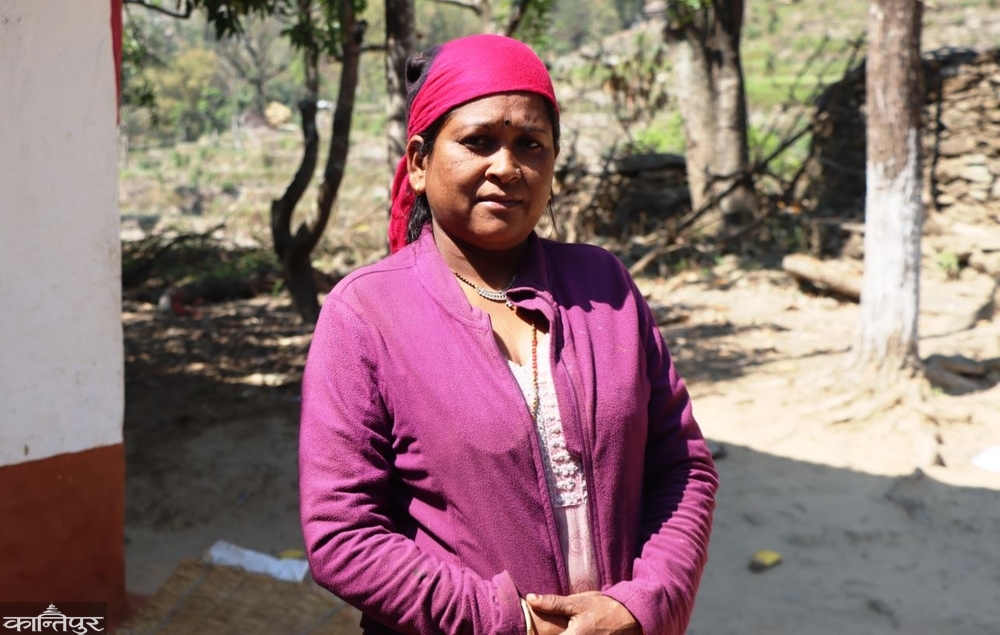
As the secondary school is far away, she has kept her two daughters in Jhapa for education. She said that since it is far to go to school and back here, she taught in Mawli. To live in this house and earn some land, two lakhs of rupees have been pledged. They get that amount back on the day they have to leave the house . But in a place where two lakhs can live, not even one ghardi will come.
Hark Bahadur, who lost his father at the age of 12, spent his 40th spring with his family. But when it didn't happen, he went abroad. Tikamaya says that the money she earns is now paying the mortgage loan. "Not only me, the first desire of all Nepalis is to nurture themselves and their families. Even after saving some money, there is a desire to buy land and build a house," she added, "I also had that desire and still have it. The old man went to earn late, but it is not like building a house to buy land. For that, she said, she had to go abroad even though she had to take a loan from her neighbors.
Out of these four representatives of Dalit, tribal tribes, Brahmin community, the mother or son of Jui representative is abroad . Those at home are also constantly trying. However, they have not been freed from squatter status. Every time the government changes, a squatter commission is formed. Their purpose is to identify the squatters and distribute the land .
There is a four-member land commission headed by Krishna Basnet in Taplejung. Their salary is the same as joint secretary and deputy secretary. That is, they get a monthly salary of up to 57 thousand rupees. But why is there no solution to the squatter problem? Basnet says, "We have identified the squatters and unorganized residents of Fungling Municipality, Sirijanga Rural Municipality and Mikwakhola Rural Municipality". It is a fact that they are landless squatters. You have the right to get land from the state. We have also issued a certificate stating that we have documented this statement in the official documents. Now we are working to find data about where there is government land in Fungling . After that, the task of distributing the land is the local government.
Identification and confirmation of squatters is the responsibility of the ward, municipality and squatter commission. The role of all three bodies is the same. After being identified, there is a provision to measure the landless squatters if they live on government land. When giving in this way, there is a provision to give a family 6 plantations in the mountains and 10 kattas in the plains . If in urban areas, it is mentioned to give 4 annas in hills and one kattha in Terai . But Basnet, Chairman of the Land Commission, says that the number of people living on government land in the hills has not been found yet.
In Taplejung, which has nine local levels consisting of one municipality and eight rural municipalities, the job of registering the names given by the landless and squatters has been done by all the municipalities. Apart from three, identification and verification work has not been done in the rest of the municipalities.
Lalimaya, who understood through Nissa Ward President Tank Palungwa, says that she will live there if she gets arable land. She said that her husband also expected the same from the official of the Land Commission who came three years ago. "He said he was getting old," Lalimaya said, "He also hoped that something would happen somewhere." However, even after his dismissal, the land giver did not come. Tikamaya thinks that even if it is only 4 annas, it will be found in the city. Thakur Prasad and God are not in the decision to let this happen.
The number of landless squatters in Fungling is 71 households. Apart from these, there are only 36 houses of Dalit families. The number of those who do not even have land and do not have a regular residence is 11 . In total, there are 118 families in the municipality.
expert member Santosh Chamling claims that he will search for land in the municipality where the person is confirmed and if not, he will immediately start the work to confirm the land . "There are four of us now," he said.

