When parents are unaware of their children's feelings, they may go on the path of suicide or practice wrong actions due to psychological problems.
We use Google Cloud Translation Services. Google requires we provide the following disclaimer relating to use of this service:
This service may contain translations powered by Google. Google disclaims all warranties related to the translations, expressed or implied, including any warranties of accuracy, reliability, and any implied warranties of merchantability, fitness for a particular purpose, and noninfringement.
Some time ago, Prakriti Lamsal, a Nepali student studying B-Tech third year at Kalinga Institute of Industrial Technology (KIIT) in Odisha, India, died suspiciously. Prakriti was found dead in the hostel. Until this report was prepared, the investigation report of his death has not been made public.
According to a Nepali student studying at the university, Indian student Advik Srivastava repeatedly abused Lamsal. They say that Lamsal committed suicide after becoming incapacitated. Earlier, Lamsal had also filed a complaint against Srivastava in the university administration saying that she had been abused. However, Nepali students say that the university administration did not hear the complaint.
Prakriti of Siddharth Nagar-8 Bank Colony in Rupandehi was in regular conversation with her family. But she didn't even tell her parents what she was feeling, what thoughts were coming to her mind, what stress she was experiencing.
Even the parents could not see what kind of stress their daughter is going through. On the day of the incident, his mother was also spoken to. His mother said that he did not show any signs of stress while talking. The conversation took place at 2:51 pm. The festival is going on in the college, the artist Badshah is coming,' said the mother, 'it was decided to go now at 4 o'clock, I will be ready.'
Parents are the first door to know about the condition of their children But due to various events and studies, parents are often ignorant about their children's mood.
23-year-old Sesam (name changed) attempted suicide three times at the age of 15. He felt that someone would have come to him at that time and asked 'How are you?' "If there was someone who would be interested in my situation, show sympathy, if there was someone in the family who would listen to me and create a safe place to express my feelings, I would hardly have attempted suicide," she told her experience. Rhonda Boyd and Dr. Jason Jones conducted clinical interviews with more than 5,000 families in the Philadelphia area in 2018. In the study, teenagers and their parents were asked if they had ever had suicidal thoughts. One in two parents said they had never known their child to have suicidal thoughts.
The study, a collaboration between Penn Medicine and Children's Hospital of Philadelphia, used data from the Philadelphia Neurodevelopmental Cohort .  'I often find parents unaware of their children's suicidal thoughts . Adolescents give a variety of reasons for not telling their parents about suicidal thoughts. They are afraid of their parents' reactions, they don't open up for fear of being taken to a mental hospital . Some don't feel comfortable talking about this with their parents,' says psychologist Rohnda in an article, 'When teenagers are thinking about suicide, it's important for parents to be a part of their social support . They can help teenagers address the causes of suicidal thoughts.'
The rate of suicide in Nepal is constantly increasing. From the financial year 2078/079 to last November, 23 thousand 275 people have committed suicide. Experts say that in some cases of suicide, parents or friends do not know.
psychologist Dr. According to Narendrasingh Thagunna, people cannot express themselves openly because of stigma and discrimination about suicide in the society. Similarly, he says that whether there is an atmosphere in the family to express their feelings is also meaningful.
"Those who do not have a good relationship with their parents when they are young, do not have a good 'parental attachment' and grow up in a neglectful and unacceptable (neglecting and rejecting) family develop a feeling that no one understands me . There may be a psychology that there is no benefit in expressing such feelings,' says Thagunna, 'another important reason is that we listen to give feedback, we listen to give answers . Instead we must listen to understand . You have to understand the situation by having compassion, standing at the feet of others.'
The reasons for not expressing your feelings are family and social as well as personal . According to Thagunna, even if the trust is broken or there is no privacy, he has a habit of not expressing his feelings . Similarly, sometimes the person who is telling the story does not take it seriously and this problem increases. 
Mental Hospital, Lalitpur's Psychosocial Counseling Helpline According to Nomlin Ghimire, people who are unable to express their feelings often call the helpline . "The pain is lost in the hearts of those who are at risk of suicide . Suicide is attempted with the intention of getting rid of the pain. At a time when such thinking is prevalent, I feel that I have no friends. Even if you just listen to things like this, it helps. But they don't get that,' Ghimire tells her experience, 'We can be a means of support.' No one understands, I have to remind you that we are there for you in the mindset that I can't do anything . An environment should be created to bring out what is lost in them.'
Psychiatrist Dr. Vasu Karki also says that there are many misconceptions about suicide. The most common misconception is that a person who has suicidal thoughts cannot be saved. In fact, many international studies have also confirmed suicide prevention, says Karki.
``Suicide thoughts are to get rid of a painful event . A person needs protection from the event, he has to avoid it. Life is not meant to end. This happens only if there is no information that the solution to the incident is necessary and possible,' he says, 'Every suicidal person thinks that the cause of the pain is not known or that it cannot be changed . Awareness programs have not been enough to remove this superstition and confusion.'  What are the symptoms?
Experts say that negative emotions are stronger in people who are at risk of suicide. They have a weak mentality that no one understands them, no one cares. As a whole, a person can be negative towards himself, towards the situation and towards the future. The negativity that there is no other way out of a difficult situation remains in the mind . Such negative thinking gives rise to the thought that suicide is a better solution than living in such a situation . At such a time, it can increase the risk that a person will not be optimistic.
What kind of person is at risk of suicide?
Psychiatrist Dr. According to Vasu Karki, anyone with mental health problems is more at risk than others. People who are addicted to drugs, family members with a history of suicide, those who have had a very painful childhood, teenagers who have experienced a traumatic event, and people who have recently lost a valuable thing or person are at risk.
We have to communicate with such people . Social and personal initiatives should also be taken to protect individuals.
What signs should not be ignored ?
Experts say that the behavior shown by a person with suicidal thoughts should be carefully considered . Some may be complaining that they are tired of life, they want to go into solitude, they want to get closer to God, no one understands what I am saying,' said Dr. Thagunna says, 'What is the use of telling it to someone? If they are expressing disappointment that everyone is happy without me, we should be aware.' He says that people who often talk about death, behave in a negative or depressed manner, or express themselves on social media may also have signs of suicide. Apart from that, Thagunna said that it is also a sign of not paying attention to one's health and hygiene and life-threatening behavior.
dr. Karki also says that people who don't socialize with others, behave out of character, stay calm and want to have fun should be understood as showing signs of suicide. "Unusual behavior such as sharing what you like with others, trying to finish your plans, a person who seemed happy until yesterday suddenly looks sad can be a sign of suicide," he said.
Sometimes there can be a dilemma whether the signs or expressions shown by a person are true or a threat . "In order to know whether it is really a suicidal threat or not, you have to look at the situation and practical changes." What happened in his life recently, he may have gone through trauma by losing someone close to him . Conditions good No, and if his expression is like that, it should be understood that there is a risk of suicide,' says Thagunna, "We are meeting enough risk factors and there may be a risk if there are practical changes." How does the 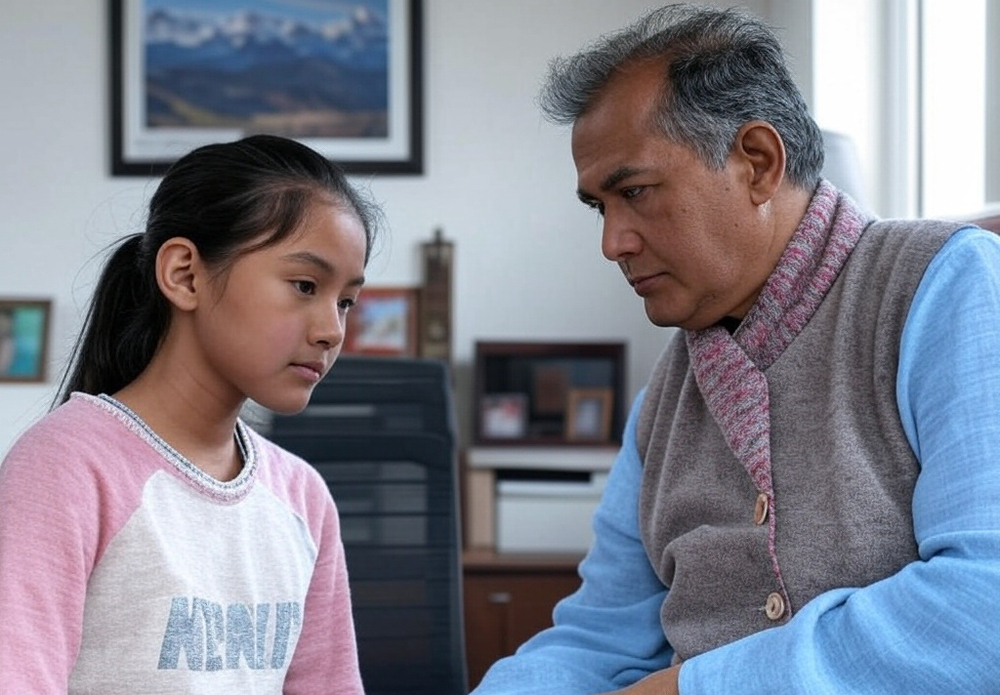 helpline help? In the experience of Model Ghimire, who is giving counseling through the
helpline number, there is also a case where a person who had thoughts of suicide was freed from such thoughts by calling the helpline . "We have sent the police and rescued those who called ready to commit suicide. Some problems are such that we can help, some problems require personal counseling . At that time, we refer to a psychosocial consultant,' she says, 'In many things, confidentiality has to be maintained . But suicide is not a secret. If there is an extreme risk, we will inform the family and help.'
Mental hospital's national helpline number is '1166'. Individually, everyone can help those at risk of suicide .
Every person needs to be aware of the risks and symptoms of suicide. Psychiatrist Dr. stating that the government is preparing to release suicide risk assessment guidelines. Karki says, "Every person, family, community should at least be aware of mental health and suicide risk."
If there are direct or indirect signs of suicide, he suggests to maintain amicable communication while maintaining privacy rather than ignoring, insulting and discriminating. "You can help by telling the life experiences of those who have been successful, you can help by creating an environment in which people can talk openly in the family," he says, "If you talk openly about suicide in the health care system and in the family, suicide prevention is possible if people who are at risk are properly listened to." Everyone's initiative is necessary.'

