After opening the bilateral border crossing closed due to the corona epidemic, the movement of goods and people is also going on, but the import and export of livestock has stopped and the farmers are suffering.
We use Google Cloud Translation Services. Google requires we provide the following disclaimer relating to use of this service:
This service may contain translations powered by Google. Google disclaims all warranties related to the translations, expressed or implied, including any warranties of accuracy, reliability, and any implied warranties of merchantability, fitness for a particular purpose, and noninfringement.
Nupu Sherpa, president of Taplejung Yak-Chaunri Farmers' Federation, has reared 80 yaks and 10 chaunri in the shed. He reared yaks for the purpose of carrying heavy loads and reared them for sale. Taking it out of the shed and leaving it in the barn is fun for a while. Nupu who continued the business done by Babubaje also gets joy. However, there is pain along with it.
They have not been able to get their money from the business of exchanging cash for four years . Every year 25 to 30 cubs are born and added. 15 to 20 die a year. From the attack of a disease or a wild animal . Few die of old age,'' said Nupu, 'the business done for income is only playing the game of rearing and killing.'
If it was according to his plan, he would have sold the old people and forced the calves to eat dirty food . Being attacked by wild animals and dying of disease is a disaster. It's very embarrassing when the goods to be sold get old and fall,'' Nupu added, 'He sat like a wild animal in the lake regardless of the sun, rain, rain, or cold. ’
After 15/16 years of cutting, yak-choori find it difficult to eat grass, become thin, do not like to walk, do not reach their destination, and are easily targeted by wild animals . They gradually reach a state of not being able to walk . At that time, you can neither lead with others nor want to leave and walk. 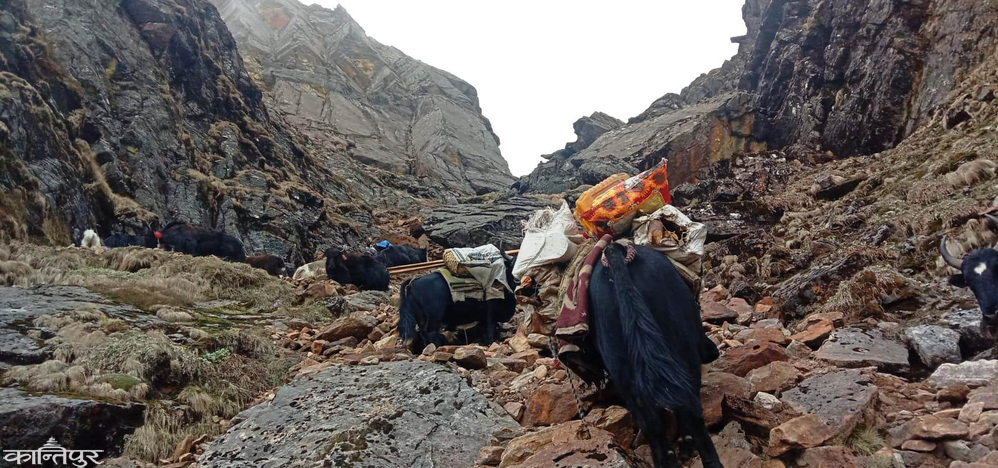
The love of cattle brought up since childhood has been causing pain to the cattle breeder . The wild animals that wandered away should bear the suffering and death.
24-year-old Nupu, who was born in Mikwakhola Rural Municipality-5 Papung, usually keeps a cow at 3200 meters high Papung Tokpegola . From March/May to August/August, they reach the border of China . From October/November to January/February they lead from Khark of Sankhuvasabha to Tehrathum and the confluence of Sankhuvasabha to Guphapokhri . Snow, rain, and landslides trickle down and reach one mountain after another. They have also bought money from a creditor by giving 25 to 60 thousand annually to keep a cowshed. There are four places such as Fakumwa, Tokpegola, Cave Pond. The person who looked at it sat down in the barn, ate and drank, and even though it looked like happiness, he himself could not take self-satisfaction.
His fellow traveler Neighbor Nike Chungdak Sherpa's current situation is more painful than Nupu's. He raised about 150 animals including chaunri and yak, and lost 67 of them due to lumpy skin infection last year. He did not think that such a disruption would happen, and now he is just waiting for when the Chinese market will open. His heart is saying, 'I will leave the cowshed after the opening of the Chinese market and wash my hands of my ancestral profession and spend the rest of my life in Papung (home).' 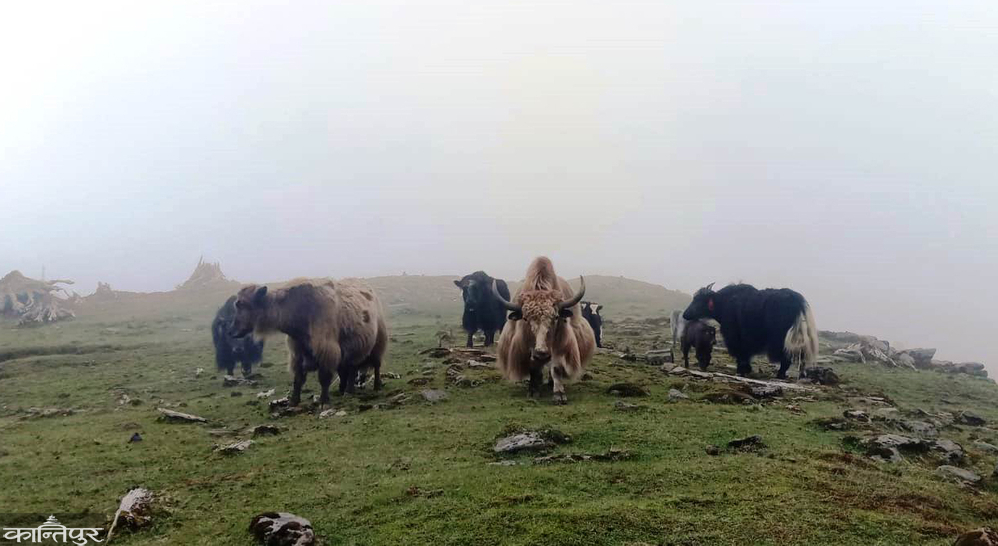
After the damage done by Lamki, he is in pain and anger . Nike lost the coveted baby, adult, and old quarterbacks they had been chasing. He says that he is working to buy salt from the headquarter Fungling and feed them in the hope of the day when the export will be opened. "I have been feeding the grass of the forest since the salt of the market," Nike said, "Now how long will I have to cry?" He is waiting for the day when import-export opens.
Cattle reared in the Himalayan and hilly districts including Taplejung, Panchthar, Ilam, Tehrathum, Sankhuwasabha, Solukhumbu and others were bought and sold in China, Tibet and Sikkim in India . The import-export of Chaunri Yak, which is raised in China's Tibet, Nepal, India's Sikkim, used to be double. Especially the Nepali farmers were earning cash income by rearing and selling in those countries. After the corona infection, it has stopped .
Although the border crossing is open for the movement of people and other commercial purposes, the import and export of livestock is at a standstill. Since they do not cross borders, all three countries travel on four feet, but it has not been opened for commercial purposes . Being a border district, cattle breeders of Panchthar, Elam also sell to Sikkim, India. But the farmer says that it is not on a large scale.
According to current prices in Dingze County, China, 90 chaunri and yaks of Nupu are worth more than 90 million . "If we understand the Tibetan market now, it will be sold for 80,000 to 120,000 rupees," Nupu said, "If we keep the price, we can exchange it for 90,000 rupees per goat at the rate of 100,000." Nike, which has lost a large number of four feet from Lamki, is also aiming to exchange at least one and a half million rupees by selling the cow.
8 thousand 500 yaks in Chaunri district
Farmers in the Himalayan region rear two species, Chaunri and Yak. It is easy to get rid of chaunri . Comparatively, it is a bit straight natured . They use it to carry heavy loads. It thrives in areas below 3500 meters and prefers to live . 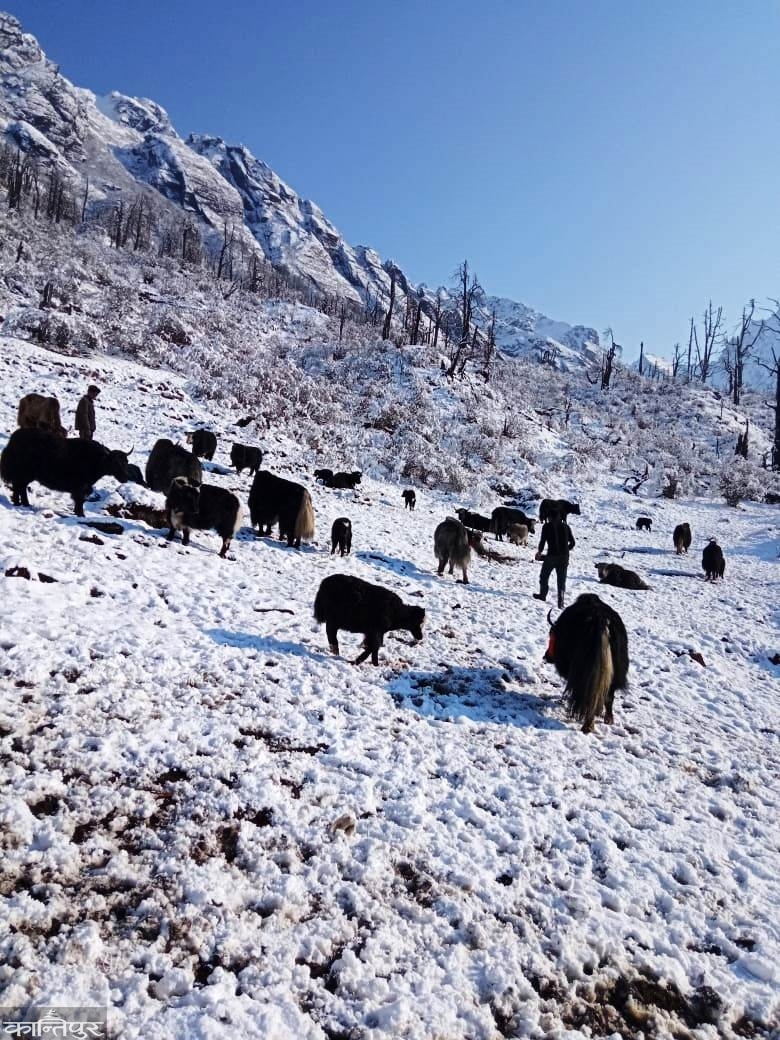
Yak is sharp . Nupu says that it will be difficult to do heavy lifting all the time. It thrives in the area above 3500 meters . Both of these species are male. Yak and chaunri can be used to make curd, mohi, ghee, chhurpi. Duhuna Bastu is now being used for the same purpose, said Nike. Since there is no market for milk in the Himalayan region, the work of storing and selling mohi is being done. "We are using the money from the sale of ghee and churppi to buy salt, chaff, and khark," added Nupu.
Chounri can be milked in the morning and evening. Yak is given only once a day in the morning. A yak gives up to three liters of milk . Chounri gives up to four liters . There is not much to extract the ghee from this milk. Nike says, "When milk of 12/13 chaunri yaks is condensed, only one kilo of ghee comes out".
The price of one kilo of ghee is one thousand rupees. But the cattle breeders say that the ghee market is good. Churpi should be sent to the headquarter, Fungling. Farmers barely get money after five/six months after sale.
According to Animal Services Office Taplejung, there are around 8,500 yak chaunri in the district. Most of them are reared in Mikwakhola Rural Municipality - 5 Papung and 4 Sanwa. There is a figure of 3500 in this municipality. Then there are 2500 in Paktanglung Rural Municipality. There are also in Meringden, Maiwakhola, Sidingwa and Sirijunga Rural Municipality. In Fungling municipality, two farmers raised about 100 yaks in the data of Chounri Farmers Federation.
Waiting for the opening of the border
Nupu says that the Chinese market is ready to sell 5000 yak chaunri immediately. China has been buying milk and meat for breeding purposes. The farmer says that the Tibetans will search for good yak chaunri breed and the price will be more than one and a half lakhs.
These quadrupeds, which are kept in cages as mobile cages, could be sold freely in the Chinese market until the corona virus infection. In the year 2077, Nupu also took 20 yaks to the market in Dingje county and sold them. He exchanged up to 90,000 for one at that time.
Five other farmers along with Nupu took cattle from Thudam Omdola crossing of Sankhuwasabha . At that time, Nepali rupees 50 lakhs that everyone brought in is the last income received so far. After that, the farmer says that the sale stopped .
"At that time, one yuan of China was worth 16 Nepalese rupees," Nupu added, "now the money has also increased to 19 rupees." 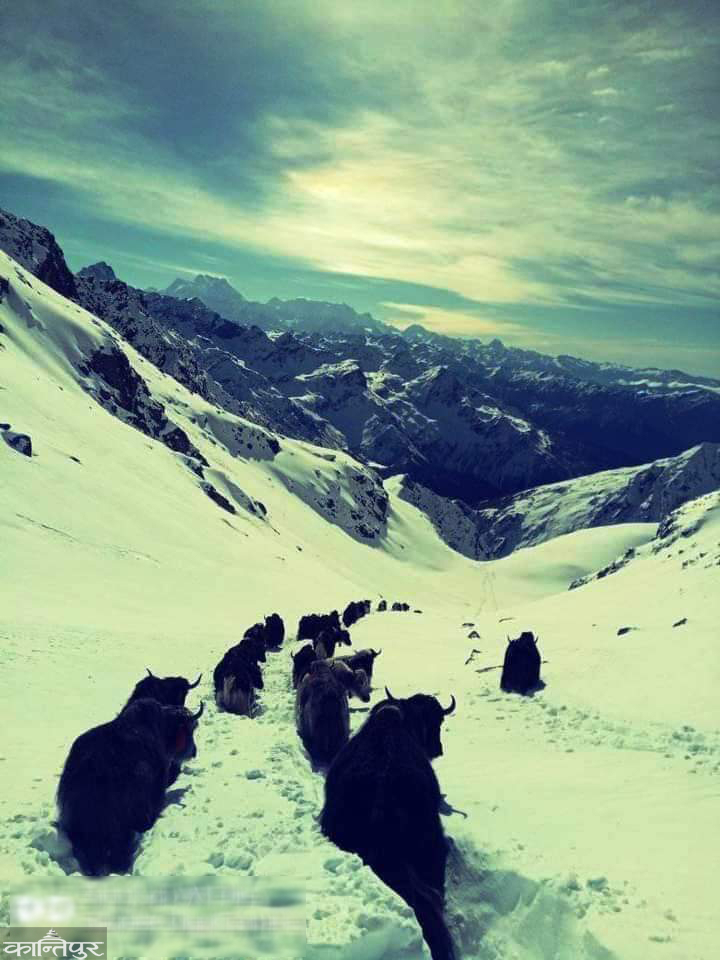
According to Yakchaunri Farmers Federation, 180 farming families in the district are fully involved in this profession. According to the federation, the number of families raising four/five to eight/ten children is more than three hundred. Obstacle in China export is their common problem.
Bilateral border crossings that were closed due to Corona have opened. Other goods and people movement is open . But only the import-export of livestock is closed. Nepalese used to bring it from China for breeding improvement. They haven't got that either. Federation President Nupu says there is no option to let it die if it is not sold in the Chinese market.
Taplejung's chief district officer Netra Prasad Sharma, while visiting China for the border meeting, requested the farmers here to raise this issue. Last December 29, the team led by Sharma participated in the border meeting of the chief leadership of Dingje County. In the meeting, Sharma also requested the Chinese representative to take this issue seriously. "I brought it up as an agenda item under the agricultural produce, the friends of China replied that they would request the same agency because they have blocked all the borders from a higher authority than them," he said.
Sharma says that even though they did not indicate an immediate solution in the November meeting, they are serious. "They said that there should be a decision of the center on the matter of animal husbandry and we will request it from the higher authorities," said Cheten Sherpa Lama, the ward president of Paktanglung rural municipality-7, who acted as an interpreter, "We are following up, hopefully we will address it." Sharma said that he came back after seeing with his own eyes that the yak chaunri and the milk, churpi, and ghee produced from it could not be exported.
Taplejung's Tiptala Bhanjyang, Sankhuwasabha's Kimathanka Naka, which were closed due to corona infection, have been opened since 11th of May. Nupu Sherpa, a livestock farmer in the border region of Olangchungola, says that the ban on import and export has also damaged Tibet. There was also a practice of bringing Masina calves from Tibet and rearing them and selling them there when they grow up. "Many of us used to produce calves from our own cows," said Mingmadiki of Olangchungola, "Some brought them from China and reared them and sold them when they grew up."
Locals suspect that it is because of lumpy skin seen in Nepal. But China has not revealed the reason for stopping, Chief District Officer Sharma says. Ward president Cheten said, "I asked them what should be done now if they are worried about this, but they did not give a clear answer." He says that the scene of every farmer raising calves in the barn and burying the grown-up yaks is painful. "Wada says that the municipality should give subsidy, even the government does not have the resources to compensate," he said. He said that when the commodity increases, there will be a lack of consumption and the farmers will not have the money to run it. "We, the people's representatives, are also under pressure," said Sherpa. 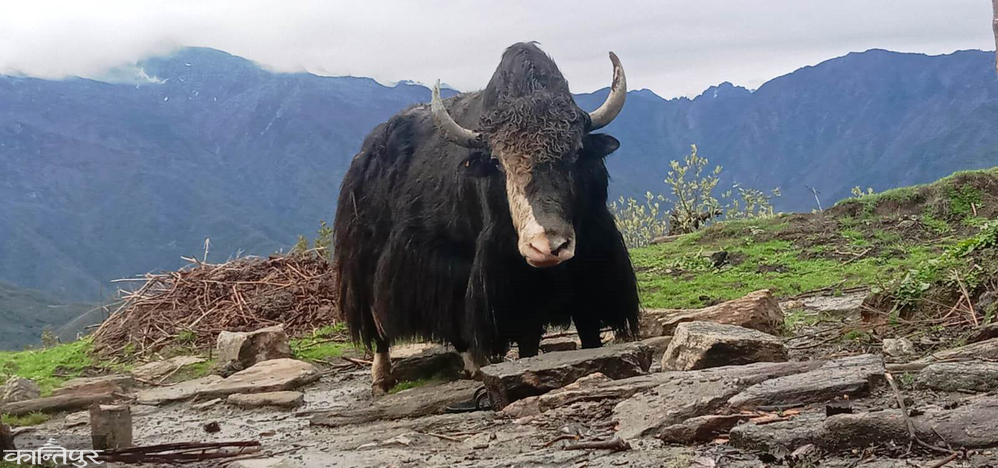
Female yaks are distinguished as 'D' and males as 'Yak' . Based on China's market price and the current number, Taplejung alone has about one billion worth of chauri yak.
For the time being, 60 percent selling environment will increase enthusiasm among the farmers and it is the understanding of Animal Services Office that further promotion can be done by raising Masina bachchabachchi . The residents of the Himalayan region have been promoting it as an ancestral profession.
The height of three thousand to five thousand meters is considered as the grazing area of Yak Chounri. Wild animals such as tigers, bears, wolves, snow leopards cause damage every year. Lumpy Skin has damaged around 3,000 in the data of Animal Services Office .

