In December 2076, the price of medium eggs was 255 rupees per crate and the price of large eggs was 275 rupees per crate. On February 17, 2081, the price of medium eggs reached 405 rupees per crate and large eggs reached 425 rupees per crate.
We use Google Cloud Translation Services. Google requires we provide the following disclaimer relating to use of this service:
This service may contain translations powered by Google. Google disclaims all warranties related to the translations, expressed or implied, including any warranties of accuracy, reliability, and any implied warranties of merchantability, fitness for a particular purpose, and noninfringement.
According to a report published by the Department of Animal Services, the contribution of grain to the price of eggs is 75 percent. Labor cost is 7 percent, capital (cage cost) is 2 percent, interest on investment is about 6 percent and chick price is about 3 percent.
Recently, the price of grain has not increased . But the price of eggs is going up and down in two/four days.
The price in the market is unstable when egg producers adjust their prices. Most of the big businessmen who produce eggs produce eggs professionally by rearing layer chickens. The price is also set by them," said a poultry farmer, "The price of eggs that is set by themselves is attractive when it arrives from the producer to the market.
The data of Nepal Layers Poultry Farmers Association also shows that the price of handpicks has increased since February. On February 9, the association fixed the price of medium size eggs at 350 rupees per crate and the price of large eggs at 370 rupees per crate. On February 12, the price of medium-sized eggs reached 390 rupees per crate, and large eggs reached 410 rupees per crate.
2081 From February 17, the price of eggs increased again . The association has fixed a price of Rs 405 per crate for medium eggs and Rs 425 for large eggs. This wholesale price is determined based on Chitwan. When eggs are loaded from Chitwan and delivered to depot/dealer, freight, cartons and crates will add about 20 rupees per crate. Then it reaches the retail store . Even the retail shops have made more expensive while selling with some profit .
In eggs, only middlemen and large producers have an advantage over real farmers,' said the businessman, 'on the one hand, the farmers have not received the price, on the other hand, the consumer price is too high.' Madan Pokharel, secretary of the association, claimed that the price of eggs is determined based on demand and supply. The various levels in the market also said that the consumer price seems to be a bit higher. But in the case of farmers, he claims that the cost price has not yet risen.
According to Pokharel, one egg production costs a farmer 16 rupees 53 paise. Farmers get 13 rupees 33 paise for medium size eggs and only 14 rupees for large eggs . But the farmers allege that the association spoiled the market. The market price of an egg has been set at 22 rupees 50 paisa to benefit the middlemen by giving a small price to the farmers. Experts say that this will benefit the middlemen by about 9 rupees per egg.
Although the association has fixed the price per crate of medium eggs at 405 rupees per crate from February 17, the farmers get only 400 rupees. Although the price of big eggs is 425 rupees per crate, the transporters pay less than 5 rupees,' said one egg producing farmer, 'If you protest, the eggs will not be picked up.' According to
professionals, eggs reach consumers only after passing through 6 levels. Eggs are mainly produced in Chitwan, Dang, Makanpur, Jhapa, Morang, Sunsari and other districts. The price of eggs is determined on the basis of chitwan . After the manufacturer sets the price, the distributor sells the box, crate and shipping to the retailer.
After fixing the price, the supplier transports the goods from the farmer's firm to the depots in different districts . Depot sends eggs to Sub Depot . Sub Depot sells to grocery stores, hotels . Then the grocery store will sell to the consumer .
"Except for shipping, adding everything including crates, boxes, and footrests has become a bit expensive for consumers," Secretary Pokharel said, "Actually, it is possible to keep up to 20 percent profit, but the businessmen have not kept 20 percent." To control the market price The Consumer Protection Act 2075 also stipulates market level determination. But the government has not determined the market level yet. On that occasion, the businessmen have been reducing the price according to their needs . And, middlemen are being encouraged . The study conducted by Animal Services Department in October 2077 also pointed out that middlemen dominate egg sales and distribution. One of the reasons for the increase in prices was the opinion of Vivig that the price of grain is also . But has not given any interest in price control .
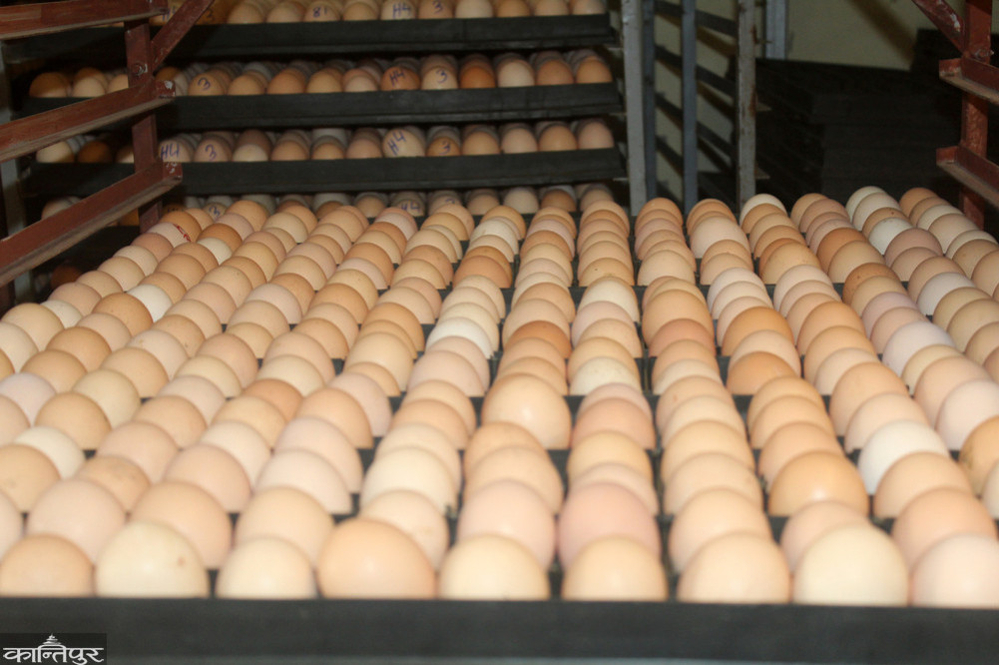
Deputy Director General of Animal Services Department Lekhraj Dahal said that the price of chicken and eggs will be determined by the market. Sometimes we have studied for internal purposes, but it is not the animal department that sets the price. "The department does not interfere in the price," said Dahal, "There is no separate organization to determine the price." Dick Bahadur Karki, information officer of the department, also pointed out that the price is determined by the businessmen themselves. "When the price increases unnaturally, we have called the businessmen for discussion, but the price has not been interfered with," he said.
Consumer rights activists say that when the responsible bodies remain silent, the middleman is favored. They claim that if the rights given by the Consumer Protection Act are used, the intermediaries and the levels will be automatically controlled. "Businessmen have an excuse for demand and supply". According to the government's data, there is sufficient production, but the price has increased," said Madhav Timalsina, president of Consumer Rights Research Forum, "if the department does not intervene, it is necessary to intervene from the Prime Minister's Office." The then Prime Minister KP Sharma Oli and the then Minister of Agriculture and Livestock Development Padyama Aryal claimed self-sufficiency by saying that there are 61 eggs per person per year in Nepal. They claimed to have succeeded in taking a step forward in one area. Even now the Prime Minister is KP Sharma Oli. But Timalsina says that the businessmen are interested.
According to the information of the association, the price of eggs in the crate has increased by 150 rupees in a period of 5 years . In 2076, the price of medium eggs per crate was 255 rupees and the price of large eggs per crate was 275 rupees. On February 17, 2081, the price of medium eggs reached 405 rupees per crate and large eggs reached 425 rupees per crate. The union has said that many farmers have been displaced since Covid. Before Covid, about 800 small and big farmers produced eggs. It is said that now it is only around 250. 28 to 32 million tons have been produced daily. The union claims that the production is less as per the demand .
President of Nepal Egg Production Association Shivram KC said that the main reason for the decrease in production is the decrease in the number of farmers. "Challa, layers chicken farming farmers have decreased. At the same time, the demand for eggs has also increased, that's why the price has increased,' said KC, 'currently, the rate has not yet reached the farmers . The cost is expensive .'


